Siegfried Siegesmund - Monument Future
Здесь есть возможность читать онлайн «Siegfried Siegesmund - Monument Future» — ознакомительный отрывок электронной книги совершенно бесплатно, а после прочтения отрывка купить полную версию. В некоторых случаях можно слушать аудио, скачать через торрент в формате fb2 и присутствует краткое содержание. Жанр: unrecognised, на немецком языке. Описание произведения, (предисловие) а так же отзывы посетителей доступны на портале библиотеки ЛибКат.
- Название:Monument Future
- Автор:
- Жанр:
- Год:неизвестен
- ISBN:нет данных
- Рейтинг книги:4 / 5. Голосов: 1
-
Избранное:Добавить в избранное
- Отзывы:
-
Ваша оценка:
Monument Future: краткое содержание, описание и аннотация
Предлагаем к чтению аннотацию, описание, краткое содержание или предисловие (зависит от того, что написал сам автор книги «Monument Future»). Если вы не нашли необходимую информацию о книге — напишите в комментариях, мы постараемся отыскать её.
Alle vier Jahre treffen sich auf einer internationalen Tagung Experten, die sich mit den entsprechenden Sachfragen beschäftigen. Der „14th International Congress on the Deterioration and Conservation of Stone“ findet im September 2020 in Göttingen statt. Er ist die wichtigste Veranstaltung zur Verbreitung des Wissens von Praktikern und Forschern, die im Bereich der Steinkonservierung zur Erhaltung des baulichen Kulturerbes arbeiten: Geowissenschaftler, Architekten, Bauspezialisten, Ingenieure, Restauratoren, Denkmalpfleger und Bauherren.
Der Tagungsband mit über 150 wissenschaftlichen Beiträgen repräsentiert und erfasst den neuesten Stand der Technik auf diesem Gebiet.
Themen sind:
– Charakterisierung von Schadensphänomenen von Steinen und verwandten Baumaterialien (Stuck, Putz, Mörtel usw.)
– Methoden zur Untersuchung des Steinverfalls in situ und zerstörungsfreie Prüfung
– Langzeitüberwachung von Steindenkmälern und Gebäuden
– Simulation und Modellierung des Zerfalls
– Technologien und Entwicklung verbesserter Bearbeitung und Verwendung von Stein in Neubauten
– Bewertung der Langzeitwirkung von Bearbeitungstechniken
– Auswirkungen des Klimawandels auf die Steinverwitterung des Kulturerbes
– Berichte zur Steinkonservierung: Fallstudien und Projekte
– Digitalisierung und Dokumentation von Steinkonservierung
–
The 14th International Congress on the Deterioration and Conservation of Stone, entitled MONUMENT FUTURE: DECAY AND CONSERVATION OF STONE is a quadrennial event that brings together a world-wide community of geoscientists, architects, building specialists, engineers, conservators, restorators, monument curators and building owners who are concerned about the conservation of cultural stone structures and objects. Since antiquity, the weathering and deterioration of historical buildings, masonry, monuments, sculptures etc. using natural stones has been a very well-known problem.
This conference is the main gathering for the dissemination of knowledge in the field of stone deterioration issues. It represents and captures the state-of-the-art in the field of stone conservation and cultural heritage conservation with regards to the following topics:
– Characterisation of damage phenomena of stone and related building materials (plaster, rendering, mortar etc.)
– Methods for the investigation of stone decay; in-situ and non-destructive testing
– Long-term monitoring of stone monuments and buildings
– Simulation and modelling of decay
– Technology and development of improved treatments and use of stone in new buildings
– Assessment of long-term effects of treatments
– Impact of climate change on stone decay of Cultural Heritage
– Reports about stone conservation: case studies and projects
– Digitalization and documentation in stone conservation
Monument Future — читать онлайн ознакомительный отрывок
Ниже представлен текст книги, разбитый по страницам. Система сохранения места последней прочитанной страницы, позволяет с удобством читать онлайн бесплатно книгу «Monument Future», без необходимости каждый раз заново искать на чём Вы остановились. Поставьте закладку, и сможете в любой момент перейти на страницу, на которой закончили чтение.
Интервал:
Закладка:
All baluster and cylinder specimens exposed for heating in the fire container show macroscopically visible cracks (Fig. 6b). Moreover, they reveal heavy sooting on the surfaces. Discoloration of the sandstone or crack surfaces could not be detected by the naked eye.
The temperature curves for the small sandstone specimens (50 × 25 mm) are shown in Fig. 6c. They were heated at different temperature levels of 400, 500, 600, 700, 800 and 1,000 °C in the laboratory oven at the TU BAF. The set-point temperatures (dashed lines) and the actual temperatures measured (solid lines) show a good correlation. It is recognisable that the heating experiments in the laboratory oven are precisely reproducible.
In contrast, the temperature curves in the fire container at a height of 1.8 m (solid lines) illustrate that the temperature increased very fast (after approx. 3 minutes) to max. 900 °C (Fig. 6d). After a dwell time of about 15 minutes (= the time the wood crib takes to burn through), the temperature in the fire container decreased rapidly.
If one compares the slow and even heating in the laboratory oven to the dynamic heating in the fire container, the differences between both treatments become obvious. According to the temperature curves measured by the thermocouples in the experiment displayed in Fig. 6b, on the stone surfaces (dashed lines), even in one and the same experiment, the temperatures range between 400 and 600 °C (Fig. 6d). The maximum temperature of about 600 °C is reached after approx. 14 minutes. The heating of the air in the container is faster and reaches higher maximum temperatures than the stone surfaces. However, the stone surface is cooling down much slower than the 93surrounding air. The upper right diagram in Fig. 6d shows remarkable lower temperatures within the stone compared to the stone surfaces. The maximum temperature of about 230 °C is reached only after approx. 55 minutes, i. e. long after the rapid decrease of the temperature of the surrounding air. Although the absolute temperatures measured may differ between single experiments, the general patterns of temperature development in the air, on the stone surfaces, and within the stone are similar. That means that the direct fire impact results in very unequal spatial and temporal distribution of temperature in the specimen within a short time of heating. These differences in temperature may lead to material tension caused by different thermic dilatation between the outer and the inner parts of the objects, resulting in cracks (Gómez-Heras et al. 2009). Many authors refer to the transformation of α-quartz to β-quartz at around 573 °C and the related volume increase to explain deterioration and damage of quartz-rich building stones (e. g. Chakrabarti et al. 1996, Hajpál & Török 2004). In the presented example, heavy damages (cracks) occur, although this temperature is hardly reached on the sandstone surface (see Fig. 6d).
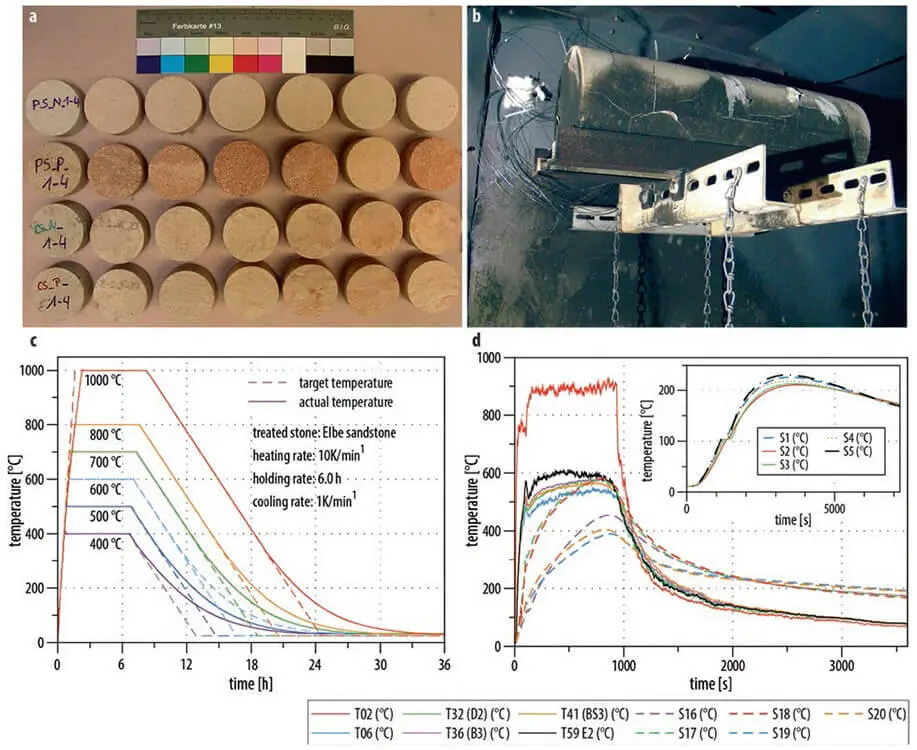
Figure 6: a) Small specimens (50 × 25 mm) of Posta and Cotta sandstone parallel (PS_P & CS_P) and normal (PS_N & CS_N) to bedding after heating at different temperature levels in the laboratory oven at the TU BAF, from left to right: 25, 400, 500, 600, 700, 800 and 1,000 °C b) significant cracks and heavy sooting on the Posta type sandstone cylinder after the fire test at the IBK in Heyrothsberge c) temperature curves of the small sandstone specimens (50 × 25 mm) heated in the laboratory oven at the TU BAF for different temperature levels d) temperature curves of the thermocouples in the fire container at a height of 1.8 m (solid lines) and at the stone surfaces (dashed lines). The small diagram shows the temperature curves of the thermocouples inside the Posta type sandstone cylinder.
In the oven-heated smaller specimens, tension due to temperature gradients does not occur due to 94slower, even heating. From this point of view, this kind of experiment does not reflect real, short-term fire scenarios on buildings. However, these testings give insight into effects of heat on mineral grains and intergranular matrix. In case of long-lasting fire events, these effects may additionally affect building stones and their material properties.
Conclusions
This study compares two different heat scenarios which are both necessary to investigate fire damages on sandstone objects or monuments.
The realistic fire scenario with the exposure of architectural sandstone elements to a burning wood crib within a fire container for a short time results in damages comparable to those observed on monuments which suffered from fire attack. The temperatures measured on stone surfaces and within the inner core of the objects indicate high gradients, resulting in material tension and subsequent cracking.
In contrast, smaller specimens of the same sandstone materials reveal no cracking even at higher temperatures when gradually heated in a laboratory oven. However, such tests and the respective test specimens which will be further investigated, may also be useful for enlightening the change of petrographic and material properties during heating.
Acknowledgements
The authors thank the Free State of Saxony (Sächsische Aufbaubank – Förderbank – SAB) for funding the work within the project WI631.
References
Chakrabarti B., Yates T., Lewry A. 1996. Effect of fire damage on natural stonework in buildings. Construction and Building Materials 10(7):539–544.
Ehling A., Köhler W. 2000. Fire damaged natural building stones. Proc. 6th Int. Congr. on Applied Mineralogy ICAM 2:975–978. Göttingen.
Gómez-Heras M., Álvarez de Buergo M., Fort R., Hajpál M., Török Á., Varas M. J. 2006. Evolution of porosity in Hungarian building stones after simulated burning. In: Fort R., Álvarez de Buergo M., Gómez-Heras M., Vazquez-Calvo C. (eds) Heritage, Weathering and Conservation. Taylor & Francis, London, 513–519.
Gómez-Heras M., McCabe S., Smith B. J., Fort R. 2009. Impacts of Fire on Stone-Built Heritage. Journal of Architectural Conservation 15(2):47–58.
Grunert S. 2007. Der Elbsandstein: Vorkommen, Verwendung, Eigenschaften. Geologica Saxonica – Journal of Central European Geology 52/53:3– 22.
Grunert S., Szilaghy J. 2010. Petrophysikalische Eigenschaften einer Auswahl von Baugesteinen aus Deutschland und ihr Bezug zur Petrographie dieser Gesteine. Geologica Saxonica – Journal of Central European Geology 56(1):39–82.
Hager I. 2014. Sandstone colour change due to the high temperature exposure. Advanced Materials Research 875-877:411–415.
Hajpál M., Török Á. 2004. Mineralogical and colour changes of quartz sandstones by heat. Environmental Geology 46:311–322.
Koser E., Althaus E. 1999. Brandschäden an Bauwerken aus Naturstein – Hohenrechberg und andere Objekte im Laborexperiment. Internationale Tagung des SFB 315 Heft 16/1999.
Lintao Y., Marshall A. M., Wanatowski D., Stace R., Ekneligoda T. 2017. Effect of high temperatures on sandstone – a computed tomography scan study. International Journal of Physical Modelling in Geotechnics 17(2):75–90.
McCabe S., Smith B. J., Warke P. A. 2007. Sandstone response to salt weathering following simulated fire damage: a comparison of the effects of furnance heating and fire. Earth Surface Processes and Landforms 32:1874–1883.
Pohle F., Jäger W. 2003. Material properties of historical masonry of the Frauenkirche and the masonry guideline for reconstruction. Construction and Building Materials 17:651–667.
Smith A. G., Pells P. J. N. 2008. Impact of fire on tunnels in Hawkesbury sandstone. Tunnelling and Underground Space Technology 23:65–74.
Читать дальшеИнтервал:
Закладка:
Похожие книги на «Monument Future»
Представляем Вашему вниманию похожие книги на «Monument Future» списком для выбора. Мы отобрали схожую по названию и смыслу литературу в надежде предоставить читателям больше вариантов отыскать новые, интересные, ещё непрочитанные произведения.







Обсуждение, отзывы о книге «Monument Future» и просто собственные мнения читателей. Оставьте ваши комментарии, напишите, что Вы думаете о произведении, его смысле или главных героях. Укажите что конкретно понравилось, а что нет, и почему Вы так считаете.