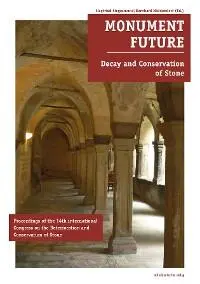
Siegfried Siegesmund - Monument Future
Здесь есть возможность читать онлайн «Siegfried Siegesmund - Monument Future» — ознакомительный отрывок электронной книги совершенно бесплатно, а после прочтения отрывка купить полную версию. В некоторых случаях можно слушать аудио, скачать через торрент в формате fb2 и присутствует краткое содержание. Жанр: unrecognised, на немецком языке. Описание произведения, (предисловие) а так же отзывы посетителей доступны на портале библиотеки ЛибКат.
- Название:Monument Future
- Автор:
- Жанр:
- Год:неизвестен
- ISBN:нет данных
- Рейтинг книги:4 / 5. Голосов: 1
-
Избранное:Добавить в избранное
- Отзывы:
-
Ваша оценка:
Monument Future: краткое содержание, описание и аннотация
Предлагаем к чтению аннотацию, описание, краткое содержание или предисловие (зависит от того, что написал сам автор книги «Monument Future»). Если вы не нашли необходимую информацию о книге — напишите в комментариях, мы постараемся отыскать её.
Alle vier Jahre treffen sich auf einer internationalen Tagung Experten, die sich mit den entsprechenden Sachfragen beschäftigen. Der „14th International Congress on the Deterioration and Conservation of Stone“ findet im September 2020 in Göttingen statt. Er ist die wichtigste Veranstaltung zur Verbreitung des Wissens von Praktikern und Forschern, die im Bereich der Steinkonservierung zur Erhaltung des baulichen Kulturerbes arbeiten: Geowissenschaftler, Architekten, Bauspezialisten, Ingenieure, Restauratoren, Denkmalpfleger und Bauherren.
Der Tagungsband mit über 150 wissenschaftlichen Beiträgen repräsentiert und erfasst den neuesten Stand der Technik auf diesem Gebiet.
Themen sind:
– Charakterisierung von Schadensphänomenen von Steinen und verwandten Baumaterialien (Stuck, Putz, Mörtel usw.)
– Methoden zur Untersuchung des Steinverfalls in situ und zerstörungsfreie Prüfung
– Langzeitüberwachung von Steindenkmälern und Gebäuden
– Simulation und Modellierung des Zerfalls
– Technologien und Entwicklung verbesserter Bearbeitung und Verwendung von Stein in Neubauten
– Bewertung der Langzeitwirkung von Bearbeitungstechniken
– Auswirkungen des Klimawandels auf die Steinverwitterung des Kulturerbes
– Berichte zur Steinkonservierung: Fallstudien und Projekte
– Digitalisierung und Dokumentation von Steinkonservierung
–
The 14th International Congress on the Deterioration and Conservation of Stone, entitled MONUMENT FUTURE: DECAY AND CONSERVATION OF STONE is a quadrennial event that brings together a world-wide community of geoscientists, architects, building specialists, engineers, conservators, restorators, monument curators and building owners who are concerned about the conservation of cultural stone structures and objects. Since antiquity, the weathering and deterioration of historical buildings, masonry, monuments, sculptures etc. using natural stones has been a very well-known problem.
This conference is the main gathering for the dissemination of knowledge in the field of stone deterioration issues. It represents and captures the state-of-the-art in the field of stone conservation and cultural heritage conservation with regards to the following topics:
– Characterisation of damage phenomena of stone and related building materials (plaster, rendering, mortar etc.)
– Methods for the investigation of stone decay; in-situ and non-destructive testing
– Long-term monitoring of stone monuments and buildings
– Simulation and modelling of decay
– Technology and development of improved treatments and use of stone in new buildings
– Assessment of long-term effects of treatments
– Impact of climate change on stone decay of Cultural Heritage
– Reports about stone conservation: case studies and projects
– Digitalization and documentation in stone conservation
Monument Future — читать онлайн ознакомительный отрывок
Ниже представлен текст книги, разбитый по страницам. Система сохранения места последней прочитанной страницы, позволяет с удобством читать онлайн бесплатно книгу «Monument Future», без необходимости каждый раз заново искать на чём Вы остановились. Поставьте закладку, и сможете в любой момент перейти на страницу, на которой закончили чтение.
Интервал:
Закладка:
In order to examine this assumption, the surface temperature on the top and the bottom of all faces of the main stele was measured in 2019 hourly with an infrared thermometer (Bosch Thermodetektor PTD 1) from sunrise to sunset. It is notable that particularly after sunrise (between 6:30 and 7:30) the surface of the east face heated up verifiably faster than the shaded west face. While 32 °C were measured on the top of the east face, the top of the west face had only 11.5 °C. Further, a perceptible difference of up to 4.1 °C could be measured from 8:30 to 14:30 between the top and the bottom of the East and South face. Over the measuring period the surface temperature varied from the minimum of 7.7 °C to the maximum of 44.6 °C.
Although the measurements only reflect heating and cooling during an average summer day, it is obvious that there have been thermal loads and a measurable temperature gradient between the front and back face of the stele since its erection 1,300 years ago. Particularly the gradient on the top might play a role in the delamination which is particularly distinctive in this area.
106Freeze-thaw-cylces, which considerably contribute to stone deterioration at our (European) latitudes, could be widely excluded as cause of damage in Mongolia. From September to November and middle of February to middle of April successive temperature transitions over the freeze point have to be expected in the Mongolian steppe. As there is hardly precipitation in these periods (less than 5 mm), damage caused by freeze-thaw-cycles can be neglected (Ruedrich, Kirchner and Siegesmund 2011).
Summary
The project provided the unique opportunity for the Austrian and Mongolian conservators and conservation scientists to study a stone monument from the 8th century, which has been continuously exposed to weathering.
Condition surveys together with extensive analyses of taken samples and three non-destructive field tests enabled to characterize the extent and type of decay. The findings showed a clear correlation between material instrinsic properties and prevalent decay patterns: while the stone varieties with layering mainly suffered from delamination, those without layering were rather affected by disintegration. They further revealed that particularly the human- and animal-shaped sculptures are, different to what was expected, heavily decayed and suffer from advanced disintegration.
Surface temperature measurements and the evaluation of meterological and climate data suggested that thermal loads and temperature gradients rather than freeze-thaw-cyles enhance decay and weathering of the site.
Based on the findings, the conservation treatment concept was developed and implemented. While the emphasis at the animal- and human-shaped sculptures was on the injection of fissures and partial consolidation, backfilling and micro pointing were carried out at the two steles.
Monitoring, survey, assessment and conservation of the heritage site have been carried out in a collaborative model-like approach to be utilized as a best practice example for future preservation efforts. In addition, the field tests, which were carried out for the first time at the respective site, provided important measurement data on pulse velocities and water absorptions of local stone varities to be used for comparative studies at similar sites in Mongolia.
References
Hoffmann A. 2006. Naturwerksteine Thailands: Lagerstättenerkundung und Bewertung. Dissertation Georg-August-Universität, Göttingen.
Kotwicz W., Samoïovitch A. 1928. Le monument turc d’Ikhe-khuchotu en Mongolie centrale. Rocznik Orientalistyzny, vol. 4, pp 60–107.
Rodrigues J. D. 1980. Decay of granite, Advanced study course, Science and technology of the environment for sustainable protection of cultural heritage. Relim.
Ruedrich J., Kirchner D., Siegesmund S. 2011. Physical weathering of building stones induced by freeze-thaw action: a laboratory long-term study. Environmental Earth Sciences, Volume 63, Issue 7-7, pp 1573–1586.
Svahn H. 2006. Non-Destructive Field Tests in Stone Conservation, Field and Laboratory Tests. Rapport från Riksantikvarieämbetet, Stockholm.
Vandevoorde D., Pamplona M., Schalma O., Vanhellemont Y., Cnudded V., Verhaeven E. 2009. Contact sponge method: Performance of a promising tool for measuring the initial water absorption. Journal of Cultural Heritage, Volume 10, Issue 1, pp 41–47.
Vandevoorde D., Cnudde V., Dewanckele J., Boone M. N., Verhaeven E. 2011. Contact sponge method: Performance compared with Capillary Rise, Karsten Tube and Mirowski Pipe. European Workshop on Cultural Heritage Preservation, EWCHP.
Vasconcelos G., Lourenco P. B., Alves C. A. S., Pamplona J. 2008. Ultrasonic evaluation of the physical and mechanical properties of granites. Ultrasonics 48(5):453–66.
Winkler E. M. 2013. Stone in architecture: properties, durability. Springer, Berlin-Heidelberg.
107
CHARACTERIZATION AND DETERIORATION ASSESSMENT OF KÖSSEINE GRANITE IN PALACIO SALVO, MONTEVIDEO, URUGUAY
Manuela Morales Demarco, Eloísa Cocorel
IN: SIEGESMUND, S. & MIDDENDORF, B. (EDS.): MONUMENT FUTURE: DECAY AND CONSERVATION OF STONE.
– PROCEEDINGS OF THE 14TH INTERNATIONAL CONGRESS ON THE DETERIORATION AND CONSERVATION OF STONE –
VOLUME I AND VOLUME II. MITTELDEUTSCHER VERLAG 2020.
Instituto de Ciencias Geológicas, Facultad de Ciencias, Universidad de la República, Uruguay
Abstract
In Uruguay, one of the most important buildings is Palacio Salvo. The present research is part of a diagnosis for the definition of an interdisciplinary project of intervention for the revalorization and conservation of its façades.
These activities started with the identification of the rock used as Kösseine Granite, of Wunsiedel, Germany. This rock is applied as polished pieces and most of them show, as deterioration features, rounding, missing parts, perforations with or without metallic inserts, often surrounded by oxide staining, deposits and soiling. Some plates eventually show up to 20 cm cracks in the edges related to splintering, chipping and two large plates are crossed by 80 cm fractures. Pieces used as steps show abrasion, rounding, and fractures in the edges causing missing parts.
Exterior and paving are among the most demanding applications of dimensional stones. Nevertheless, Kösseine Granite presents a good performance and its state of deterioration is low.
Keywords: Historical and cultural heritage, Kösseine Granite, Uruguay
Introduction
One of the most iconic buildings in Montevideo is Palacio Salvo, in the heart of the city: 18 de Julio Avenue and Plaza Independencia. Built between 1922 and 1928 by Mario Palanti, an Italian architect, it was commissioned by Salvo brothers.
In the declaration of Palacio Salvo as National Historical Monument, in 1996, it is clearly stated the relevance of its preservation and recovery (Presidential Resolution N° 1144/996, Uruguay). In this sense, an agreement was signed between the company owner of the building, Palacio Salvo S. A., and FADU (Facultad de Arquitectura, Diseño y Urbanismo – Universidad de la República) for a study for the conservation of its façades (IC-FADU, 2019). The ICG team (Instituto de Ciencias Geológicas, Facultad de Ciencias) was assigned a 3-month period the deterioration assessment of the granitic external façade of the ground floor.
Identifying the granitic façade
For the general registration of the rock applied and its deterioration assessment, the recommendations of the working group “Natural Stones and Weathering” (2019) of Aachen University were followed. It 108was not possible to map the entire external façade due to time constrains of the study, therefore only four sections of the building were mapped.
Читать дальшеИнтервал:
Закладка:
Похожие книги на «Monument Future»
Представляем Вашему вниманию похожие книги на «Monument Future» списком для выбора. Мы отобрали схожую по названию и смыслу литературу в надежде предоставить читателям больше вариантов отыскать новые, интересные, ещё непрочитанные произведения.







Обсуждение, отзывы о книге «Monument Future» и просто собственные мнения читателей. Оставьте ваши комментарии, напишите, что Вы думаете о произведении, его смысле или главных героях. Укажите что конкретно понравилось, а что нет, и почему Вы так считаете.