Siegfried Siegesmund - Monument Future
Здесь есть возможность читать онлайн «Siegfried Siegesmund - Monument Future» — ознакомительный отрывок электронной книги совершенно бесплатно, а после прочтения отрывка купить полную версию. В некоторых случаях можно слушать аудио, скачать через торрент в формате fb2 и присутствует краткое содержание. Жанр: unrecognised, на немецком языке. Описание произведения, (предисловие) а так же отзывы посетителей доступны на портале библиотеки ЛибКат.
- Название:Monument Future
- Автор:
- Жанр:
- Год:неизвестен
- ISBN:нет данных
- Рейтинг книги:4 / 5. Голосов: 1
-
Избранное:Добавить в избранное
- Отзывы:
-
Ваша оценка:
Monument Future: краткое содержание, описание и аннотация
Предлагаем к чтению аннотацию, описание, краткое содержание или предисловие (зависит от того, что написал сам автор книги «Monument Future»). Если вы не нашли необходимую информацию о книге — напишите в комментариях, мы постараемся отыскать её.
Alle vier Jahre treffen sich auf einer internationalen Tagung Experten, die sich mit den entsprechenden Sachfragen beschäftigen. Der „14th International Congress on the Deterioration and Conservation of Stone“ findet im September 2020 in Göttingen statt. Er ist die wichtigste Veranstaltung zur Verbreitung des Wissens von Praktikern und Forschern, die im Bereich der Steinkonservierung zur Erhaltung des baulichen Kulturerbes arbeiten: Geowissenschaftler, Architekten, Bauspezialisten, Ingenieure, Restauratoren, Denkmalpfleger und Bauherren.
Der Tagungsband mit über 150 wissenschaftlichen Beiträgen repräsentiert und erfasst den neuesten Stand der Technik auf diesem Gebiet.
Themen sind:
– Charakterisierung von Schadensphänomenen von Steinen und verwandten Baumaterialien (Stuck, Putz, Mörtel usw.)
– Methoden zur Untersuchung des Steinverfalls in situ und zerstörungsfreie Prüfung
– Langzeitüberwachung von Steindenkmälern und Gebäuden
– Simulation und Modellierung des Zerfalls
– Technologien und Entwicklung verbesserter Bearbeitung und Verwendung von Stein in Neubauten
– Bewertung der Langzeitwirkung von Bearbeitungstechniken
– Auswirkungen des Klimawandels auf die Steinverwitterung des Kulturerbes
– Berichte zur Steinkonservierung: Fallstudien und Projekte
– Digitalisierung und Dokumentation von Steinkonservierung
–
The 14th International Congress on the Deterioration and Conservation of Stone, entitled MONUMENT FUTURE: DECAY AND CONSERVATION OF STONE is a quadrennial event that brings together a world-wide community of geoscientists, architects, building specialists, engineers, conservators, restorators, monument curators and building owners who are concerned about the conservation of cultural stone structures and objects. Since antiquity, the weathering and deterioration of historical buildings, masonry, monuments, sculptures etc. using natural stones has been a very well-known problem.
This conference is the main gathering for the dissemination of knowledge in the field of stone deterioration issues. It represents and captures the state-of-the-art in the field of stone conservation and cultural heritage conservation with regards to the following topics:
– Characterisation of damage phenomena of stone and related building materials (plaster, rendering, mortar etc.)
– Methods for the investigation of stone decay; in-situ and non-destructive testing
– Long-term monitoring of stone monuments and buildings
– Simulation and modelling of decay
– Technology and development of improved treatments and use of stone in new buildings
– Assessment of long-term effects of treatments
– Impact of climate change on stone decay of Cultural Heritage
– Reports about stone conservation: case studies and projects
– Digitalization and documentation in stone conservation
Monument Future — читать онлайн ознакомительный отрывок
Ниже представлен текст книги, разбитый по страницам. Система сохранения места последней прочитанной страницы, позволяет с удобством читать онлайн бесплатно книгу «Monument Future», без необходимости каждый раз заново искать на чём Вы остановились. Поставьте закладку, и сможете в любой момент перейти на страницу, на которой закончили чтение.
Интервал:
Закладка:
In a second step, a set of non-destructive field tests were carried out in order to further characterize and evaluate the degree of decay and weathering. Multiple ultrasonic pulse velocity measurements using the PUNDIT ®PL-200 (Proceq) with p-wave transducers 250 kHz (and 350-fold receiver gain) were done at all objects in different directions to detect cracks, voids and cavities within the materials more precisely. Further, inhomogeneity or disintegrated areas, which are an indication of enhanced degradation, were determined. Figure 3 illustrates the obtained measuring results at the main stele. In the upper two thirds a signal was received only very sporadically. The measurements perpendicular to the layering (i. e. from east to west) showed an average pulse velocity of 1,769 m/s in the lower third. Parallel to the layering an average pulse velocity of 2,050 m/s was measured in the upper third.
At the small stele signal were received only sporadically perpendicular to the layering (i. e. from north to south) with an average pulse velocity of 949 m/s. Parallel to the layering an average pulse velocity of 3,116 m/s was measured whereby signals were detected over the whole height. At four of the animal- and human shaped sculptures (no. 2, 6, 7, 11) no signal was received regardless of the direction. At the others a transmission of the pulse was partly possible. Altogether the average pulse velocities were lower than those at the two steles. The Karsten tube and the contact-sponge were used to assess the Water Absorption Behaviour (WAB) of the stone materials in order to further describe the porosity and degree of weathering (Svahn 2006: 21; Vandevoorde et al. 2009; Vandevoorde et al. 2011). Of particular interest were striking deviations in the WAB among the individual objects.
The contact-sponge method was applied on all objects. Results revealed that the average water absorption (WA) of the stone varieties with layering is 0.76 g/ m 2s (A1, main stele) and 0.59 g/ m 2s (A3, small stele) respectively. Only a roughened surface 104on top of the west face of the main stele showed a maximum WA of 5.38 g/ m 2s. The third stone variety (A2, human- and animal-shaped sculptures) shows a slightly higher average WA of 1.12 g/ m 2s, whereby four sculptures (no. 6, 9, 11 and 14) stand out due to a noticeably higher WA.
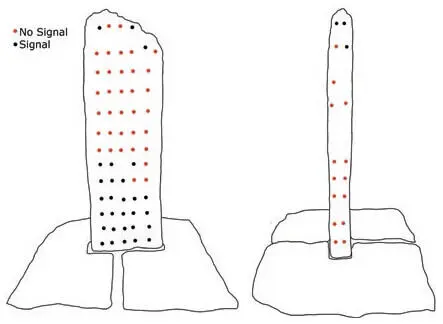
Figure 3:Mappings of the ultrasonic pulse velocity at the main stele (no. 1); measurements at the front perpendicular to the layering (left) and at the side parallel to the layering (right).
Due to time constraints only the two steles and five human- and animal-shaped sculptures (No. 2, 4, 7, 9, 11) could be exemplarily tested with the Karsten tube method. Results obtained from this field test widely correspond to the results of the contact-sponge tests: the two steles showed very low to no WA over a period of 45 minutes. Among the animal- and human-shaped sculptures no. 9 and 11 had the highest WA, equivalent to the results given by the contact-sponge tests. The others showed a constant but slower water uptake.
Interpretation of Results
In general the measured ultrasonic velocities were rather slow compared to the other values of granitoids given in literature (Hoffmann 2006: 80; Vasconcelos et al. 2008: 27), which indicate an advanced degree of deterioration (Svahn 2006: 21–23). This assumption was supported by the WA measured with the contact-sponge and Karsten tube method. Although it was not very high (compare Vandevoorde et al. 2009), it proves a moderate weathering of the respective material.
The lack of signals in the upper third of the main stele (in right angle to the layering) confirmed the visually determined heavy decay. It showed that delamination is advanced and cracks and cavities run through the entire material. Also the smaller stele seems to suffer from advanced delamination as the pulse was only partly transmitted from bottom to top (in right angle to the layering). As the steles absorbed little to no water it can be assumed that they are hardly affected by disintegration or fissures.
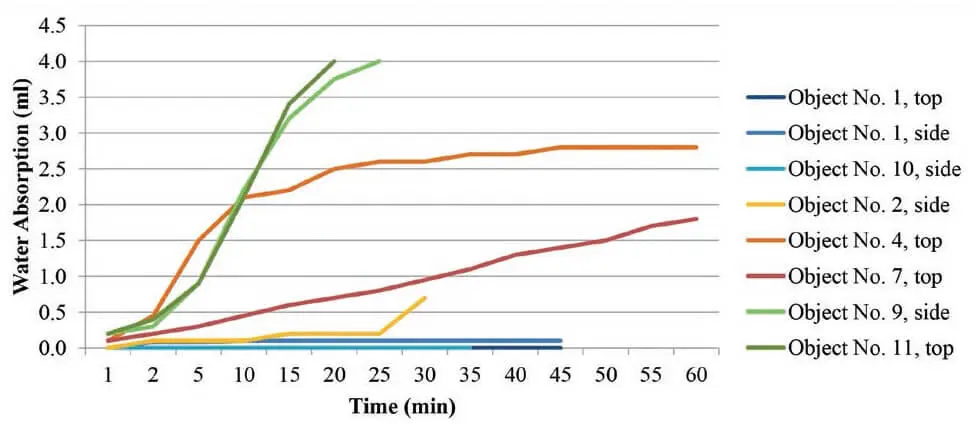
Figure 4:Water absorption measured with Karsten tube (4 ml, contact time up to 60 min) at the two steles (no. 1 and 10) and the sculptures (no. 2, 4, 7, 9, 11).
The failed or partial transmission of the pulse at all of the animal- and human shaped sculptures 105indicated that the material suffered from advanced disintegration. This assumption was confirmed by the water absorption behaviour of the stones. Interestingly, this finding contradicted the macroscopic examination, which indicated a rather good condition (hardly cracks and no sanding). Particularly the sculptures no. 9 and 11 with the highest water absorption (contact-sponge and Karsten tube) showed a rather slow or no signal during ultrasonic measurements. In general, sculptures with a comparatively higher water uptake also had a slower or no transmission of the pulse.
The combined use of the three non-destructive fields test and the comparative analyses of results helped to gain a better understanding on the degree of decay among the individual sculptures. Results mutually support and confirm each other. Thus a clearer picture of the state of condition could be gained.
Reflections on Decay Patterns
The reflection on probable material intrinsic and environmental factors that might cause, contribute or accelerate the two predominant decay patterns was important in order to gain a better understanding on their damaging potential and the rates of degradation.
It was assumed that on one hand, stone-intrinsic properties and style of quarrying have caused and accelerated these kinds of decay. The distinctive stratification of the stone varieties A1 and A3 combined with the unsuitable positioning of the steles – the layers are orientated at a right angle to the ground – might have favoured delamination. The vertically aligned layers can be a wear point and initiate cracking and fissuring.
It is also likely that the granite quarried was not totally sound. The hardness of the material makes it very difficult to quarry, especially when structural defects are lacking. So it is possible that pre-weathered stone slabs or boulders from the surrounding were used in first place for the erection of the complex monument. This was also underpinned by the inspection of the surrounding area which indicated no traces of possibilities for mining or quarrying. The pre-weathering in turn can adversely affect the subsequent degradation rate of the stone (Rodrigues 1980).
On the other hand, the hypothesis is proposed that thermal loads and temperature gradient play a significant part in the decay process.
The evaluation of meteorological and climate data from a weather station approx. 150 km south of the respective site (Saikhan-Ovoo, Dundgovi) showed that in summer maximum temperatures reach around 35 °C, while in winter temperatures can drop to minus 25 °C. Throughout the year the temperature difference between day and night is approximately 15 °C. The area counts almost 250 sunny days a year, often with clear cloudless skies. Combined with the lack of trees and therefore shadow in the steppe, this direct sunlight leads to a quick heating up of the stone. This in turn is assumed to result in a considerable temperature gradient within the stone and thermal stress due to a differential expansion of the rock minerals. Both factors might accelerate physical weathering and delamination (Rodrigues 1980).
Читать дальшеИнтервал:
Закладка:
Похожие книги на «Monument Future»
Представляем Вашему вниманию похожие книги на «Monument Future» списком для выбора. Мы отобрали схожую по названию и смыслу литературу в надежде предоставить читателям больше вариантов отыскать новые, интересные, ещё непрочитанные произведения.







Обсуждение, отзывы о книге «Monument Future» и просто собственные мнения читателей. Оставьте ваши комментарии, напишите, что Вы думаете о произведении, его смысле или главных героях. Укажите что конкретно понравилось, а что нет, и почему Вы так считаете.