Siegfried Siegesmund - Monument Future
Здесь есть возможность читать онлайн «Siegfried Siegesmund - Monument Future» — ознакомительный отрывок электронной книги совершенно бесплатно, а после прочтения отрывка купить полную версию. В некоторых случаях можно слушать аудио, скачать через торрент в формате fb2 и присутствует краткое содержание. Жанр: unrecognised, на немецком языке. Описание произведения, (предисловие) а так же отзывы посетителей доступны на портале библиотеки ЛибКат.
- Название:Monument Future
- Автор:
- Жанр:
- Год:неизвестен
- ISBN:нет данных
- Рейтинг книги:4 / 5. Голосов: 1
-
Избранное:Добавить в избранное
- Отзывы:
-
Ваша оценка:
Monument Future: краткое содержание, описание и аннотация
Предлагаем к чтению аннотацию, описание, краткое содержание или предисловие (зависит от того, что написал сам автор книги «Monument Future»). Если вы не нашли необходимую информацию о книге — напишите в комментариях, мы постараемся отыскать её.
Alle vier Jahre treffen sich auf einer internationalen Tagung Experten, die sich mit den entsprechenden Sachfragen beschäftigen. Der „14th International Congress on the Deterioration and Conservation of Stone“ findet im September 2020 in Göttingen statt. Er ist die wichtigste Veranstaltung zur Verbreitung des Wissens von Praktikern und Forschern, die im Bereich der Steinkonservierung zur Erhaltung des baulichen Kulturerbes arbeiten: Geowissenschaftler, Architekten, Bauspezialisten, Ingenieure, Restauratoren, Denkmalpfleger und Bauherren.
Der Tagungsband mit über 150 wissenschaftlichen Beiträgen repräsentiert und erfasst den neuesten Stand der Technik auf diesem Gebiet.
Themen sind:
– Charakterisierung von Schadensphänomenen von Steinen und verwandten Baumaterialien (Stuck, Putz, Mörtel usw.)
– Methoden zur Untersuchung des Steinverfalls in situ und zerstörungsfreie Prüfung
– Langzeitüberwachung von Steindenkmälern und Gebäuden
– Simulation und Modellierung des Zerfalls
– Technologien und Entwicklung verbesserter Bearbeitung und Verwendung von Stein in Neubauten
– Bewertung der Langzeitwirkung von Bearbeitungstechniken
– Auswirkungen des Klimawandels auf die Steinverwitterung des Kulturerbes
– Berichte zur Steinkonservierung: Fallstudien und Projekte
– Digitalisierung und Dokumentation von Steinkonservierung
–
The 14th International Congress on the Deterioration and Conservation of Stone, entitled MONUMENT FUTURE: DECAY AND CONSERVATION OF STONE is a quadrennial event that brings together a world-wide community of geoscientists, architects, building specialists, engineers, conservators, restorators, monument curators and building owners who are concerned about the conservation of cultural stone structures and objects. Since antiquity, the weathering and deterioration of historical buildings, masonry, monuments, sculptures etc. using natural stones has been a very well-known problem.
This conference is the main gathering for the dissemination of knowledge in the field of stone deterioration issues. It represents and captures the state-of-the-art in the field of stone conservation and cultural heritage conservation with regards to the following topics:
– Characterisation of damage phenomena of stone and related building materials (plaster, rendering, mortar etc.)
– Methods for the investigation of stone decay; in-situ and non-destructive testing
– Long-term monitoring of stone monuments and buildings
– Simulation and modelling of decay
– Technology and development of improved treatments and use of stone in new buildings
– Assessment of long-term effects of treatments
– Impact of climate change on stone decay of Cultural Heritage
– Reports about stone conservation: case studies and projects
– Digitalization and documentation in stone conservation
Monument Future — читать онлайн ознакомительный отрывок
Ниже представлен текст книги, разбитый по страницам. Система сохранения места последней прочитанной страницы, позволяет с удобством читать онлайн бесплатно книгу «Monument Future», без необходимости каждый раз заново искать на чём Вы остановились. Поставьте закладку, и сможете в любой момент перейти на страницу, на которой закончили чтение.
Интервал:
Закладка:

Figure 1:The ciborium of the Saint Mark’s Basilica.
Historically, these columns have been wrongly identified as of oriental alabaster (for ex. Lorenzetti 1994: 188), often confirmed in publications by several scholars. This misidentification may be justified by the gilding still partially present on their surface, which has been subject to repeated protective treatments with natural organic substances leading to a full covering of their surface. On accurate macroscopic observation by the current authors, marble appeared to be the more likely material of these columns, tentatively identified as Proconnesian (Lazzarini 1997). Proconnesian marble was quarried in ancient Proconnesos, the present day Island of Marmara (Turkey) and is the marble of Venetian monuments (Lazzarini 2015). On a monographic collective study of these columns, it was possible to sample three of them, and submit the marble to archaeometric studies (minero-petrographic and isotopic, see below) that allowed identification of two of the columns to be of Dokymaean and/or Pentelic (Lazzarini 2015b: 59) marble. To determine the origin of the fourth column as well as to investigate the 153nature and stratification of the gilding and past treatments a new sampling was made recently.

Figure 2:Details of the four carved marble column: a) column A at the back and B at the front; b) column C at the back and D at the front.
Sampling and experimental
The sampling was made by removing with a small, very sharp chisel micro fragments of the marble of the four columns (Fig. 3) from now on indicated as follows: column A = back, left (looking from the front of the ciborium); column B = front, left; column C = back, right; column D = front, right.
Also sampled were some of the gildings (including the relative red bole-preparation) and of the patinas. Polished cross-sections of the latter two components were prepared and later examined in polarized reflected light and in ultraviolet light under a LEITZ DM RXP microscope. The same sections were then studied under a SEM coupled with an EDS microanalysis (EVO+BRUKER) for the topographical and chemical analyses. Raman spectroscopy supported the identification of the pigments used for the preparation of gilding layers. The chemical nature of the gilding preparation and of eventual past treatments was determined by FTIR and µFTIR analysis using ThermoScientific instruments (iZ10 and iN10 Infrared Microscope). The µFTIR investigations of allowed the mapping of the distribution and penetration depth of the organic components, whereas FTIR analyses of microflakes on standard KBr pellets allowed better identification of the mixture-components.
To identify the marble provenance, a small portion of each marble sample was finely ground and the powder subjected to X-Ray diffraction (PANalytical Empyrean X-ray diffractometer, Cu-Kα radiation at 40 kV and 20 mA) to evaluate the possible presence and relative abundance of dolomite. O and C stable isotopes ratio analyses were performed on the same powders through a Gasbench II preparation line connected on-line to a Thermo Finnigan Five Plus mass spectrometer in a continuous flow mode. All δ13C and δ18O values were measured against a PDB standard: the results were then plotted in reference isotopic diagrams obtained from the most updated database (Antonelli and Lazzarini, 2015). The remaining larger fragment of each marble sample was used for the preparation of a thin section studied under a LEITZ DM RXP polarising microscope. The main petrographic features of marbles (fabric, boundary shapes of the carbonate crystals, maximum grain size (MGS) of the largest crystal of calcite expressed in mm, presence and relative quantity of accessory minerals) were compared with both the most recent published data and with reference samples taken from ancient quarries (the extensive thin section collection present in the LAMA, University Iuav of Venice).
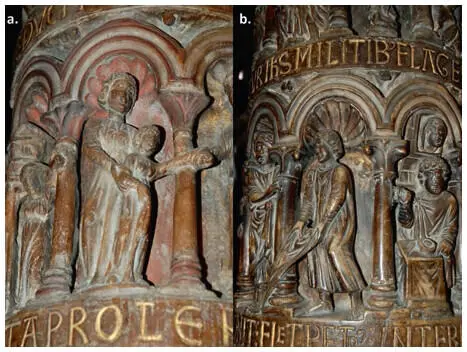
Figure 3:Detail of columns A (left) and D (right).
Results and their discussion
The results of the minero-petrographic and isotopic analyses of the columns’ marbles are summarised in Table 1. There was considerable homogeneity of the results for the fabric parameters, hetero/homeoblastic mosaic type, embayed crystal boundaries and maximum grain size around 0.6–0.8 mm (Fig. 4), and mineral composition: rather pure calcite, with small amounts of accessories, mainly carbonaceous matter/graphite and traces of quartz and k-mica. The results of the isotopic analyses indicate that the columns clearly forms two groups, one with δ values around –0.8, and one with δ +1.6/–1.7, while for 3 columns gave similar δ values (around –9.4/–9.7), one totally different (–5.4). From the plot of such results in the reference diagram (Fig. 5) it may be deduced that columns A and D were cut from the same quarry locus, possibly the same block of marble, while columns 154B and C came from different quarries. Combining the results of the minero-petrographic and isotopic analyses, with reference to the most updated databases (Antonelli, Lazzarini 2015) and with direct comparison of thin sections of ancient quarry samples, it may be concluded that the marble of three columns is most probably from ancient Docimium (corresponding to the present-day village of Iscehisar, province of Afyon, Turkey), namely from two different loci, one for columns A and D, and one for column C. The isotopic ratio of the fourth column is outside all the known reference fields of the most important fine-grained marbles used in antiquity and therefore, cannot be assigned isotopically. Considering that its petrographic features are very close to those of the other three shafts, however, one may hypothesize that column B is also of the same marble, but of an unknown ancient quarry.
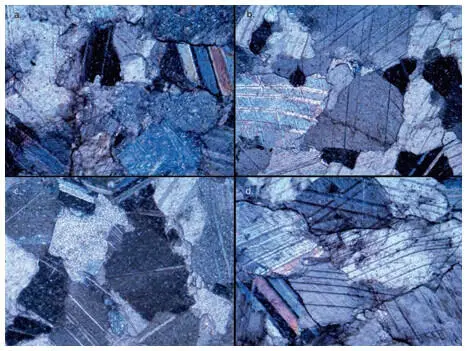
Figure 4:Photomicrograph of the thin sections of the marbles of columns A, C, B, D (left to right, top to button), N+, long side = 3.8 mm: all showing similar mosaic fabric formed by calcite crystals with curved-to-embayed boundaries.
In a thin cross section of column D, a superficial brown film of Ca-oxalates (Fig. 6a) was observed by optical microscopy, formed from the mineralization of an unknown organic treatment material. The presence of abundant phosphorus (P) (Fig. 6b), covered by a deposit of airborne quartz particles and gypsum (Fig. 6c and d) suggests the organic matter to be casein, corresponding to an ancient conservation treatment, with a weak sulphation process affecting the marble of the column.
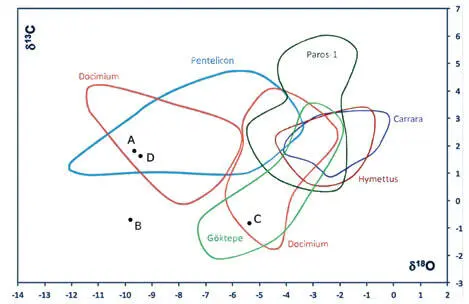
Figure 5:Plot on the reference isotopic diagram of the most important fine-grained marbles (Antonelli, Lazzarini 2015) of the resulting ratios of the 4 columns.
Table 1:Summary of the minero-petrographic and isotopic analyses (HE, heteroblastic; HO, homeoblastic; M. G. S., maximum grain size; +++, very abundant; ++, abundant; +, present; ±, traces; –, absent).
Читать дальшеИнтервал:
Закладка:
Похожие книги на «Monument Future»
Представляем Вашему вниманию похожие книги на «Monument Future» списком для выбора. Мы отобрали схожую по названию и смыслу литературу в надежде предоставить читателям больше вариантов отыскать новые, интересные, ещё непрочитанные произведения.











Обсуждение, отзывы о книге «Monument Future» и просто собственные мнения читателей. Оставьте ваши комментарии, напишите, что Вы думаете о произведении, его смысле или главных героях. Укажите что конкретно понравилось, а что нет, и почему Вы так считаете.