Ted Klontz - Money Mammoth
Здесь есть возможность читать онлайн «Ted Klontz - Money Mammoth» — ознакомительный отрывок электронной книги совершенно бесплатно, а после прочтения отрывка купить полную версию. В некоторых случаях можно слушать аудио, скачать через торрент в формате fb2 и присутствует краткое содержание. Жанр: unrecognised, на английском языке. Описание произведения, (предисловие) а так же отзывы посетителей доступны на портале библиотеки ЛибКат.
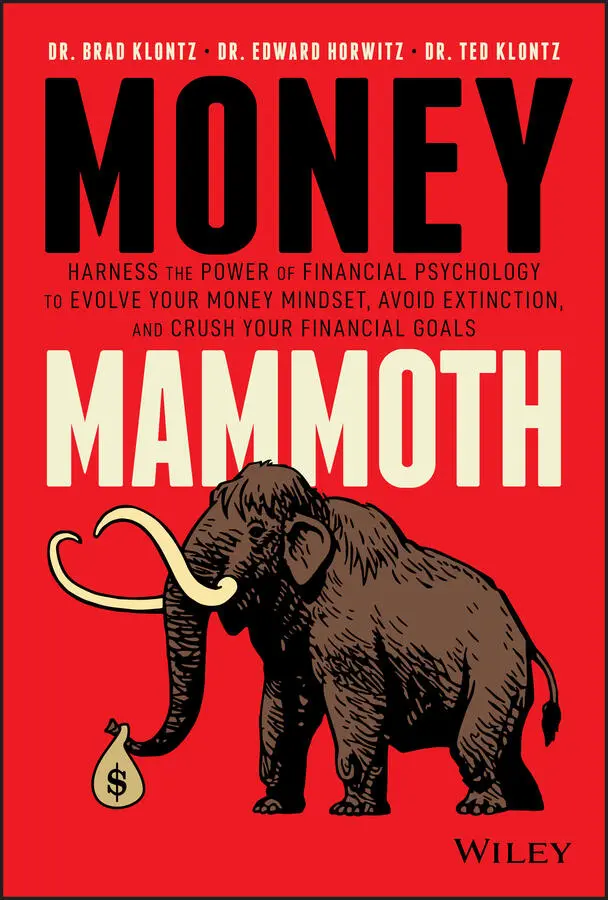
- Название:Money Mammoth
- Автор:
- Жанр:
- Год:неизвестен
- ISBN:нет данных
- Рейтинг книги:4 / 5. Голосов: 1
-
Избранное:Добавить в избранное
- Отзывы:
-
Ваша оценка:
Money Mammoth: краткое содержание, описание и аннотация
Предлагаем к чтению аннотацию, описание, краткое содержание или предисловие (зависит от того, что написал сам автор книги «Money Mammoth»). Если вы не нашли необходимую информацию о книге — напишите в комментариях, мы постараемся отыскать её.
Recent findings from the field of
could help the many Americans who know what they need to do but just can’t seem to make it happen. If you fall into this category, consider
.
This book looks at financial well-being from a psychological and evolutionary perspective. It reveals the obstacles that prevent people from taking their first critical steps towards financial wellness. It examines how our instincts and beliefs about money influence our financial behaviors. It explores money beliefs, how they develop, and how they drive our money behaviors
As the world’s leading experts in financial psychology, authors Dr. Brad Klontz, Dr. Ed Horwitz, and Dr. Ted Klontz can help you:
Discover how the experience of your ancestors are impacting your finances Understand how your friends, family members, and tribe may be holding you back Overcome mental roadblocks to wealth and success Harness the power of your emotional brain to transform your relationship with money Build confidence in your ability to take control of your financial future In
, the authors reveal the secrets to harnessing the power of your psychology to reach your financial goals.
Money Mammoth — читать онлайн ознакомительный отрывок
Ниже представлен текст книги, разбитый по страницам. Система сохранения места последней прочитанной страницы, позволяет с удобством читать онлайн бесплатно книгу «Money Mammoth», без необходимости каждый раз заново искать на чём Вы остановились. Поставьте закладку, и сможете в любой момент перейти на страницу, на которой закончили чтение.
Интервал:
Закладка:
4 Rip off the financial band-aid. Since money is such a powerful reinforcer, threats and warnings that aid will end unless certain behaviors occur are typically met with failure, especially if the financial enabling has been going on for years. It is very difficult if not impossible for the financial dependent to change until the money stops flowing. Set a date by which the financial support will end and stick to it. You might want to brainstorm other ways to assist that don't involve giving money, which could include paying for therapy, career counseling, life coaching, or financial planning.
5 Establish ongoing support. It can be very difficult to stick to your guns as you are withdrawing financial support to a loved one, as it is not uncommon for the person to become angry or depressed. Financially dependent people may even engage in an adult version of a toddler's temper tantrum, which could involve crying, yelling, or making threats. As such, it is very important for the financially enabling to have an emotional support system to help keep them strong and encourage them to stay the course and not give in to adult temper tantrums.
RAISING FINANCIALLY HEALTHY CHILDREN
Children are born into a world of money like fish are born into water. Children are raised in a particular socioeconomic environment and have experiences common to that environment. This becomes their reality—their type of food, clothes, transportation, school, home, and so on. As they grow older, they will become increasingly cognizant of money and its implications. They will become curious about it. They will see the value that others place on money. They will pay more and more attention to it. They will begin to notice that their experiences of money are not the same as everyone else's.
Children will learn very powerful messages about money. They receive these messages from their parents, their extended family members, their culture, their peers, and from society at large. Sometimes these messages are overt and explicit, but many times, they are much more subtle.
For example, consider the lullaby “Hush Little Baby.” Have you ever really thought about the explicit money messages this seemingly innocuous song delivers, embedded in gentle, soothing tones and oxytocin-fueled cuddles? So what does a loving parent do when your bird won't sing, your diamond ring turns out to be a fake, your mirror breaks, your mode of transportation breaks down, and you've got a stubborn goat? Don't worry, all problems can be solved with the purchase of something. Papa is going to just keep buying you stuff until you feel better.
Early in life, children develop a conceptualization of money, and their formulation will set them on a financial course. So parents have two choices. They can let children make up stories about what money is and how it is to be used with the help of social media and their peers. Or parents can consciously teach children what money is, what it does, what it can't do, how it should be used, how it can cause joy or pain, and the values they want associated with it.
IT'S NOT SO SIMPLE
Money is an incredibly complex subject akin to issues like time, death, sex, and God. Except there is no money Bible. Even if there were, there would probably be no more agreement about the true meaning of money than there is about God between the Torah, the New Testament, or the Koran.
So, the challenge is to become clear about what money means to you and how it fits in with your values, goals, and worldview. We can't teach what we don't know. And then, of course, there is your child's other parent. Are they reading from the same script as you? How about grandpa and grandma?
It is also important to remember that children learn more from what they see around them than what those around them say. Are you modeling your own beliefs about money in your daily life—about what you believe is possible? Your actions will teach them whether you say anything or not. Remember, your actions will be much more powerful a teacher than anything that you will say to them about money. This is one of those critical times in life where your parenting message cannot be “do as I say and not as I do.” Your children will interpret that as “do as my parents did and not blah, blah, blah….”
So what do your behaviors reveal about your relationship with money? For a quick look, spend a few minutes examining where your money went last month. Want to take a quick look at what you actually value? How much money did you save? How much money did you spend? How much money did you give to charity? Look at how much you have saved. Warning: This can be an “ouch” moment for many of us.
A BIG HEADS-UP
Beware! Your children will be learning about money long before you think you need to teach them. From birth, they have been exposed to money. At some point in time, they witness the magic. They may not know what happened, but they noticed something big happened, and money was involved. By the age of two, they will begin becoming aware of its magic-like qualities. It's power to bring, or take away, happiness or sadness, and that it often arrives around birthday time with other gifts and attention.
For example, imagine walking through a mall with a young child when he or she notices one of those coin-operated mechanical horses that when you drop a coin in, it magically starts moving, providing an instant adventure. Your little one is enraptured by the sight and sound of the horse rocking and his or her awareness that another child is mounted on it bouncing up and down, squealing with delight. As you approach, your child sees that the other child is dismounting with an incredible look of satisfaction.
Your child begins pulling on your hand, looking up into your eyes with a pleading gaze that says, “Please, please, please!” You're in a rush, but you weigh the costs of saying, “No,” and decide to consent in order to maintain the peace you need. You dig into your purse or wallet, fish out some quarters, and insert them. From now on, when your child sees something that he or she wants to do, he or she has learned that you carry magic coins with you that bring fun and happiness. If you didn't have any coins with you, you might have to deny your child that experience, and he or she would quickly learn the consequences of not having money.
QUICK START TIPS FOR HEALTHY FINANCIAL HABITS
Entire books have been written on how to raise financially healthy children. One of our favorites is written by the New York Times columnist Ron Lieber, titled The Opposite of Spoiled . 7We cover some key considerations for creating healthy financial habits.
ALLOWANCES
Allowances can provide wonderful teaching opportunities. There is some debate over whether allowances should be a basic right that a child has simply by being a member of the family or if allowances should be tied to a list of chores, responsibilities, or behaviors that are rewarded monetarily. Regardless of your opinion, allowances can be used to reinforce values and to teach basic money management skills.
A common mistake is to give children an allowance without any strings attached. Don't be surprised if they mismanage it. Of course they will! Their prefrontal cortex, the part of their brain responsible for planning, controlling impulses, and delaying gratification is not fully developed until early adulthood. The best approach is to build structure around the allowance in accordance with the values you wish to instill. For example, you could teach the concepts of buckets, where the allowance is divided into four portions: 1) saving, 2) spending, 3) giving, and 4) investing, as follows.
Saving
Интервал:
Закладка:
Похожие книги на «Money Mammoth»
Представляем Вашему вниманию похожие книги на «Money Mammoth» списком для выбора. Мы отобрали схожую по названию и смыслу литературу в надежде предоставить читателям больше вариантов отыскать новые, интересные, ещё непрочитанные произведения.









Обсуждение, отзывы о книге «Money Mammoth» и просто собственные мнения читателей. Оставьте ваши комментарии, напишите, что Вы думаете о произведении, его смысле или главных героях. Укажите что конкретно понравилось, а что нет, и почему Вы так считаете.