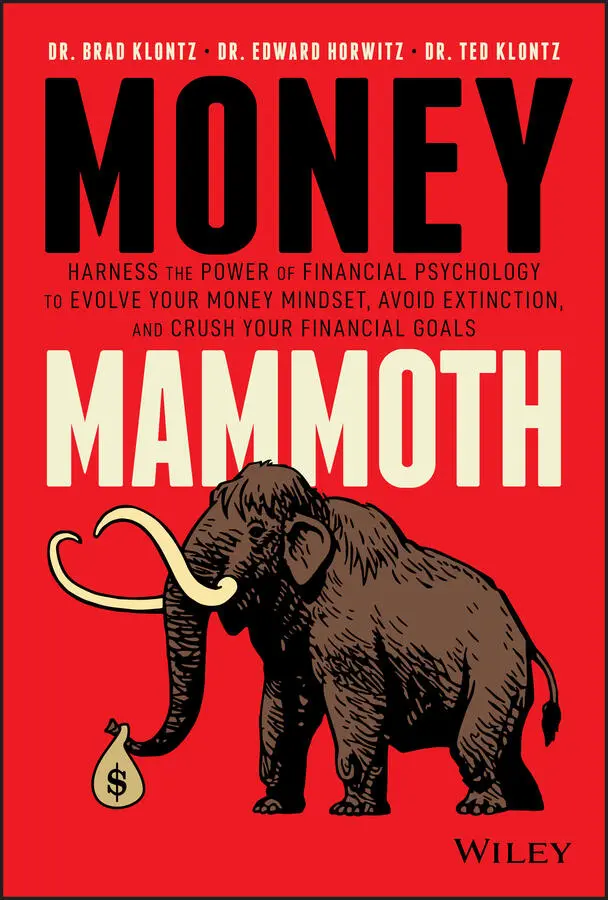
Ted Klontz - Money Mammoth
Здесь есть возможность читать онлайн «Ted Klontz - Money Mammoth» — ознакомительный отрывок электронной книги совершенно бесплатно, а после прочтения отрывка купить полную версию. В некоторых случаях можно слушать аудио, скачать через торрент в формате fb2 и присутствует краткое содержание. Жанр: unrecognised, на английском языке. Описание произведения, (предисловие) а так же отзывы посетителей доступны на портале библиотеки ЛибКат.
- Название:Money Mammoth
- Автор:
- Жанр:
- Год:неизвестен
- ISBN:нет данных
- Рейтинг книги:4 / 5. Голосов: 1
-
Избранное:Добавить в избранное
- Отзывы:
-
Ваша оценка:
Money Mammoth: краткое содержание, описание и аннотация
Предлагаем к чтению аннотацию, описание, краткое содержание или предисловие (зависит от того, что написал сам автор книги «Money Mammoth»). Если вы не нашли необходимую информацию о книге — напишите в комментариях, мы постараемся отыскать её.
Recent findings from the field of
could help the many Americans who know what they need to do but just can’t seem to make it happen. If you fall into this category, consider
.
This book looks at financial well-being from a psychological and evolutionary perspective. It reveals the obstacles that prevent people from taking their first critical steps towards financial wellness. It examines how our instincts and beliefs about money influence our financial behaviors. It explores money beliefs, how they develop, and how they drive our money behaviors
As the world’s leading experts in financial psychology, authors Dr. Brad Klontz, Dr. Ed Horwitz, and Dr. Ted Klontz can help you:
Discover how the experience of your ancestors are impacting your finances Understand how your friends, family members, and tribe may be holding you back Overcome mental roadblocks to wealth and success Harness the power of your emotional brain to transform your relationship with money Build confidence in your ability to take control of your financial future In
, the authors reveal the secrets to harnessing the power of your psychology to reach your financial goals.
Money Mammoth — читать онлайн ознакомительный отрывок
Ниже представлен текст книги, разбитый по страницам. Система сохранения места последней прочитанной страницы, позволяет с удобством читать онлайн бесплатно книгу «Money Mammoth», без необходимости каждый раз заново искать на чём Вы остановились. Поставьте закладку, и сможете в любой момент перейти на страницу, на которой закончили чтение.
Интервал:
Закладка:
For most people, there are days when we are just not looking forward to going to work. Perhaps it's cold outside and your bed is so comfy and warm. Perhaps you're tired, you've got a hangover, or you would rather just go hiking. So what makes you push through your resistance and go to work even though it would feel so much better to play hooky? The answer lies in the powerful reinforcing nature of money.
When you think about it, money is incredible! You can trade it for food, shelter, and warmth. You can use it to adorn yourself in beautiful attire and to display your relative status to attract and secure a mate. You can use it to provide safety for you and your family. You can use it in the service of your most important values. For many people across the world and throughout history, having money was often a matter of life or death. So we want money. We need money. And for most of us, the more money the better.
HUMANS ARE LAZY
Human beings are lazy. We are designed for the conservation of resources. Consider the example of muscle building. Building muscle is an easy concept that requires two ingredients: muscle overload and being hyper caloric. Essentially, you take whatever muscle you want to grow, and you give it more than it can handle. Then you eat more calories than you need. Then your body makes the muscles bigger. Repeat this process and you can become a muscle-bound freak. But muscles take energy to maintain, so the moment you stop loading the muscle with weight, your body takes that energy back to use elsewhere and the muscle atrophies. Essentially, if the resources aren't needed to get the job done, then the body self-corrects in favor of atrophy.
Psychologically, humans are wired to seek pleasure and avoid pain. Inevitably, work becomes difficult or boring and becomes a source of pain, while non-work activities can hold the promise of pleasure. So unless we are properly motivated and reinforced for our work efforts, just like a muscle that is no longer needed to carry a heavy load, our motivation to work at tasks that can be painful will naturally atrophy in favor of activities that require less effort and provide more immediate pleasure.
Money acts as a powerful reinforcer to help us push through the inevitable discomfort we experience at work. It keeps us getting up and doing our job even on those days when we would rather be golfing or fishing. The promise of pay increases may further reinforce keeping us focused and engaged.
What happens when we get a cookie whether we eat our vegetables or not? Or what happens if you get a cookie for NOT eating your vegetables? What happens when we get money for nothing; when we get paid for not going into work? What happens when we get money whether we put ourselves in challenging, uncomfortable, or painful situations or not? If you would get paid the same amount whether you slept in on Monday and then spent the day doing your favorite activity or dragged yourself out of bed early and worked an eight-hour day at your job, which would you choose?
How many days in a row would you maintain your work ethic if you realized it made no difference because you were going to get paid either way? If you accept the arguments that humans are lazy and money is a powerful reinforcer, we would argue that working when work is unnecessary to support oneself is more difficult to explain than someone who decides not to work because they are getting paid regardless.
FINANCIAL ENABLING AND FINANCIAL DEPENDENCE
When we get paid for doing nothing, the act of doing nothing gets reinforced. When getting paid for doing nothing becomes a habit, it can lead to a syndrome of financial dependence.
Financial dependence is the reliance on nonwork income to meet one's financial needs. Our research has found that financial dependence is associated with some devastating financial and psychological consequences that seem to emerge regardless of where the money comes from.
Whether financial support is coming from the government in the form of public assistance or from a family trust, dependence on others for financial support has consequences. On the psychological side, dependence on nonwork-related income is associated with a lack of passion, drive, motivation, and creativity. Financially, it is associated with lower income and lower net worth. While financially dependent people rely on the income, they also tend to resent the source of the income. Clearly, it should come as no surprise that money can be used to manipulate and control others, especially as their dependence on nonwork money grows over time.
In many ways, financial dependence is a debilitating condition that can destroy a person's drive and passion. As such, it is something to be avoided, especially when considering how we are raising our children around money.
Financial enabling is the other side of the financial dependence equation. Financial enabling is essentially financial help that hurts. It is almost always done with the best intentions, such as when a parent wants to support a child's goals or passions. However, in the case of financial enabling, the enabler may report having a hard time saying no to requests for money. Our research has shown that financial enablers also tend to have lower income, higher credit card debt, and may feel feelings of resentment or anger after giving away money. 4Financial enabling behavior can get complicated and very emotional when it involves friends and/or family members.
CUTTING THE FINANCIAL UMBILICAL CORD: FIVE STEPS
We have worked with many families stuck in the financial enabling–financial dependence cycle. We have also worked with financial professionals who are worried about clients who are putting their financial health in jeopardy by financially enabling their children. In our work, we have identified five steps to help cut the financial umbilical cord. 5
1 Recognize that financial help can hurt. The first step in breaking the enabler-dependent cycle is recognizing how your attempts to help someone via financial support can actually be harmful. Financial enabling is almost always done from a good place. You see someone you love in need and you want to help him or her. But by definition, financial enabling hurts. It can hurt you, the giver, financially. If you are reinforcing irresponsible or harmful behaviors then you are hurting the receiver. Financial dependence can be quite psychologically crippling, robbing the dependent of drive, motivation, passion, and/or creativity. You may also be hurting your relationship as financially enabling often comes with strings attached from the giver, and feelings of resentment on the part of the receiver.
2 Understand the curse of too many options. Depending on the level of financial support being provided, you may be giving the financial dependent too many choices. For example, we know of many adult children who have earned multiple graduate degrees in different fields without ever settling on a career or getting a job. Others move around frequently, or start and quit jobs often, never allowing themselves the opportunity to establish themselves. When people need to depend on their own work efforts to fund their lives, the experience can be quite grounding and can give a deep sense of purpose. These people also grow psychologically as they learn to delay gratification and to stick out challenging situations and learn to navigate challenging relationships.
3 Acknowledge the curse of unstructured free time. Research on the concept of “flow” by Mihaly Csikszentmihalyi, found that it is much more difficult to enjoy unstructured free time than it is work. 6Gainful employment brings with it the opportunity to have flow experiences, where you are being challenged and you lose yourself in productive efforts to meet challenges. Contrary to popular belief, we struggle much more to enjoy unstructured free time, like during weekends and on vacation. With too much free time, we tend to dwell on our problems and feel isolated and uneasy. Work has many built-in social and emotional benefits, even if we find parts of our job distasteful. This is another way that financial enabling can hurt someone.
Читать дальшеИнтервал:
Закладка:
Похожие книги на «Money Mammoth»
Представляем Вашему вниманию похожие книги на «Money Mammoth» списком для выбора. Мы отобрали схожую по названию и смыслу литературу в надежде предоставить читателям больше вариантов отыскать новые, интересные, ещё непрочитанные произведения.












Обсуждение, отзывы о книге «Money Mammoth» и просто собственные мнения читателей. Оставьте ваши комментарии, напишите, что Вы думаете о произведении, его смысле или главных героях. Укажите что конкретно понравилось, а что нет, и почему Вы так считаете.