Ted Klontz - Money Mammoth
Здесь есть возможность читать онлайн «Ted Klontz - Money Mammoth» — ознакомительный отрывок электронной книги совершенно бесплатно, а после прочтения отрывка купить полную версию. В некоторых случаях можно слушать аудио, скачать через торрент в формате fb2 и присутствует краткое содержание. Жанр: unrecognised, на английском языке. Описание произведения, (предисловие) а так же отзывы посетителей доступны на портале библиотеки ЛибКат.
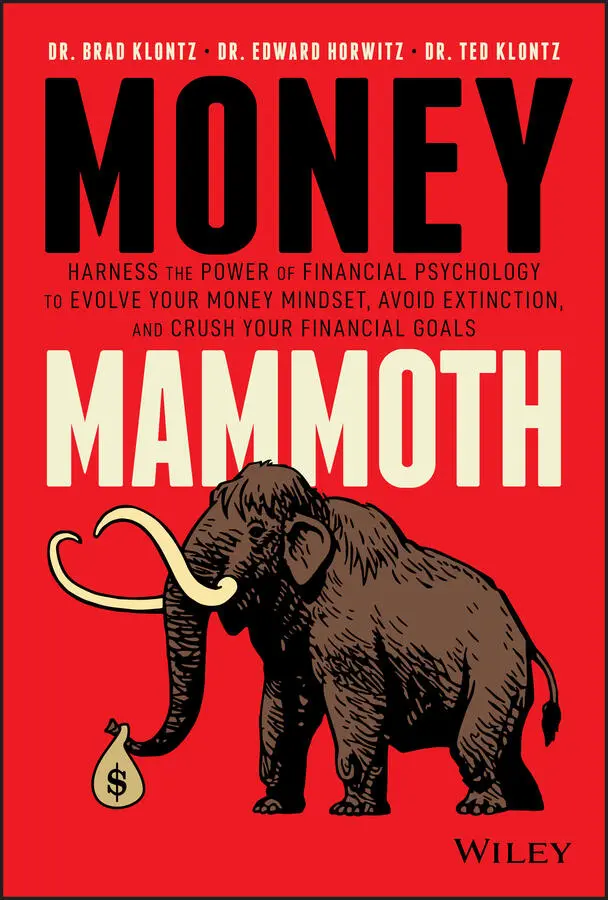
- Название:Money Mammoth
- Автор:
- Жанр:
- Год:неизвестен
- ISBN:нет данных
- Рейтинг книги:4 / 5. Голосов: 1
-
Избранное:Добавить в избранное
- Отзывы:
-
Ваша оценка:
Money Mammoth: краткое содержание, описание и аннотация
Предлагаем к чтению аннотацию, описание, краткое содержание или предисловие (зависит от того, что написал сам автор книги «Money Mammoth»). Если вы не нашли необходимую информацию о книге — напишите в комментариях, мы постараемся отыскать её.
Recent findings from the field of
could help the many Americans who know what they need to do but just can’t seem to make it happen. If you fall into this category, consider
.
This book looks at financial well-being from a psychological and evolutionary perspective. It reveals the obstacles that prevent people from taking their first critical steps towards financial wellness. It examines how our instincts and beliefs about money influence our financial behaviors. It explores money beliefs, how they develop, and how they drive our money behaviors
As the world’s leading experts in financial psychology, authors Dr. Brad Klontz, Dr. Ed Horwitz, and Dr. Ted Klontz can help you:
Discover how the experience of your ancestors are impacting your finances Understand how your friends, family members, and tribe may be holding you back Overcome mental roadblocks to wealth and success Harness the power of your emotional brain to transform your relationship with money Build confidence in your ability to take control of your financial future In
, the authors reveal the secrets to harnessing the power of your psychology to reach your financial goals.
Money Mammoth — читать онлайн ознакомительный отрывок
Ниже представлен текст книги, разбитый по страницам. Система сохранения места последней прочитанной страницы, позволяет с удобством читать онлайн бесплатно книгу «Money Mammoth», без необходимости каждый раз заново искать на чём Вы остановились. Поставьте закладку, и сможете в любой момент перейти на страницу, на которой закончили чтение.
Интервал:
Закладка:
The unusual part of the story came at Ethan's trial when his mother and attorney asserted what has now become known as the “affluenza defense.” A psychologist called in for expert testimony made the argument that Ethan's socioeconomic privilege was actually a mental disorder. The defense argued that Ethan was afflicted by his wealthy upbringing and environment, which resulted in criminal insanity. Due to his wealthy upbringing, the argument went, he was unable to distinguish between right and wrong. Ethan became known as the “affluenza teen.” 1
While nobody can say for certain whether this line of defense impacted the judge's verdict and sentencing, it raises several interesting points. Can growing up in a wealthy environment, spoiled with materialistic possessions and luxuries, warp your sense of reality to the point where you can't function as a normal member of society? Could wealth so warp your sense of reality that you could be classified as insane and not be held legally responsible for your actions? Is it the wealth that can lead to a disconnect from “reality” or is it more the result of bad parenting?
You can imagine how someone could be raised in an environment that puts him or her out of touch with the experience of the average person. For example, imagine you grew up in a world where you got everything you wanted, where you could do whatever you wanted without consequence, and where your parents would use their money and influence to fix whatever problems you created for yourself. Don't you think that after years of living in that environment, your sense of reality and personal responsibility would be skewed? While fair-minded people would agree that this experience would be detrimental to a well-adjusted upbringing, it certainly wouldn't excuse drunk driving.
WERE YOU A SPOILED CHILD?
It's easy to point fingers at people who are wealthier than you and argue that they are spoiling their children. However, the concept of spoiling is really a matter of perspective. To the average European in the Middle Ages, we as adults today were all spoiled as children. In fact, we were living in the lap of luxury. We had our own room (or only had to share it with one or two other people); we had indoor plumbing; we didn't have to start working until we were teenagers (or even adults); we got to go to school, we probably weren't beat on a regular basis (sorry, if you were); we probably had more than one set of clothes or shoes; we were regularly given a bath with warm water; and we were probably taken to a doctor or dentist for “check-ups” when there was nothing major wrong.
So, rather than putting people into categories of good/bad, right/wrong, it can be helpful to look at the concept of “spoiling” along a continuum. Certainly, Ethan would have been on the outer edge of our modern spoiling analysis, but in historical terms, so were we and so would our children be. But when does spoiling cross the line? At what point does a little spoiling and protecting of children go too far and risk doing real damage?
THE COLLEGE ADMISSIONS SCANDAL
In 2019, over 50 people were charged in a multimillion-dollar scheme revolving around William “Rick” Singer, a college admissions consultant. 2It was alleged that, for a fee, Rick would help your child get admitted into a prestigious university. Reportedly, Rick had a network of people inside many of these universities, including one or more college athletic coaches and admissions administrators who could help facilitate the admissions either directly or indirectly. The network also involved admissions exam proctors, who in some cases changed students' answers to increase their scores.
His services allegedly also arranged for creating fake academic and athletic student profiles of participation to help gain admissions, sometimes working directly with athletic coaches and officials inside the universities. Of course, cooperation and help with admissions came at a price, depending on the university desired and how much help was needed.
There were several celebrity cases that were heavily featured surrounding this scandal. For example, actress Lori Loughlin and her fashion designer husband Mossimo Giannulli allegedly paid over $500,000 to Rick so that their two children could gain admission to University of Southern California (USC) as student-athlete rowers, even though neither were rowing athletes.
In another case, actress Felicity Huffman paid $15,000, disguised as a charitable donation, to increase her daughter's SAT scores post-exam. There were other stories like these reported, where there were bribes, corruption within the admissions system, and test-taking integrity was compromised. To date, none of the students were charged, as their parents were seen as the “principal actors” in these cases.
After sentencing, Huffman confessed, “I am deeply sorry to the students, parents, and colleges impacted by my actions. I am sorry to my daughters and my husband. I have betrayed them all.” Huffman said her daughter asked why she didn't believe in her. “I had no answer,” Huffman said. “I can only say I'm so sorry. I was frightened, I was stupid, and I was so wrong. I am deeply ashamed of what I have done. I have done more damage than I could ever imagine. I realize now with my mothering that love and truth go hand in hand. I take full responsibility for my actions.” 3
Many were quick to pile on and condemn the actions of Huffman and others who were clearly trying to game the system to give their children an advantage. After all, isn't it totally unfair and outrageous? Not only is it cheating, it also seems to be the worst kind, where wealthy people use their advantage to elevate their children at the expense of people who couldn't afford to hire college admission consultants—let alone one who had the ability to game the system. This feeds into the worst stereotypes of the wealthy and famous.
However, ask yourself this question: If you were able to help your child get into an “elite” university, would you do it? Set aside the cheating aspect for a moment. If you had the money to do it, would you hire tutors and/or a college admissions consultant if you thought it would help your child have a better life?
It's easy to say that you wouldn't go to the extent that Huffman and others went. If she could go back in time, she would almost certainly make a different choice too. But what if a consultant told you that's what all the other wealthy people are doing? What if he sold you on the idea that the other children your child was competing with were also receiving similar advantages, and if you didn't do the same, you would be hurting your child's chances at a better future.
Parents will go to dramatic lengths to provide a better, happier, and safer life for their children. Many would sacrifice their lives for their children, not to mention their time and money. If it seemed like there was no other way, many of us would be tempted to become involved in questionable or even illegal acts if we felt it would give our children a leg up in life. Many of us might be tempted even if it involved illegal acts. Put aside these more dramatic stories for a moment and consider the impact that too much family support can have on the development of a child. What happens when parents go too far?
MONEY IS A POWERFUL REINFORCER
Money is a powerful reinforcer. In psychological terms, a reinforcer is anything that increases the likelihood that a specific behavior will occur. For example, when you promise a child a cookie if he or she eats all the vegetables on the plate, it will likely increase the chances that the child will eat all of the vegetables. As such, the cookie is a reinforcer since it increases the vegetable-eating behavior. In many ways, money is like this cookie.
Читать дальшеИнтервал:
Закладка:
Похожие книги на «Money Mammoth»
Представляем Вашему вниманию похожие книги на «Money Mammoth» списком для выбора. Мы отобрали схожую по названию и смыслу литературу в надежде предоставить читателям больше вариантов отыскать новые, интересные, ещё непрочитанные произведения.









Обсуждение, отзывы о книге «Money Mammoth» и просто собственные мнения читателей. Оставьте ваши комментарии, напишите, что Вы думаете о произведении, его смысле или главных героях. Укажите что конкретно понравилось, а что нет, и почему Вы так считаете.