Ted Klontz - Money Mammoth
Здесь есть возможность читать онлайн «Ted Klontz - Money Mammoth» — ознакомительный отрывок электронной книги совершенно бесплатно, а после прочтения отрывка купить полную версию. В некоторых случаях можно слушать аудио, скачать через торрент в формате fb2 и присутствует краткое содержание. Жанр: unrecognised, на английском языке. Описание произведения, (предисловие) а так же отзывы посетителей доступны на портале библиотеки ЛибКат.
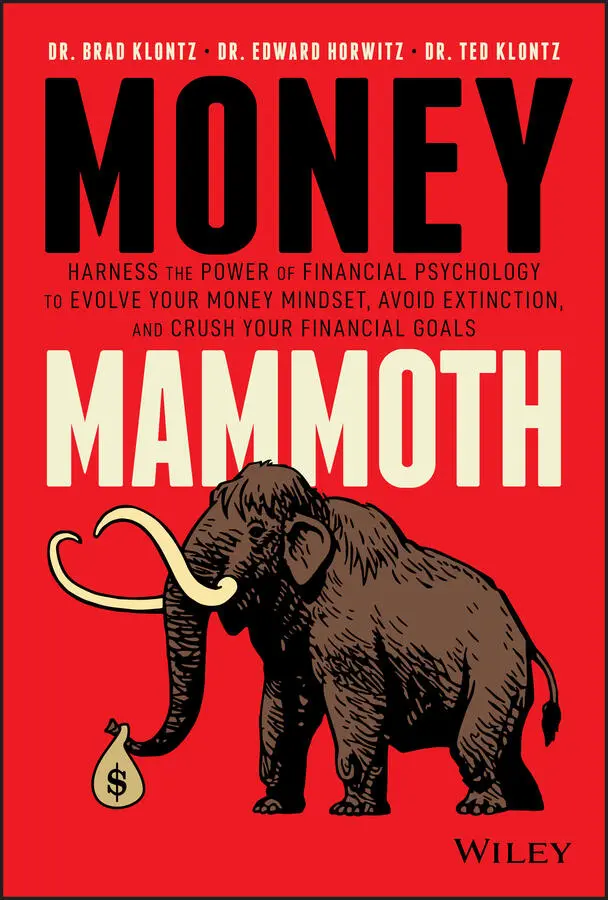
- Название:Money Mammoth
- Автор:
- Жанр:
- Год:неизвестен
- ISBN:нет данных
- Рейтинг книги:4 / 5. Голосов: 1
-
Избранное:Добавить в избранное
- Отзывы:
-
Ваша оценка:
Money Mammoth: краткое содержание, описание и аннотация
Предлагаем к чтению аннотацию, описание, краткое содержание или предисловие (зависит от того, что написал сам автор книги «Money Mammoth»). Если вы не нашли необходимую информацию о книге — напишите в комментариях, мы постараемся отыскать её.
Recent findings from the field of
could help the many Americans who know what they need to do but just can’t seem to make it happen. If you fall into this category, consider
.
This book looks at financial well-being from a psychological and evolutionary perspective. It reveals the obstacles that prevent people from taking their first critical steps towards financial wellness. It examines how our instincts and beliefs about money influence our financial behaviors. It explores money beliefs, how they develop, and how they drive our money behaviors
As the world’s leading experts in financial psychology, authors Dr. Brad Klontz, Dr. Ed Horwitz, and Dr. Ted Klontz can help you:
Discover how the experience of your ancestors are impacting your finances Understand how your friends, family members, and tribe may be holding you back Overcome mental roadblocks to wealth and success Harness the power of your emotional brain to transform your relationship with money Build confidence in your ability to take control of your financial future In
, the authors reveal the secrets to harnessing the power of your psychology to reach your financial goals.
Money Mammoth — читать онлайн ознакомительный отрывок
Ниже представлен текст книги, разбитый по страницам. Система сохранения места последней прочитанной страницы, позволяет с удобством читать онлайн бесплатно книгу «Money Mammoth», без необходимости каждый раз заново искать на чём Вы остановились. Поставьте закладку, и сможете в любой момент перейти на страницу, на которой закончили чтение.
Интервал:
Закладка:
THE 2008 HOUSING CRISIS
An example of a recent shared financial flashpoint was how many parents struggled to make ends meet in the wake of the 2008 housing crisis. Many parents probably exposed their children to new beliefs about banks, the stock market, and home ownership. In fact, studies have shown that Millennials are less likely to desire or seek home ownership and are less trustful of the stock market compared to previous generations. 2The reasons given were not student debt levels, as some would have thought, but rather a belief that home ownership was not a reliable way to build wealth. However, for the previous two generations, equity built through home ownership was a major source of wealth creation. At the time of this book's writing, home ownership is at or near all-time high, and property values in most markets have recovered to near pre-2008 levels or higher. Additionally, all three major stock market indexes are at or near record high levels and more than recovered from pre-2008 levels.
The lesson here is that you must accept the fact that your parents may not know best when it comes to money management and money relationships. Don't be too hard on them; they were only doing what they had learned. Some of you have already recognized that fact as you got older. Are you able to recognize your parents' money beliefs and behaviors that you share?
As parents, many of us struggle with how much we should expose to our children. On one hand, we want them to respect a hard day's work and the value of a well-earned dollar. On the other hand, we don't want them to worry about money and spoil their childhood innocence. However, good money lessons are important to learn and establish. Kids are bombarded through social media and living in a highly materialistic society to consume and assimilate into society. Debt is advertised on TV and everything seems to be connected to money. Wealth, success, fame, and celebrity are front and center in our culture, and our kids see it everywhere. Parents have a near impossible task to educate their kids about money and good financial savings habits versus societal and peer pressures. What makes it even harder is most parents don't have it all figured out either. The advice you received may have been flawed or inaccurate. It's okay to still love your parents and ignore their money and money relationship advice. Sometimes you need to be okay with that idea for you to move ahead and rewrite those incorrect beliefs.
In the next chapter, we explore in greater detail how to help children develop a healthy money mindset. Remember, nobody is born knowing and understanding everything they need to know about money and proper financial management. Healthy money mindsets must be learned. If the money mindsets handed down from your parents need some correcting, it's time to fix them for your children.
Chapter 2 Mammoth Mindset Insights
1 In terms of understanding and mastering your own financial psychology, uncovering the details of your family history is pure gold.
2 Your children are the next in line to inherit your family financial legacy. The great news is that it is not too late to make “edits” to your family legacy.
3 There is no shame in having financial stress or concerns, but you need to be careful not to burden children with your issues, as it can hurt them.
4 Studies consistently show that above middle class, there is no significant correlation between money and happiness.
5 Innocent answers and simple reasoning can become the basis for our financial decision-making well into adulthood.
6 It's okay to still love your parents and ignore their money and money relationship advice. Sometimes you need to be okay with that idea in order for you to move ahead and rewrite those incorrect beliefs.
NOTES
1 1. B. Klontz, S. L. Britt, K. L. Archuleta, and T. Klontz, “Disordered Money Behaviors: Development of the Klontz Money Behavior Inventory, Journal of Financial Therapy 3, no. 1 (2012): 2.
2 2. Jamie Lenz, “Millennials Are Buying Homes Far Less Often Than Older Generations Did, and That Puts a Large Sector of the U.S. Economy at Risk,” BusinessInsider.com, The Conversation, May 21, 2019, https://www.businessinsider.com/millennials-are-buying-homes-far-less-often-putting-economy-at-risk-2019-5.
CHAPTER 3 Your Children
How far would you go to protect the life of a close family member who was in mortal danger? If you had no other choice, would you kill to protect them? If you are a parent, how far would you go to protect your own child? How far would you go to protect a child's emotional well-being? How far would you go to give your child a leg up in the world? While it is easy to criticize others for going too far with their children, it's important to recognize that the desire to help children—especially our own children—is hardwired and is in a large part responsible for the survival of humanity. Human offspring are immobile, defenseless, and totally dependent for years after they are born.
We are wired to perpetuate our genes. This is the origin of sexual behavior and the natural protective instincts we all have. Even if we are not parents, we are wired to feel empathy and protective toward children. Childlike features trigger a protective impulse in most of us. It is why you see total strangers often immediately soften, smile, or otherwise change their demeanor when a small child makes eye contact with them. The typical social distance and emotional reservation will often instantly melt away, and many people will tilt their heads, lean over, or even squat down to engage a child—even when they are total strangers. When it comes to our own offspring or that of close family members of friends, this instinct is intensified.
If your child, or a close family member, was in mortal danger, would you kill to save him or her? The majority of human beings have a strong inhibition toward killing other human beings. However, when the lives of our family members are threatened, this inhibition can be overridden. This is one of the reasons that in training soldiers, the military works hard to facilitate the creation of a family. The soldiers in a platoon, for example, consider each other brothers and sisters. Many accounts from combat reveal that soldiers are able to override their inhibition to killing not for patriotism or political causes, but out of a desire to protect their brothers and sisters.
So while we are prone to self-preservation, this impulse can be easily suppressed when we feel like the lives and/or well-being of our family members are threatened—especially our children. This natural impulse helps explain a variety of destructive financial behaviors. They are all done from a place of love, worry, and concern, but they can backfire quite dramatically. It is important to be aware of these impulses so that we can engage our analytical brains to think through the long-term consequences of our behaviors.
CAN MONEY MAKE YOU INSANE?
Ethan is 16 years old. One evening, he and his friends got a little bit wild. On an impulse, they stole some beer and had an impromptu party at his parents' house. But these decisions were not the worst ones he made that night. Later that evening, Ethan and his buddies decided to go for a drive. Tragically, Ethan's drunk driving led to the death of four pedestrians and left one of his passengers brain damaged and paralyzed. Ethan's blood alcohol level was tested at 0.24 several hours after the crash, which was about three times the legal limit in Texas.
Due to the horrific nature of the crime, the prosecutor pushed for 20 years in state prison. Ethan pleaded guilty to four counts of manslaughter and received 10 years of probation from the juvenile court. Many were outraged by the verdict. They thought that his family's wealth afforded a defense that allowed him to receive a reduced sentence. However, the sentence isn't what makes this story so remarkable.
Читать дальшеИнтервал:
Закладка:
Похожие книги на «Money Mammoth»
Представляем Вашему вниманию похожие книги на «Money Mammoth» списком для выбора. Мы отобрали схожую по названию и смыслу литературу в надежде предоставить читателям больше вариантов отыскать новые, интересные, ещё непрочитанные произведения.










Обсуждение, отзывы о книге «Money Mammoth» и просто собственные мнения читателей. Оставьте ваши комментарии, напишите, что Вы думаете о произведении, его смысле или главных героях. Укажите что конкретно понравилось, а что нет, и почему Вы так считаете.