Position, Navigation, and Timing Technologies in the 21st Century
Здесь есть возможность читать онлайн «Position, Navigation, and Timing Technologies in the 21st Century» — ознакомительный отрывок электронной книги совершенно бесплатно, а после прочтения отрывка купить полную версию. В некоторых случаях можно слушать аудио, скачать через торрент в формате fb2 и присутствует краткое содержание. Жанр: unrecognised, на английском языке. Описание произведения, (предисловие) а так же отзывы посетителей доступны на портале библиотеки ЛибКат.

- Название:Position, Navigation, and Timing Technologies in the 21st Century
- Автор:
- Жанр:
- Год:неизвестен
- ISBN:нет данных
- Рейтинг книги:5 / 5. Голосов: 1
-
Избранное:Добавить в избранное
- Отзывы:
-
Ваша оценка:
Position, Navigation, and Timing Technologies in the 21st Century: краткое содержание, описание и аннотация
Предлагаем к чтению аннотацию, описание, краткое содержание или предисловие (зависит от того, что написал сам автор книги «Position, Navigation, and Timing Technologies in the 21st Century»). Если вы не нашли необходимую информацию о книге — напишите в комментариях, мы постараемся отыскать её.
Volume 1 of
contains three parts and focuses on the satellite navigation systems, technologies, and engineering and scientific applications. It starts with a historical perspective of GPS development and other related PNT development. Current global and regional navigation satellite systems (GNSS and RNSS), their inter-operability, signal quality monitoring, satellite orbit and time synchronization, and ground- and satellite-based augmentation systems are examined. Recent progresses in satellite navigation receiver technologies and challenges for operations in multipath-rich urban environment, in handling spoofing and interference, and in ensuring PNT integrity are addressed. A section on satellite navigation for engineering and scientific applications finishes off the volume.
Volume 2 of
consists of three parts and addresses PNT using alternative signals and sensors and integrated PNT technologies for consumer and commercial applications. It looks at PNT using various radio signals-of-opportunity, atomic clock, optical, laser, magnetic field, celestial, MEMS and inertial sensors, as well as the concept of navigation from Low-Earth Orbiting (LEO) satellites. GNSS-INS integration, neuroscience of navigation, and animal navigation are also covered. The volume finishes off with a collection of work on contemporary PNT applications such as survey and mobile mapping, precision agriculture, wearable systems, automated driving, train control, commercial unmanned aircraft systems, aviation, and navigation in the unique Arctic environment.
In addition, this text:
Serves as a complete reference and handbook for professionals and students interested in the broad range of PNT subjects Includes chapters that focus on the latest developments in GNSS and other navigation sensors, techniques, and applications Illustrates interconnecting relationships between various types of technologies in order to assure more protected, tough, and accurate PNT
will appeal to all industry professionals, researchers, and academics involved with the science, engineering, and applications of position, navigation, and timing technologies.pnt21book.com
Position, Navigation, and Timing Technologies in the 21st Century — читать онлайн ознакомительный отрывок
Ниже представлен текст книги, разбитый по страницам. Система сохранения места последней прочитанной страницы, позволяет с удобством читать онлайн бесплатно книгу «Position, Navigation, and Timing Technologies in the 21st Century», без необходимости каждый раз заново искать на чём Вы остановились. Поставьте закладку, и сможете в любой момент перейти на страницу, на которой закончили чтение.
Интервал:
Закладка:
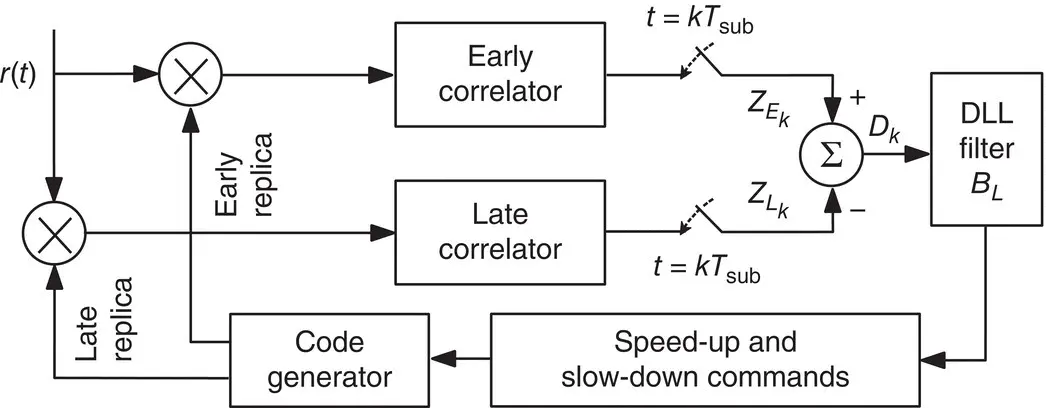
Figure 38.41 Structure of a DLL employing a coherent baseband discriminator to track the code phase (Shamaei et al. [73]).
Source: Reproduced with permission of IEEE, European Signal Processing Conference.
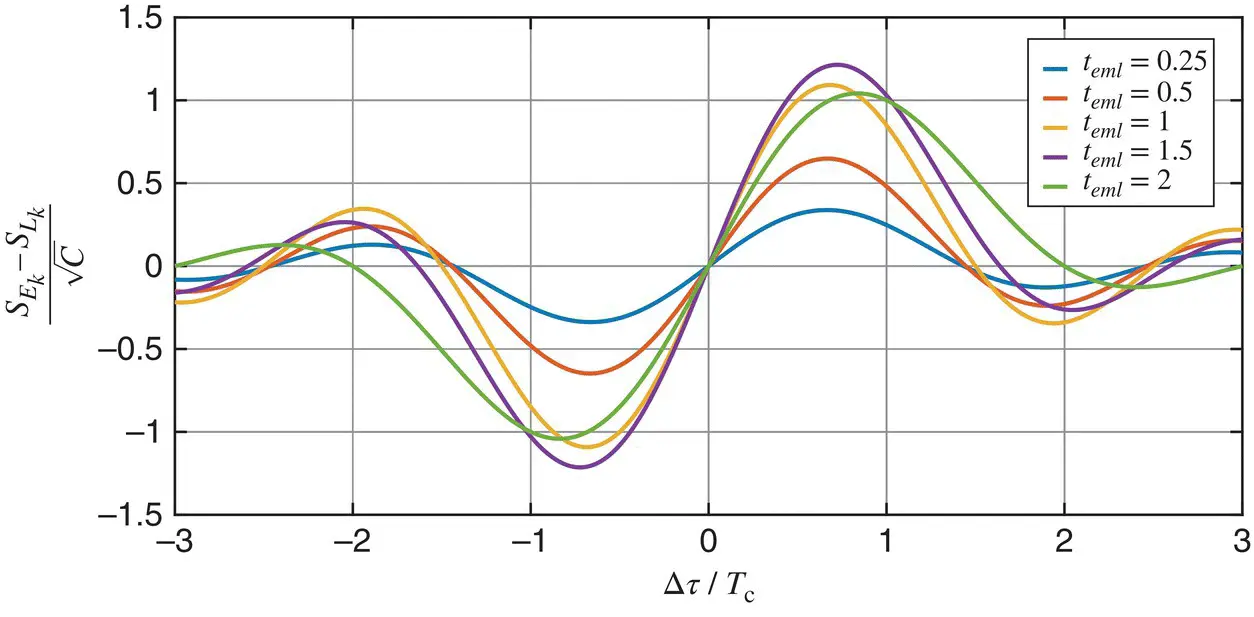
Figure 38.42 Output of the coherent baseband discriminator function for the SSS with different correlator spacing (Shamaei et al. [73]).
Source: Reproduced with permission of IEEE, European Signal Processing Conference.



Open‐Loop Analysis:The coherent baseband discriminator function is defined as


The signal component of the normalized discriminator function  is shown in Figure 38.42for t eml= {0.25, 0.5, 1, 1.5, 2}.
It can be seen from Figure 38.42that the discriminator function can be approximated by a linear function for small values of Δ τ k, given by
(38.26) 
where k SSSis the slope of the discriminator function at Δ τ k= 0, which is obtained by


The mean and variance of D kcan be obtained from Eq. (38.26)as
(38.27) 
(38.28) 
Closed‐Loop Analysis:In a rate‐aided DLL, the pseudorange rate estimated by the FLL‐assisted PLL is added to the output of the DLL discriminator. In general, it is enough to use a first‐order loop for the DLL loop filter since the FLL‐assisted PLL’s pseudorange rate estimate is accurate. The closed‐loop‐error time update for a first‐order loop is shown to be [57]

where B n, DLLis the DLL noise‐equivalent bandwidth, and K Lis the loop gain. To achieve the desired loop noise‐equivalent bandwidth, K Lmust be normalized according to
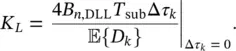
Using Eq. (38.13), the loop noise gain for a coherent baseband discriminator becomes

.
Assuming zero‐mean tracking error, that is,  , the variance time update is given by
(38.29) 
At steady state, var{Δ τ } = var {Δ τ k + 1} = var {Δ τ k}; hence,
(38.30) 
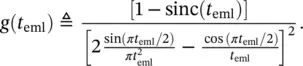
From Eq. (38.30), it can be seen that the standard deviation of the ranging error is related to the correlator spacing through g ( t eml). Figure 38.43shows g ( t eml) for 0 ≤ t eml≤ 2. It can be seen that g ( t eml) is not a linear function, and it increases significantly faster when t eml> 1. Therefore, to achieve a relatively high ranging precision, t emlmust be set to be less than 1. It is worth mentioning that for the GPS C/A code with an infinite bandwidth, g ( t eml) = t eml.
Figure 38.44shows the pseudorange error of a coherent DLL as a function of C / N 0, with B n, DLL= {0.005, 0.05} Hz and t eml= {0.25, 0.5, 1, 1.5, 2}. It is worth mentioning that in Figure 38.44, the bandwidth is chosen so as to enable the reader to compare the results with the standard GPS results provided in [55].
38.6.3.2 Non‐Coherent DLL Tracking
In a typical DLL, the correlation of the received signal with the early, prompt, and late locally generated signals at time t = kT subare calculated according to

where x can be either e , p , or l representing early, prompt, or late correlations, respectively. Figure 38.45represents the general structure of the DLL. This subsection studies the code phase error with two non‐coherent discriminators: dot‐product and early‐power‐minus‐late‐power.
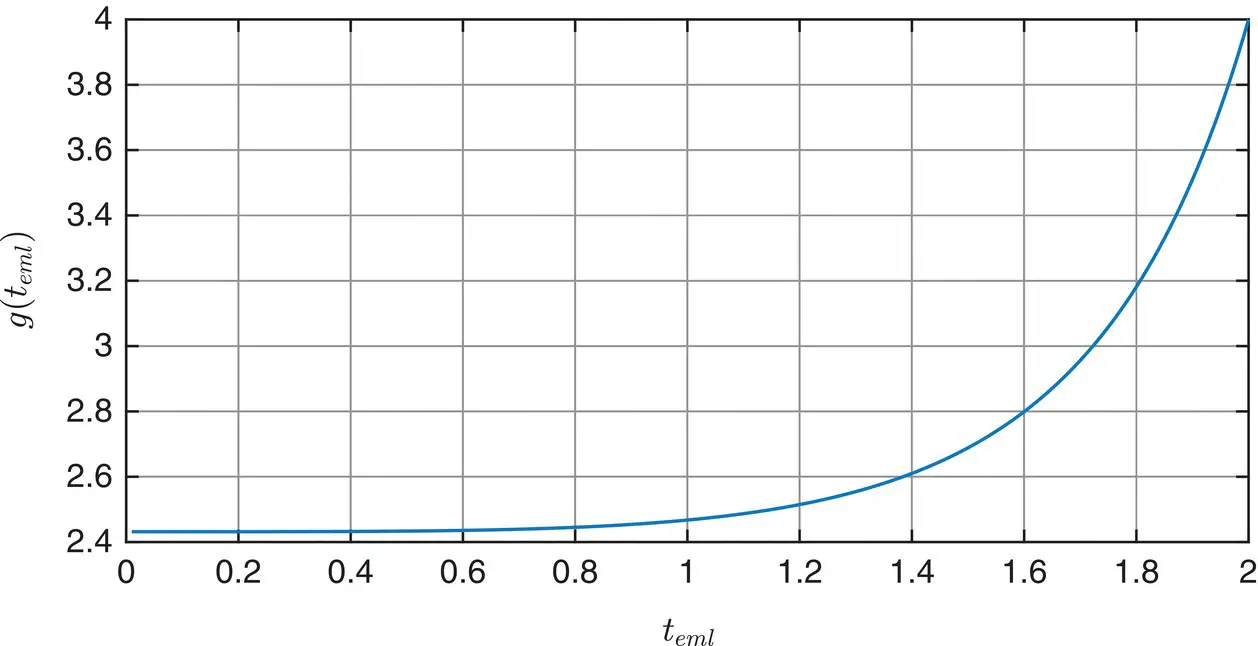
Figure 38.43 The standard deviation of the ranging error Δ τ is related to the correlator spacing through g ( t eml), which is shown as a function of t eml(Shamaei et al. [73]).
Читать дальшеИнтервал:
Закладка:
Похожие книги на «Position, Navigation, and Timing Technologies in the 21st Century»
Представляем Вашему вниманию похожие книги на «Position, Navigation, and Timing Technologies in the 21st Century» списком для выбора. Мы отобрали схожую по названию и смыслу литературу в надежде предоставить читателям больше вариантов отыскать новые, интересные, ещё непрочитанные произведения.











Обсуждение, отзывы о книге «Position, Navigation, and Timing Technologies in the 21st Century» и просто собственные мнения читателей. Оставьте ваши комментарии, напишите, что Вы думаете о произведении, его смысле или главных героях. Укажите что конкретно понравилось, а что нет, и почему Вы так считаете.