Matthew B. Hamilton - Population Genetics
Здесь есть возможность читать онлайн «Matthew B. Hamilton - Population Genetics» — ознакомительный отрывок электронной книги совершенно бесплатно, а после прочтения отрывка купить полную версию. В некоторых случаях можно слушать аудио, скачать через торрент в формате fb2 и присутствует краткое содержание. Жанр: unrecognised, на английском языке. Описание произведения, (предисловие) а так же отзывы посетителей доступны на портале библиотеки ЛибКат.
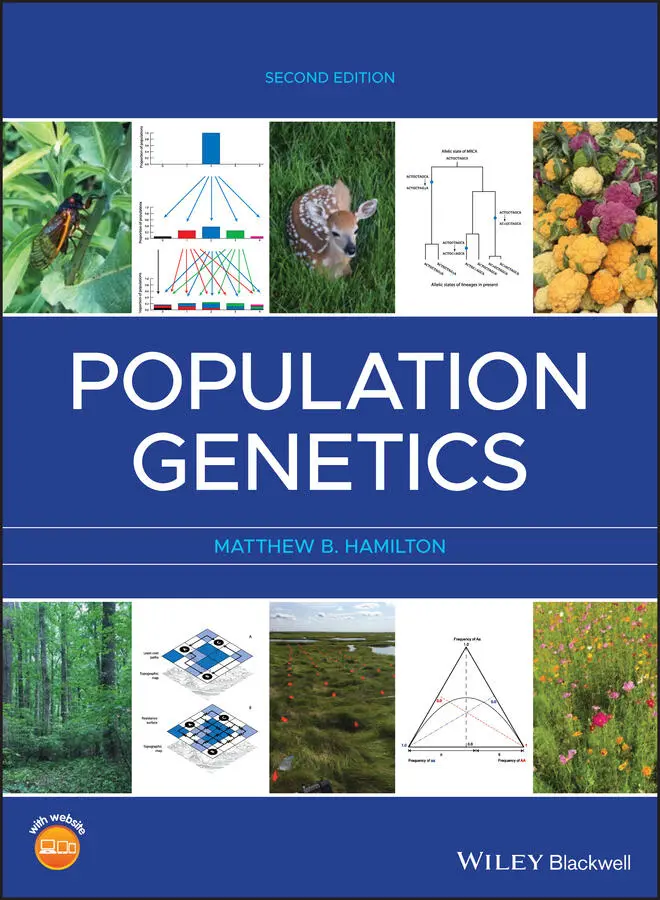
- Название:Population Genetics
- Автор:
- Жанр:
- Год:неизвестен
- ISBN:нет данных
- Рейтинг книги:4 / 5. Голосов: 1
-
Избранное:Добавить в избранное
- Отзывы:
-
Ваша оценка:
Population Genetics: краткое содержание, описание и аннотация
Предлагаем к чтению аннотацию, описание, краткое содержание или предисловие (зависит от того, что написал сам автор книги «Population Genetics»). Если вы не нашли необходимую информацию о книге — напишите в комментариях, мы постараемся отыскать её.
is the classic, accessible introduction to the concepts of population genetics. Combining traditional conceptual approaches with classical hypotheses and debates, the book equips students to understand a wide array of empirical studies that are based on the first principles of population genetics.
Featuring a highly accessible introduction to coalescent theory, as well as covering the major conceptual advances in population genetics of the last two decades, the second edition now also includes end of chapter problem sets and revised coverage of recombination in the coalescent model, metapopulation extinction and recolonization, and the fixation index.
Population Genetics — читать онлайн ознакомительный отрывок
Ниже представлен текст книги, разбитый по страницам. Система сохранения места последней прочитанной страницы, позволяет с удобством читать онлайн бесплатно книгу «Population Genetics», без необходимости каждый раз заново искать на чём Вы остановились. Поставьте закладку, и сможете в любой момент перейти на страницу, на которой закончили чтение.
Интервал:
Закладка:
| Parental mating | Expected frequency of mating | Frequency of gametes in next generation | |||
|---|---|---|---|---|---|
| A 1B 1 | A 2B 2 | A 1B 2 | A 2B 1 | ||
| A 1B 1/A 1B 1 | ( p 1 q 1) 2 | ( p 1 q 1) 2 | |||
| A 2B 2/ A 2B 2 | ( p 2 q 2) 2 | ( p 2 q 2) 2 | |||
| A 1B 1/ A 1B 2 | 2( p 1 q 1)( p 1 q 2) | ( p 1 q 1)( p 1 q 2) | ( p 1 q 1)( p 1 q 2) | ||
| A 1B 1/ A 2B 1 | 2( p 1 q 1)( p 2 q 1) | ( p 1 q 1)( p 2 q 1) | ( p 1 q 1)( p 2 q 1) | ||
| A 2B 2/ A 1B 2 | 2( p 2 q 2)( p 1 q 2) | ( p 2 q 2)( p 1 q 2) | ( p 2 q 2)( p 1 q 2) | ||
| A 2B 2/ A 2B 1 | 2( p 2 q 2)( p 2 q 1) | ( p 2 q 2)( p 2 q 1) | ( p 2 q 2)( p 2 q 1) | ||
| A 1B 2/ A 1B 2 | ( p 1 q 2) 2 | ( p 1 q 2) 2 | |||
| A 2B 1/ A 2B 1 | ( p 2 q 1) 2 | (p 2q 1) 2 | |||
| A 2B 2/ A 1B 1 | 2( p 2 q 2)( p 1 q 1) | (1− c )( p 2 q 2)( p 1 q 1) | (1− c )( p 2 q 2)( p 1 q 1) | c ( p 2 q 2)( p 1 q 1) | c ( p 2 q 2)( p 1 q 1) |
| A 1B 2/ A 2B 1 | 2( p 1 q 2)( p 2 q 1) | c ( p 1 q 2)( p 2 q 1) | c ( p 1 q 2)( p 2 q 1) | (1− c )( p 1 q 2)( p 2 q 1) | (1− c )( p 1 q 2)( p 2 q 1) |
We can relate two locus Hardy–Weinberg expected genotype frequencies to the recombination rate and two locus disequilibrium if we sum the columns to determine the expected gamete frequencies with the possibility of recombination. Focus on the column for the gamete A 1B 1. Summing the five terms in that column, we get
(2.34) 
And expanding the two terms on the right gives
(2.35) 
which can be rearranged by noticing the first four terms all contain g 11which can be factored out to give
(2.36) 
Recall that D = g 11 g 22− g 12 g 21and make the substitution to obtain
(2.37) 
Next, notice that ( g 11+ g 22+ g 21+ g 22) is the sum of all gamete frequencies and equals one. Making that substitution, we obtain
(2.38) 
This final result shows that gamete frequencies in the second generation are a function of the gamete frequency we expect from multiplying the respective allele frequencies, increased or decreased by the product of the recombination rate and the amount of two locus disequilibrium. The expected frequency of the A 1A 1B 1B 1genotype, for example, in the next generation is then ( g 11‐ cD ) 2, and it is not just a function of the product of the allele frequencies but also depends on the recombination rate and the amount of two locus disequilibrium. This is analogous to adjusting single locus H‐W expected genotype frequencies using F to account for one locus disequilibrium.
It is helpful to keep in mind that the term linkage disequilibriumis widely employed in the literature and has deep historic roots (e.g. Lewontin 1964), even though it is an imprecise label that confounds a pattern (two locus haplotypes or genotypes departing from the frequencies expected by the product of frequencies of alleles) and a process. Linkage disequilibrium is a misnomer since physical linkage only dictates the rate at which allelic combinations approach independent assortment or equilibrium. Processes other than linkage are responsible for the production of deviations from independent assortment of alleles at multiple loci in gametes. Using terms like gametic disequilibrium or two‐locus disequilibrium reminds us that the deviation from random association of alleles at two loci is a pattern seen in gametes or haplotypes. Although linkage can certainly contribute to this pattern, so can many other population genetic processes. It is likely that several processes operating simultaneously produce the two‐locus disequilibrium observed in any population, as illustrated by the pie chart in Figure 2.20.
Gametic disequilibrium is a central concept in formulating predictions for multiple locus genotype and haplotype frequencies in populations. Observations of the amount of gametic disequilibrium present in populations can then be used to identify the fundamental population genetic processes operating in populations. Thus, gametic disequilibrium forms the basis for a wide range of hypotheses to explain multiple locus genotype and haplotype frequencies, with gametic equilibrium or Mendel's second law serving as the null hypothesis. The numerous processes that maintain or increase gametic disequilibrium include those discussed in more detail the following sections.
Physical linkage
Linkage is the physical association of loci on a chromosome that causes alleles at the loci to be inherited in their original combinations. This association of alleles at loci on the same chromosome is broken down by crossing over and recombination. The probability that a recombination event occurs between two loci is a function of the distance along the chromosome between two loci. Loci that are very far apart (or on separate chromosomes) have recombination rates approaching 50% and are said to be unlinked. Loci located very near each other on the same chromosome might have recombination rates of 5 or 1% and would be described as tightly linked. Therefore, the degree of physical linkage of loci dictates the recombination rate and thereby the decay of gametic disequilibrium. Genome locations are often mapped in terms of their recombination frequencies with the measure centimorgan(abbreviated cM) or map unit(m.u.) where 1 cM is equivalent to a 1% recombination rate under a model that corrects for multiple crossovers called Haldane's map function (see Casares 2007).
Читать дальшеИнтервал:
Закладка:
Похожие книги на «Population Genetics»
Представляем Вашему вниманию похожие книги на «Population Genetics» списком для выбора. Мы отобрали схожую по названию и смыслу литературу в надежде предоставить читателям больше вариантов отыскать новые, интересные, ещё непрочитанные произведения.









Обсуждение, отзывы о книге «Population Genetics» и просто собственные мнения читателей. Оставьте ваши комментарии, напишите, что Вы думаете о произведении, его смысле или главных героях. Укажите что конкретно понравилось, а что нет, и почему Вы так считаете.