Matthew B. Hamilton - Population Genetics
Здесь есть возможность читать онлайн «Matthew B. Hamilton - Population Genetics» — ознакомительный отрывок электронной книги совершенно бесплатно, а после прочтения отрывка купить полную версию. В некоторых случаях можно слушать аудио, скачать через торрент в формате fb2 и присутствует краткое содержание. Жанр: unrecognised, на английском языке. Описание произведения, (предисловие) а так же отзывы посетителей доступны на портале библиотеки ЛибКат.
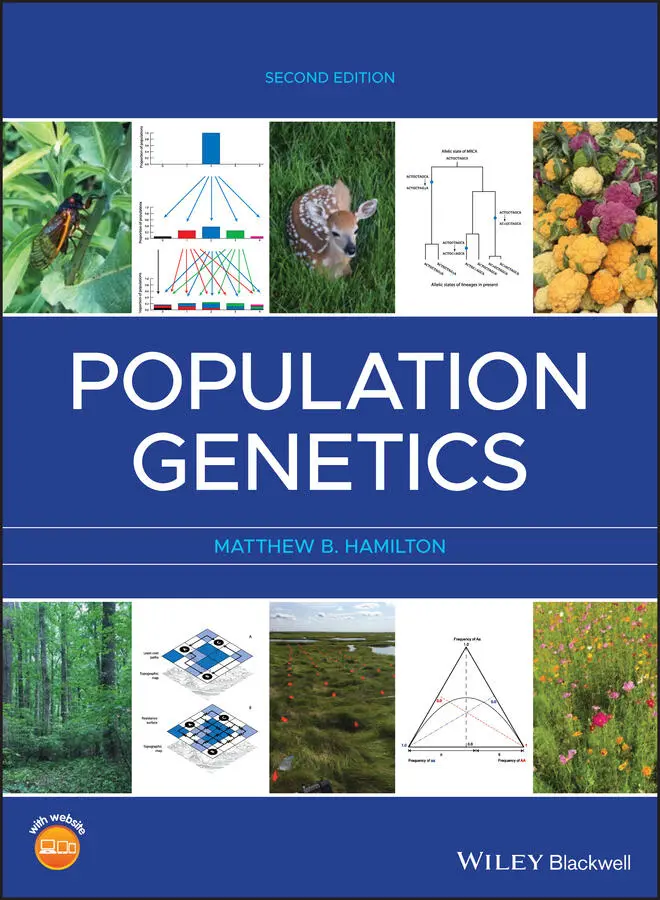
- Название:Population Genetics
- Автор:
- Жанр:
- Год:неизвестен
- ISBN:нет данных
- Рейтинг книги:4 / 5. Голосов: 1
-
Избранное:Добавить в избранное
- Отзывы:
-
Ваша оценка:
Population Genetics: краткое содержание, описание и аннотация
Предлагаем к чтению аннотацию, описание, краткое содержание или предисловие (зависит от того, что написал сам автор книги «Population Genetics»). Если вы не нашли необходимую информацию о книге — напишите в комментариях, мы постараемся отыскать её.
is the classic, accessible introduction to the concepts of population genetics. Combining traditional conceptual approaches with classical hypotheses and debates, the book equips students to understand a wide array of empirical studies that are based on the first principles of population genetics.
Featuring a highly accessible introduction to coalescent theory, as well as covering the major conceptual advances in population genetics of the last two decades, the second edition now also includes end of chapter problem sets and revised coverage of recombination in the coalescent model, metapopulation extinction and recolonization, and the fixation index.
Population Genetics — читать онлайн ознакомительный отрывок
Ниже представлен текст книги, разбитый по страницам. Система сохранения места последней прочитанной страницы, позволяет с удобством читать онлайн бесплатно книгу «Population Genetics», без необходимости каждый раз заново искать на чём Вы остановились. Поставьте закладку, и сможете в любой момент перейти на страницу, на которой закончили чтение.
Интервал:
Закладка:

Figure 2.18 A schematic diagram of the process of recombination between two loci, A and B. Two double‐stranded chromosomes (drawn in color and gray) exchange strands and form a Holliday structure. The cross over event can resolve into either of two recombinant chromosomes that generate new combinations of alleles at the two loci. The chance of a cross over event occurring generally increases as the distance between loci increases. Two loci are independent when the probability of recombination and non‐recombination are both equal to ½. Gene conversion, a double cross over event without exchange of flanking strands, is not shown.
Linkage of loci has the potential to impact multilocus genotype frequencies and violate Mendel's law of independent segregation, which assumes the absence of linkage. To generalize expectations for genotype frequencies for two (or more) loci requires a model that accounts explicitly for linkage by including the rate of recombination between loci. The effects of linkage and recombination are important determinants of whether or not expected genotype frequencies under independent segregation of two loci (Mendel's second law) are met. Autosomal linkage is the general case that will be used to develop expectations for genotype frequencies under linkage.
The frequency of a two‐locus gamete haplotype will depend on two factors: (i) allele frequencies and (ii) the amount of recombination between the two loci. We can begin to construct a model based on the recombination rate by asking what gametes are generated by the genotype A 1A 2B 1B 2. Throughout this section, loci are indicated by the letters, alleles at the loci by the numerical subscripts, and allele frequencies by p 1and p 2for locus A and q 1and q 2for locus B. The problem is easier to conceptualize if we draw the two‐locus genotype as being on two lines akin to chromosomal strands
| A 1 | B 1 |
| A 2 | B 2 |
This shows a genotype as two haplotypes and reveals phaseor the sets of alleles packaged together on the same chromosomal strand (in contrast to writing the genotype as A 1A 2B 1B 2where phase would be unknown). Given this physical arrangement of the two loci, what are the gametes produced during meiosis with and without recombination events?
| A 1B 1and A 2B 2 | “Coupling” gametes: alleles on the same chromosome remain together (a term coined by Bateson and Punnett). |
| A 1B 2and A 2B 1 | “Repulsion” gametes: alleles on the same chromosome seem repulsed by each other and pair with alleles on the opposite strand (a term coined by Thomas Morgan Hunt). |
The recombination fraction, symbolized as c (or sometimes r ), refers to the total frequency of gametes resulting from recombination events between two loci. Using c to express an arbitrary recombination fraction, let's build an expectation for the frequency of coupling and repulsion gametes. If c is the rate of recombination, then 1 − c is the rate of non‐recombination since the frequency of all gametes is 1, or 100%. Within each of these two categories of gametes (coupling and repulsion), two types of gametes are produced so the frequency of each gamete type is half that of the total frequency for the gamete category. We can also determine the expected frequencies of each gamete under random association of the alleles at the two loci based on Mendel's law of independent segregation.
| Gamete | Frequency | ||
| Expected | Observed | ||
| A 1B 1 | p 1 q 1 | g 11= (1 − c )/2 | 1 − c is the frequency of all coupling gametes. |
| A 2B 2 | p 2 q 2 | g 22= (1 − c )/2 | |
| A 1B 2 | p 1 q 2 | g 12= c /2 | c is the frequency of all recombinant gametes. |
| A 2B 1 | p 2 q 1 | g 21= c /2 |
The recombination fraction, c , can be thought of as the probability that a recombination event will occur between two loci. With independent assortment, the coupling and repulsion gametes are in equal frequencies and c equals ½ (like the chances of getting heads when flipping a coin). Values of c less than ½ indicate that recombination is less likely than non‐recombination, so coupling gametes are more frequent. Values of c greater than ½ are possible and would indicate that recombinant gametes are more frequent than non‐recombinant gametes (although such a pattern would likely be due to a process such as natural selection eliminating coupling gametes from the population rather than recombination exclusively).
We can utilize observed gamete frequencies to develop a measure of the degree to which alleles are associated within gamete haplotypes. This quantity is called the gametic disequilibrium(or sometimes linkage disequilibrium) parameterand can be expressed by:
(2.27) 
where g xystands for a gamete frequency. D is the difference between the product of the coupling gamete frequencies and the product of the repulsion gamete frequencies. This makes intuitive sense: with independent assortment, the frequencies of the coupling and repulsion gamete types are identical and cancel out to give D = 0, or gametic equilibrium. Another way to think of the gametic disequilibrium parameter is as a measure of the difference between observed and expected gamete frequencies: g 11= p 1 q 1+ D , g 22= p 2 q 2+ D , g 12= p 1 q 2– D , and g 21= p 2 q 1– D (note that observed and expected gamete frequencies cannot be negative). In this sense, D measures the deviation of gamete frequencies from what is expected under independent assortment. Since D can be either positive or negative, both coupling and repulsion gametes can be in excess or deficit relative to the expectations of independent assortment.
Different estimators of gametic disequilibrium have different strengths and weaknesses (see Hedrick 1987; Flint‐Garcia et al. 2003). The discussion here will focus on the classical parameter and estimator D to develop the conceptual basis of measuring gametic disequilibrium and to understand the genetic processes that cause it.
Gametic disequilibrium: An excess or deficit or absence of all possible combinations of alleles at a pair of loci in a sample of gametes or haplotypes.
Linkage: Co‐inheritance of loci caused by physical location on the same chromosome.
Recombination fraction: The proportion of “repulsion” or recombinant gametes produced by a double heterozygote genotype each generation.
Now that we have developed an estimator of gametic disequilibrium, it can be used to understand how allelic association at two loci changes over time or its dynamic behavior. If a very large population without natural selection or mutation starts out with some level of gametic disequilibrium, what happens to D over time with recombination? Imagine a population with a given level of gametic disequilibrium at the present time ( D t = n). How much gametic disequilibrium was there a single generation before the present at generation n − 1? Recombination will produce c recombinant gametes each generation so that:
Читать дальшеИнтервал:
Закладка:
Похожие книги на «Population Genetics»
Представляем Вашему вниманию похожие книги на «Population Genetics» списком для выбора. Мы отобрали схожую по названию и смыслу литературу в надежде предоставить читателям больше вариантов отыскать новые, интересные, ещё непрочитанные произведения.








Обсуждение, отзывы о книге «Population Genetics» и просто собственные мнения читателей. Оставьте ваши комментарии, напишите, что Вы думаете о произведении, его смысле или главных героях. Укажите что конкретно понравилось, а что нет, и почему Вы так считаете.