border and bordering
Здесь есть возможность читать онлайн «border and bordering» — ознакомительный отрывок электронной книги совершенно бесплатно, а после прочтения отрывка купить полную версию. В некоторых случаях можно слушать аудио, скачать через торрент в формате fb2 и присутствует краткое содержание. Жанр: unrecognised, на английском языке. Описание произведения, (предисловие) а так же отзывы посетителей доступны на портале библиотеки ЛибКат.
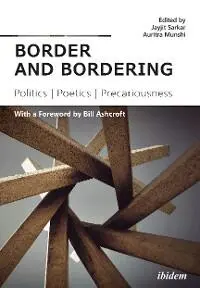
- Название:border and bordering
- Автор:
- Жанр:
- Год:неизвестен
- ISBN:нет данных
- Рейтинг книги:3 / 5. Голосов: 1
-
Избранное:Добавить в избранное
- Отзывы:
-
Ваша оценка:
border and bordering: краткое содержание, описание и аннотация
Предлагаем к чтению аннотацию, описание, краткое содержание или предисловие (зависит от того, что написал сам автор книги «border and bordering»). Если вы не нашли необходимую информацию о книге — напишите в комментариях, мы постараемся отыскать её.
border and bordering — читать онлайн ознакомительный отрывок
Ниже представлен текст книги, разбитый по страницам. Система сохранения места последней прочитанной страницы, позволяет с удобством читать онлайн бесплатно книгу «border and bordering», без необходимости каждый раз заново искать на чём Вы остановились. Поставьте закладку, и сможете в любой момент перейти на страницу, на которой закончили чтение.
Интервал:
Закладка:
ibidem-Press, Stuttgart
For all their permeability, the borders snaking across the world have never been of greater importance. This is the dance of history in our age: slow, slow, quick, quick, slow, back and forth and from side to side, we step across these fixed and shifting lines.
-Salman Rushdie
Contents
Foreword
Preface
Introduction
Contemporary Fiction as a Cultural Map of Migration
Statelessness and the Tensions between Open Borders and the Claims of Community
Rejection, Reconstruction and Erosion of Borders: The Identity Path of Grisélidis Réal
A Place Not Our Own: Gulf Emigration and Bordered Lives in Benyamin’s Jasmine Days
Challenges and Resistance to the Partition of Bengal: Impact of Baul and Marafati Oral Tradition
Bordering the Screen: Separation Themes in Popular Film and Television
Representation of Incarcerated Women in Orange is the New Black: An Intersectional Feminist Approach
Tracks and Borders: Railways in Ray’s Apu Trilogy
Oceanic Borders: Climate Refugees, Borders and Extinction in the Necrocene
Fuzzy (B)ordering: More than Human Agencies and the Ethics of (Dis)avowal
‘I alone . . . was on both sides’: The Hyphenated Self in Hélène Cixous’s Reveries of the Wild Woman
Borders in South Asia: Language, Culture and Religion from Colonialism to Globalization
Missing Links or the Diasporic Journey of a Rebel: A Study of H P Malet’s Lost Links in Indian Mutiny (1867)
Un-blinding Doctrine and Exiting ‘Molar Lines’ in Arnold’s The Scholar Gipsy
Reorganising (B)orders: Reading the Women’s Writing in Colonial Bengal
Erasing the Borders: Tagore’s Engagement with the Subalterns in Sahaj Path
Contributors
Foreword
The world has never been more mobile, more connected, never more characterised by the movement of refugees and asylum seekers and as nation states move hysterically to protect their borders from this mobile precariat, borders have become the most significant and most questioned phenomenon in the globalised world. So what would the world look like without borders? How might the utopian dream of a borderless world come about? Could rich nations open their borders with no regard for the control of migration? Could some nations and not others open their borders? These questions make us realise how recalcitrant borders are in political life. The ideology of the nation and the rigidity of its borders often preclude us thinking of any alternative. In the words of a US President who wants to build a wall along the Mexican border, “if you don’t have borders you don’t have a nation.” The apparent impossibility of a borderless world is due not only to the spectre raised by this mobility of people, but to the most destructive force of modern times, the force that keeps borders in place—nationalism. Nationalism is always complicated by ethnocentrism, racism and populism and as nationalism proliferates, violence increases.
Borders could only be dissolved if the distinction that holds them in place—between rich and poor nations, democratic and undemocratic, colonised and colonising, the nation and its others, us and them—was itself dissolved. In other words borders maintain the system of inequality without which modern global capitalism (and national antipathy) could not function. If rich nations opened their borders the poor would flood in putting untenable demands on resources. Like a racial melting pot “big enough to take the world and all it’s got” as the song goes, a borderless world might lead to equality, increase the wealth of the poor, and reduce the wealth of the wealthy. But at what level of economic and cultural security would it settle?
Borders exist because of fear and that fear is increasing. At the end of World War II, there were seven border walls or fences in the world. By the time the Berlin Wall fell in 1989, there were 15. Today, there are at least 77 walls or fences—half of which were erected since 2001. But the interesting thing about walls throughout history, the Great Wall of China, Hadrian’s Wall, the Berlin wall, is that they all eventually failed. While these contemporary boundary fences may be seen as a terrified response to the phenomenon of global mobility they may also be seen in a different way as a sign of the productive force of border crossers.
As Salman Rushdie says “The frontier is an elusive line, visible and invisible, physical and metaphorical, amoral and moral.” So there are many frontiers, many boundaries that we cross every day. But there is, of course, a deeply psychological dimension to boundaries: we understand who we are by determining who we are not. Our ‘others’ define us. Although borders go hand in hand with the emergence of nations they go deep into the history of Western modernity and its notions of space and time. Boundaries and ocularcentrism became inextricable in Western epistemology. As works in social theory, philosophy and human geography make abundantly clear western thinking proceeds according to the metaphors of visuality. The ocularcentrism of western thought is inseparable from the notion of boundaries.
The central issue of transnational/diasporic studies as many of the following essays reveal, is the crossing of borders, a crossing that leads to various kinds of conflicts and tensions. In Step Across This Line (2002), Salman Rushdie says: ‘Good writing assumes a frontierless nation. Writers who serve frontiers have become border guards.’ The literary accounts of journeys across national boundaries belong with these stories of the journey of becoming. “In our deepest natures,” says Rushdie, “we are frontier-crossing beings. We know this by the stories we tell ourselves; for we are story-telling animals, too.” (76)
What is a border? We tend to think of borders as geographical, as outlining territory, particularly the territory of a nation. The wall and the fence appear to embody them completely. But boundaries are profoundly ideological. A border is not a thing but a practice, a practice that produces power relationships, and establishes inequalities between those who are in and those who are not. Most importantly, perhaps, borders are synonymous with global capitalism and the precarity it constructs by constituting migrants as exploitable workers and individuals with low status and limited rights. Borders are both a consequence and a production of power relationships. And the process of othering on which they are based is fundamental to the fiction of identity produced within those borders. The practice of bordering answers that perennial question “Who are we?” How else can we discover who we are than by determining who is other? As Saussure made clear, signs signify not by referring but by their difference from other signs. How else can we discover who we are than by determining who is other than by establishing borders of difference? Bordering practices, whether carried out by the hegemonic activities of the state, or the cultural bordering that sets up borders of ethnicity, sexuality, class, satisfy the myriad ways in which subjects might determine their ‘others’. The scope and variety of theses bordering practices are explored in this volume.
Bill Ashcroft
Professor Emeritus
School of the Arts and Media
UNSW
Preface
The volume contains sixteen essays on various aspects of thinking border as well as border-thinking: as we find in literature, philosophy, historiography, strategic and area studies, film and TV series. Such diffusion and diversity only reinforce the idea that borders, and especially the more unfathomable bordering, are omnipresent in almost all discursive practices: be it in discourses which are considered “normative” and/or in the discourses which are now being called “precarious”. Border and bordering are forms of world-making. Border and bordering are knowledge and sites of knowledge production, at the same time. The phenomena have become so pivotal to our understanding of the contemporary world that these have ceased to remain mere an episteme and become a method in itself. The volume contains essays which are about these precarious entanglements between thinking border and border-thinking. The work is also aware of the fact that there is no water tight compartment and more often than not the poetics, politics and precarity leak into each other. The poetics of border and border in poetics are not free from the politics of border and border in politics, and vice-versa in every possible way. Precariousness, on the other hand, and especially the spectral aspects of precariousness haunt the poetics and politics of border and, in general, the ontology of any being (including the concept of nation-state) in a quite Freudian/Derridean way.
Читать дальшеИнтервал:
Закладка:
Похожие книги на «border and bordering»
Представляем Вашему вниманию похожие книги на «border and bordering» списком для выбора. Мы отобрали схожую по названию и смыслу литературу в надежде предоставить читателям больше вариантов отыскать новые, интересные, ещё непрочитанные произведения.







Обсуждение, отзывы о книге «border and bordering» и просто собственные мнения читателей. Оставьте ваши комментарии, напишите, что Вы думаете о произведении, его смысле или главных героях. Укажите что конкретно понравилось, а что нет, и почему Вы так считаете.