border and bordering
Здесь есть возможность читать онлайн «border and bordering» — ознакомительный отрывок электронной книги совершенно бесплатно, а после прочтения отрывка купить полную версию. В некоторых случаях можно слушать аудио, скачать через торрент в формате fb2 и присутствует краткое содержание. Жанр: unrecognised, на английском языке. Описание произведения, (предисловие) а так же отзывы посетителей доступны на портале библиотеки ЛибКат.
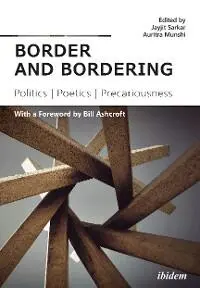
- Название:border and bordering
- Автор:
- Жанр:
- Год:неизвестен
- ISBN:нет данных
- Рейтинг книги:3 / 5. Голосов: 1
-
Избранное:Добавить в избранное
- Отзывы:
-
Ваша оценка:
border and bordering: краткое содержание, описание и аннотация
Предлагаем к чтению аннотацию, описание, краткое содержание или предисловие (зависит от того, что написал сам автор книги «border and bordering»). Если вы не нашли необходимую информацию о книге — напишите в комментариях, мы постараемся отыскать её.
border and bordering — читать онлайн ознакомительный отрывок
Ниже представлен текст книги, разбитый по страницам. Система сохранения места последней прочитанной страницы, позволяет с удобством читать онлайн бесплатно книгу «border and bordering», без необходимости каждый раз заново искать на чём Вы остановились. Поставьте закладку, и сможете в любой момент перейти на страницу, на которой закончили чтение.
Интервал:
Закладка:
The work, as the readers will find, postulates a different take on border and bordering: different from that of critical border studies with its rigorous methodologies. It deals with the lived experiences—both epic and banal—at the borders. It is precisely for this reason that we have incorporated the word ‘bordering’ in the title itself as it signifies border as a ‘becoming’ or simply, a process. Bordering is spacing and timing. There is a sense of ‘world-making’ in bordering. Border makes and unmakes itself through bordering. The volume also makes an effort in this direction by trying to understand this making and unmaking of borders with the help of phenomena like bordering, debordering and rebordering. We have tried to capture all the three aspects of border(ing) here: the creative aspect (poetics), the debilitating aspect (politics) and the more perplexing, precariousness. The perspectives in the volume are different from the perspective of traditional methodological schemes of social sciences. Though not completely denying the former’s merit, the volume takes a different path altogether. For example, we have given equal importance to popular culture which for a long time traditional social sciences have ignored. Our take on border and bordering is more credible, grounded, and close to the lived realities of the time. Unlike other works which tend to overemphasize the abstract academic discourses and almost ruthless methodologies, free from the experiences at ground zero. It is indeed difficult to intellectualize through the prevalent methods of critical border studies of how the same border could entail two completely disparate experiences: the photograph of the bodies of a father and his daughter lying upside down on the banks of the Rio Grande near Matamoros, Mexico and the image of the children playing with the recently installed pink seesaws along the same metal walls.
The disparate chapters in the volume are symptomatic of the very interdisciplinarity of borders and the varied experiences of bordering as manifested in different modes of expression. This study of the multiplicity of experiences is intrinsic to our understanding of borders: so much so that the volume prescribes, that borders can only be read through an interdisciplinary approach. This interdisciplinarity is immanent to the concept of border and imminent (“to come”) to the phenomenon of bordering. Also, the volume quite explicitly deals with the metaphors of border or border as metaphor: as a border may not necessarily be always visible or tangible—that these can also be cognitive and metaphysical. The volume, therefore, intends to attract not only academicians but also common readers. This is the reason that it has been designed in such a way. Please note that this is not yet-another volume on critical border studies and area studies. In thinking border, we have moved beyond the boundaries of border studies and area studies—as we believe that nowadays ‘studies’ of border studies and area studies are as regimented as the borders of the nation-state.
Border and Bordering focuses on the idea of border and its various geopolitical, sociocultural and cognitive incarnations. In recent times, border has emerged as a common trope in contemporary narratives with concepts such as ‘bordering’, ‘borderless’, ‘building borders’, ‘breaking borders’, ‘crossing borders’, ‘porous borders’ and ‘shifting borders’. Whether concrete or shadow, borders are omnipresent. They have been frequently erected and decimated in history and will be in future depending upon the need of the hour. Such ‘needs’, as this series has highlighted, are always generated from the above, by the above. It seems social sciences and humanities are obsessed with borders and the latter have been invoked intermittently to prove a point and also the opposite: that is, to negate a point. Even in the daily humdrum of life, we never fail to feel the eerie presence or rather absent-presence of border. At times, it is WE who knowingly or unknowingly create these building blocks: brick after brick piled upon each other and cemented together, so that we can keep the ‘other’, the ‘stranger’, the ‘foreigner’ at bay. Borders are important in keeping “us” safe and feel secure from “them”. Borders are in the air we breathe. Is it possible then to do away with borders altogether? But before coming to that we need to posit another question: is it possible to do away with modernity? Because, as the work suggests, the birth of modernity is also the birth of the borders.
***
Modernity creates its own exceptions: spaces within a space, which, although counter-intuitive and counter-discursive to the project of modernity, are actually an integral part of the so-called project as anything else. Such spaces are deemed as “pre-modern” so that these can be claimed, shaped and with time subsumed under the category of the modern. These spaces are addressed as “alternative modernities” so that no matter what the narrative is, which is most often singular, modernity remains the protagonist. These are called “counter-modernities” so that the vantage point remains with that of modernity. Modernity includes; modernity excludes; but more importantly, modernity includes by excluding. The status quo of inclusion through exclusion is always meant to be partial inclusion and never complete; the realpolitik here is actually in this suspension and deferment. It includes the other by making it the ‘other’ in the first instance—modernity claims the other as other through the process of otherization; modernity also colonizes the other as other through the process of colonization. “The rhetoric of modernity”, as Walter Mignolo points out, “is that of salvation, whereas the logic of coloniality is a logic of imperial oppression. They go hand in hand, and you cannot have modernity without coloniality; the unfinished project of modernity carries over its shoulders the unfinished project of coloniality” (2006: 313). The other, thus, is suspended, entangled and eventually made a part of the habitat of the self: it can neither make itself completely free from the self nor is it allowed to become part of the self. Modernity is, at the same time, hospitable and hostile towards the other. Objects and beings, which in any case considered exotic and sacred implicitly, are made ‘exotic’ and ‘sacred’—the others of modernity—so much so that these ideas cease to exist altogether once modernity is bracketed out. The idea of the exotic and the idea of the sacred are among many such ideas which now cannot exist beyond the realm of modernity; the very meaning of the exotic and the sacred can now only be tweaked out of the dough of modernity. So, what remains at the end of the day are the pre-, the post-, the alternative, the sub-, and the counter- of that one all-encompassing “grand narrative” called modernity. The others of modernity are not modernity’s other, rather part of the same discursive practice.
Modernity, hence, is an end in itself. It does not lead to anywhere. It is a project, an ever unfinished project: a journey whose marked destination is also modernity. It is a project of domination and colonization, of mind and body, of physics and metaphysics, of existence and essence. Unlike the modern, which is ideationally static and sedentary, modernity is constantly on the move. Modern is being; modernity is being and becoming at the same time. While hinting at the aspect of stasis and kinesis, Dilip Gaonkar in his ‘On Alternative Modernities’ lists some of the unforgettable figures of modernity: Marx’s “revolutionary”, Baudelaire’s “dandy”, Nietzsche’s “superman”, Weber’s “social scientist”, Simmel’s “stranger”, Musil’s “man without qualities” and Benjamin’s “flaneur”, and points out how “each is caught and carried in the intoxicating rush of an epochal change and yet finds himself and formulated by a disciplinary system of social roles and functions” (1999: 3). Modernity, as many have pointed out, was a reaction to a very specific socio-cultural, geographical and historical event; but what happened eventually is, because of colonization and later globalization, that it has turned into a phenomenon which is regarded as transcendental and universal. Therefore, what was primarily conceived as and meant to be local has, because of certain definite turns in world history and politics, turned out to be universal. This is what we call dissemination of modernity which has led to the rise of, what is often quoted now as, global modernity. Our argument is: there is nothing which we can call and point out as global modernity but rather globalization of a certain set of local modernities, a set of narratives which are overtly and covertly white, west European, masculine, and Christian. Modernity is a milieu of these modernities or narratives, which are mostly provincial, and which are more often than not considered and hailed as transcendental and disembodied. It is incorrectly believed to be atemporal and aspatial in characteristics and in function. The here of modernity in such scenario becomes the everywhere and the now of modernity, the always. This is what we describe as ‘modernity-history singularity’: the point at which the history of human civilization and the historical development of modernity turned into one and the same thing. Our effort here would be to look for those openings and prospects where we could disentangle the latter from the former—where history and historiography cease to remain mere discourses of modernity and affirm agencies of their own.
Читать дальшеИнтервал:
Закладка:
Похожие книги на «border and bordering»
Представляем Вашему вниманию похожие книги на «border and bordering» списком для выбора. Мы отобрали схожую по названию и смыслу литературу в надежде предоставить читателям больше вариантов отыскать новые, интересные, ещё непрочитанные произведения.







Обсуждение, отзывы о книге «border and bordering» и просто собственные мнения читателей. Оставьте ваши комментарии, напишите, что Вы думаете о произведении, его смысле или главных героях. Укажите что конкретно понравилось, а что нет, и почему Вы так считаете.