border and bordering
Здесь есть возможность читать онлайн «border and bordering» — ознакомительный отрывок электронной книги совершенно бесплатно, а после прочтения отрывка купить полную версию. В некоторых случаях можно слушать аудио, скачать через торрент в формате fb2 и присутствует краткое содержание. Жанр: unrecognised, на английском языке. Описание произведения, (предисловие) а так же отзывы посетителей доступны на портале библиотеки ЛибКат.
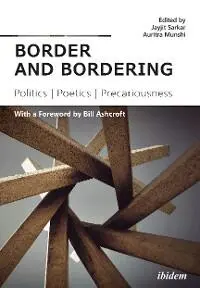
- Название:border and bordering
- Автор:
- Жанр:
- Год:неизвестен
- ISBN:нет данных
- Рейтинг книги:3 / 5. Голосов: 1
-
Избранное:Добавить в избранное
- Отзывы:
-
Ваша оценка:
border and bordering: краткое содержание, описание и аннотация
Предлагаем к чтению аннотацию, описание, краткое содержание или предисловие (зависит от того, что написал сам автор книги «border and bordering»). Если вы не нашли необходимую информацию о книге — напишите в комментариях, мы постараемся отыскать её.
border and bordering — читать онлайн ознакомительный отрывок
Ниже представлен текст книги, разбитый по страницам. Система сохранения места последней прочитанной страницы, позволяет с удобством читать онлайн бесплатно книгу «border and bordering», без необходимости каждый раз заново искать на чём Вы остановились. Поставьте закладку, и сможете в любой момент перейти на страницу, на которой закончили чтение.
Интервал:
Закладка:
This making and unmaking of borders would not have been possible without the support of the contributors from all over the world. It is mostly with their support and cooperation that we have been able to deliver a collection like this. We are grateful to Prof. Bill Ashcroft for writing a generous foreword for the volume. We thank Jakob Horstmann, the commissioning editor and the series editors of Beyond the Social Sciences: Michael Kuhn, Hebe Vessuri, and Shujiro Yazawa at ibidem for helping us to shape and materialize this project. We would also like to thank the members of the Department of English, Raiganj University for their help. We are also indebted to Prof. Himadri Lahiri, Prof. Pramod K. Nayar, Prof. Swatahsiddha Sarkar, Prof. Ranjan Ghosh, Prof. Nandana Dutta, Prof. Anindya Sekhar Purakayastha and Prof. Swargajyoti Gohainfor their constant support and encouragement. A section in the Introduction was published earlier in The Himalayan Miscellany: An Area Studies Journal in Social Sciences Vols. 28 & 29 (2017-18). We are especially thankful to the editor of the journal for allowing us to republish it. We are also grateful to our friend Jagannath Basu for his relentless assistance and vital suggestions. And, last but not the least, our respective friends and family members for being so considerate and for extending their support when needed.
Jayjit Sarkar
Auritra Munshi
Raiganj University
March 18, 2020
Introduction
I’ve been a crime reporter for many years, and I’ve seen a lot of bodies—and a lot of drowning…. You get numb to it, but when you see something like this it re-sensitizes you. You could see that the father had put her inside his T-shirt so the current wouldn’t pull her away.
He died trying to save his daughter’s life.
Will it change anything? It should. These families have nothing, and they are risking everything for a better life. If scenes like this don’t make us think again—if they don’t move our decision-makers—then our society is in a bad way.
Julia Le Duc to The Guardian (Wednesday, 28 June 2019)
One of the most incredible experiences of my and @vasfsf‘s career bringing to life the conceptual drawings of the Teetertotter Wall from 2009 in an event filled with joy, excitement, and togetherness at the borderwall. The wall became a literal fulcrum for U.S.—Mexico relations and children and adults were connected in meaningful ways on both sides with the recognition that the actions that take place on one side have a direct consequence on the other side. Amazing thanks to everyone who made this event possible like Omar Rios @colectivo.chopekefor collaborating with us, the guys at Taller Herrería in #CiudadJuarezfor their fine craftsmanship, @anateresafernandezfor encouragement and support, and everyone who showed up on both sides including the beautiful families from Colonia Anapra, and
@kerrydoyle2010, @kateggreen, @ersela_kripa, @stphn_mllr, @wakawaffles, @chris_inaboxand many others (you know who you are).
#raelsanfratello #borderwallasarchitecture #teetertotterwall #seesaw #subibaja
Ronald Rael [@rrael] (2019, July 29)
The first epigraph is an excerpt from an interview given by Julia Le Duc, the Mexican photojournalist, to The Guardian after she took the now-famous photograph of the bodies of a father and his daughter lying upside down on the banks of the Rio Grande near Matamoros, Mexico. The father, Oscar Alberto Ramirez, 23, and the daughter, Valerie, barely 2, drowned while crossing the US-Mexico border. This haunting image of the young girl tucked inside her father’s shirt as they both lie flat face down took the world by storm, created ripples around and quite naturally brought Julia Le Duc all of a sudden to the limelight. The photograph reminded us of how the borders have become ‘lines of death’, and of how brutal the borders are. The perils of international migration and at the same time the sheer desperation of the migrants in crossing the border into the Promised Land in search of better economic opportunities and a better life are some of the glaring aspects of contemporary politics, which this photograph highlights. The photograph also brought back the unsettling memories of little Aylan, the three year old Syrian boy, who got drowned and whose body washed up to the shores of the Mediterranean. Contemporary politics is increasingly becoming border politics as it is being performed on a daily basis at the borders. Border penetration and border management has turned into an everyday reality nowadays. The family of three, escaped from El Salvador, undertook a long journey, crossed borders, took desperate measures, and finally succumbed to the pressures of stringent immigration laws and border surveillance technologies. Such laws and technologies are often overtly hostile and violent to the immigrants and asylum seekers: the dehumanized ‘others’ of any modern nation-state. The large scale performance of violence at the international border is now quite rampant these days: an unprecedented phenomenon in the history of human civilization.
The second epigraph is the Instagram post of Ronald Rael, Professor of Architecture at the University of California, Berkeley who along with Virginia San Fratello, Associate Professor of Interior Design at San Jose University, installed pink seesaws along the metal walls between the El Paso in Texas, the United States and Ciudad Juarez, Mexico. The installation of the seesaws, and that too pink seesaws (#universal love #friendship #affection), transformed for that moment the otherwise extremely serious and contentious US-Mexico border into something ‘kitschy’. The same border which saw the young Salvadorian family falling prey to its violent politics just a few months before transformed in this case into an objet d’art. This act of children coming from both sides of the border and playing together suspended momentarily, through its poetics, the immanent violence and hostility amongst the citizens on both the sides. The wall, as Rael himself points out through his post, became “a literal fulcrum” for US-Mexico relations: an embodiment of connection, hospitality and altruism. This performance filled with “joy, excitement, and togetherness” was certainly not an act of undermining the realpolitik: at the cost of any one of those ground realities of the immigrants. Instead, it transcended momentarily the boundaries of conventional politics—an act where a border frees itself from the politics of bordering, an act where a border ceases to remain a boundary and becomes a bridge, and consequently subverting the idea of ‘good fences make good neighbours’ into ‘good seesaws make good neighbours’.
We are frontier-making and frontier-crossing beings: we make, break, cross, remake, break again and cross again the borders of the land and of the mind. Borders are equivocal. Borders limit, borders connect, but more importantly borders are omnipresent. Borders exist in the way we perceive the world, and there is an inherent politics as well as poetics in the manner a border exists. Border-politics and border-poetics are immanent to the way we understand border and its various incarnations. We all are in that way connected and disconnected. This (dis)connection may be based on causality or acausality or even complicated causality but the fact of the matter remains that we are all (dis)connected; and as Professor Rael attempts to make us realize how the actions that take place on one side have a direct consequence on the other.
A border is not always a signifier of transcendental nihilism, rather, as Derrida understood, thinking and (de)creating at the threshold. It is not a telos or the Ultimate but a crossing over—keeping up strategically the possibility of overstepping, trespassing and transgression alive. Derrida, while referring to Seneca, writes: “… the border (finis)… would be more essential, more originary, and more proper than those of any other territory in the world” (1993: 3). A border is not the end but by the end. There is always a sense of possibility at the border. Border is death, in the Derridean sense. The French word for death, trépas, entails both passage and trespass at the same time.
Читать дальшеИнтервал:
Закладка:
Похожие книги на «border and bordering»
Представляем Вашему вниманию похожие книги на «border and bordering» списком для выбора. Мы отобрали схожую по названию и смыслу литературу в надежде предоставить читателям больше вариантов отыскать новые, интересные, ещё непрочитанные произведения.






Обсуждение, отзывы о книге «border and bordering» и просто собственные мнения читателей. Оставьте ваши комментарии, напишите, что Вы думаете о произведении, его смысле или главных героях. Укажите что конкретно понравилось, а что нет, и почему Вы так считаете.