border and bordering
Здесь есть возможность читать онлайн «border and bordering» — ознакомительный отрывок электронной книги совершенно бесплатно, а после прочтения отрывка купить полную версию. В некоторых случаях можно слушать аудио, скачать через торрент в формате fb2 и присутствует краткое содержание. Жанр: unrecognised, на английском языке. Описание произведения, (предисловие) а так же отзывы посетителей доступны на портале библиотеки ЛибКат.
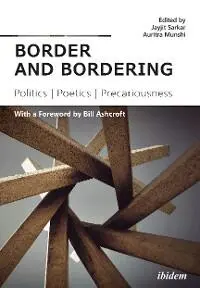
- Название:border and bordering
- Автор:
- Жанр:
- Год:неизвестен
- ISBN:нет данных
- Рейтинг книги:3 / 5. Голосов: 1
-
Избранное:Добавить в избранное
- Отзывы:
-
Ваша оценка:
border and bordering: краткое содержание, описание и аннотация
Предлагаем к чтению аннотацию, описание, краткое содержание или предисловие (зависит от того, что написал сам автор книги «border and bordering»). Если вы не нашли необходимую информацию о книге — напишите в комментариях, мы постараемся отыскать её.
border and bordering — читать онлайн ознакомительный отрывок
Ниже представлен текст книги, разбитый по страницам. Система сохранения места последней прочитанной страницы, позволяет с удобством читать онлайн бесплатно книгу «border and bordering», без необходимости каждый раз заново искать на чём Вы остановились. Поставьте закладку, и сможете в любой момент перейти на страницу, на которой закончили чтение.
Интервал:
Закладка:
But unlike politics where borderlands are conceived as spaces of fear and anxiety—as xenophobic and agoraphobic spaces; in poetics and aesthetics borderlands are celebrated as creative and ingenious spaces. The incessant tension between this side of the border and that side, which is often regarded as a problem in politics, becomes an important precondition in art and literature. The “other” is an important category in both politics and poetics so much so that one cannot do either of them without it. While in the former the other is envisaged with a lot of suspiciousness and as a threat to the self, in the latter, the other is instrumental in opening up a plethora of new possibilities. It is not through politics but through art and literature that the other speaks. Doing art and literature is one of the modes of conversation with the other. They serve as an important vantage point from and through which the other can speak to the self; as opposed to politics which is generally a monologue of the self. So, in order to understand borderland modernity, and concomitantly borderland, which is often conceived of as ambiguous and perplexing, borderland poetics can serve as a better means than borderland politics. Borderland poetics, as opposed to borderland politics, refuses to see borderland as a mere flat topography. The crests and troughs of the thousand plateaus of borderland can only justifiably be observed through its poetics.
It must be understood here that we are, without doubt, not promulgating a strict binary understanding of poetics and politics. There is a certain amount of politics in poetics; and poetics on the other hand, has its own share of politics. But what is different here is the sense of alterity: compared to politics which is most of the time hostile towards the other, poetics thrives upon its hospitality towards the same. This does not mean a complete surrender, rather a tensional space of collaborations, convergences and contestations which is “neither the site of assimilation nor the making of an alien Other” (Singh and Schmidt, 2000: 6). The other is welcomed and made part of the “habitus” (see also Bourdieu, 1977) in poetics as opposed to the “will to power” in politics (see also Nietzsche, 1968). One must also note here that our understanding of borderland poetics is more in the vein of inherent poetics of the space and certainly not a perspective from the outside: the innate poetics which flows out of the lived-experience of being and becoming borderland. The poetics of and on borderland has always been dictated by these perspectives from the outside (of borderland) which are overwhelmingly and unapologetically centrist and mainland-ish. Our understanding of borderland poetics is rather more in the sense of borderland-poetics: which is less observational and more enlivened, a poetics which comes through and from borderland. This is the kind of poetics which makes possible for us for clearer ways of understanding borderland modernity which has its own share of complexities, different from that of mainland modernity. What Mary Louis Pratt proclaims in her formulation of “contact zone”, especially the literary part, can also very well be appropriated here in our understanding of borderland poetics:
Auto-ethnography, transculturation, critique, collaboration, bilingualism, meditation, parody, denunciation, imaginary dialogue, vernacular expression—these are some of the literate arts of the contact zone. Miscomprehension, incomprehension, dead letters, unread masterpieces, absolute heterogeneity of meaning—these are some of the perils of writing in the contact zone. (1999: 373)
***
Maps shape our view of the world and mirror our cultures. They can chart us at the centre of the universe or make us disappear. Just as a writer may be described as a cartographer, a novel may be described as a map. Liminal spaces act as moments of interaction between the people and cultures of the world while at the same time performing an act of transition within the self. As the traveler leaves his or her place of origin he/she steps into the role of the other through both an internal and external process. Such moments are imagined and documented in literature. In the opening chapter, Emma Musty discusses the fractured lines and interspaces, the borderlands and borderlines depicted in two recent literary works, Signs Preceding the End of the World, by Yuri Herrera and The Gurugu Pledge, by Juan Tomás Ávila Laurel, two novels which are representative of a new trend in migration literature that reflects our atomised societies. The maps created by contemporary fiction are important interrogators of existing ideas of identity and culture in this time of globalization and migration. Driving the need for critical reflection on these cultural artefacts, which not only record the times we live in, but frame the questions we ask about our increasingly diverse and transient cultures.
In Chapter 2, Nicoletta Policek articulates a commitment to open borders which is compatible with a deep appreciation for the value of community and the importance of belonging as experienced by stateless children. Human beings need geographic ties to a physical dwelling, but also, and perhaps more importantly, they need spiritual ties to particular traditions, habits and practices that make up their sense of belonging. They also need legal ties which manifest in rights that come with nationality. This contribution calls for the need to deconstruct the importance of borders, to have margins without living at the margins, to claim citizenship and community for those who would be otherwise considered as redundant surplus.
In Chapter 3, Salvatore Perri has analysed the autobiographical writings of Grisélidis Réal (1929-2005), Swiss writer, painter and prostitute. The principal aim of his survey has been that of tracing the identity reappropriation path that has marked the life and, subsequently, the artistic expressions of the author. Starting with the principal instance in which Réal herself saw the matrix of the difficulties felt in recognizing her own physical and emotional individuality—namely the rigid interdiction toward sexuality imposed by her mother—he has identified and described the emergence of a complex and protean strategy of self-construction and affirmation, centred on the revindication of control over her own corporality and sexuality. In his study, Perri has largely analysed this gradual, and also violent, process of emancipation from a system of physical and psychological auscultation and sanction, that he has reconnected to the idea of ceremonial punishment theorized by Michel Foucault in Discipline and Punish. He has subsequently pointed out that, in order to release herself from the “cage” she felt to be trapped in, Grisélidis Réal has performed a concrete (and also textual) rejection of her social status (she was born in the cultivate and wealthy milieu of Swiss middle-class) and of all the moral values that characterized it, allocating her emotional and bodily self into the domain of abjection. Thus, Grisélidis Réal has conceived of herself—on the ashes of the renegade “native one”—a large and controversial axiological system, in which body and writing constitute a powerful device of intimate (and political) claim. The “Abject”, majorly represented by a borderless and feral idea of reality and a fetishized inclination for black men, is the antagonistic tool that the author has used to subvert the “white”, catholic and obscurantist narrative absorbed in the Swiss native context. The strategy of self affirmation of Grisélidis Réal, then, culminated in over thirty years of sex work, assumed as an act of self-determination that deserves social recognition and respect and, in the specific picture of Réal’s life and self-narration, as the ultimate way to be the “maîtresse” of a body on which, for years, a confining system of symbols had been engraved.
Читать дальшеИнтервал:
Закладка:
Похожие книги на «border and bordering»
Представляем Вашему вниманию похожие книги на «border and bordering» списком для выбора. Мы отобрали схожую по названию и смыслу литературу в надежде предоставить читателям больше вариантов отыскать новые, интересные, ещё непрочитанные произведения.







Обсуждение, отзывы о книге «border and bordering» и просто собственные мнения читателей. Оставьте ваши комментарии, напишите, что Вы думаете о произведении, его смысле или главных героях. Укажите что конкретно понравилось, а что нет, и почему Вы так считаете.