Douglas C. Montgomery - Introduction to Linear Regression Analysis
Здесь есть возможность читать онлайн «Douglas C. Montgomery - Introduction to Linear Regression Analysis» — ознакомительный отрывок электронной книги совершенно бесплатно, а после прочтения отрывка купить полную версию. В некоторых случаях можно слушать аудио, скачать через торрент в формате fb2 и присутствует краткое содержание. Жанр: unrecognised, на английском языке. Описание произведения, (предисловие) а так же отзывы посетителей доступны на портале библиотеки ЛибКат.
- Название:Introduction to Linear Regression Analysis
- Автор:
- Жанр:
- Год:неизвестен
- ISBN:нет данных
- Рейтинг книги:4 / 5. Голосов: 1
-
Избранное:Добавить в избранное
- Отзывы:
-
Ваша оценка:
Introduction to Linear Regression Analysis: краткое содержание, описание и аннотация
Предлагаем к чтению аннотацию, описание, краткое содержание или предисловие (зависит от того, что написал сам автор книги «Introduction to Linear Regression Analysis»). Если вы не нашли необходимую информацию о книге — напишите в комментариях, мы постараемся отыскать её.
New exercises and data sets New material on generalized regression techniques The inclusion of JMP software in key areas Carefully condensing the text where possible
skillfully blends theory and application in both the conventional and less common uses of regression analysis in today's cutting-edge scientific research. The text equips readers to understand the basic principles needed to apply regression model-building techniques in various fields of study, including engineering, management, and the health sciences.
Introduction to Linear Regression Analysis — читать онлайн ознакомительный отрывок
Ниже представлен текст книги, разбитый по страницам. Система сохранения места последней прочитанной страницы, позволяет с удобством читать онлайн бесплатно книгу «Introduction to Linear Regression Analysis», без необходимости каждый раз заново искать на чём Вы остановились. Поставьте закладку, и сможете в любой момент перейти на страницу, на которой закончили чтение.
Интервал:
Закладка:
(2.16) 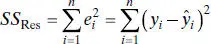
A convenient computing formula for SS Resmay be found by substituting  into Eq. (2.16)and simplifying, yielding
(2.17) 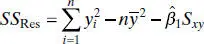
But

is just the corrected sum of squares of the response observations, so
(2.18) 
The residual sum of squares has n − 2 degrees of freedom, because two degrees of freedom are associated with the estimates  and
and  involved in obtaining
  . Section C.3shows that the expected value of SS Resis E ( SS Res) = ( n − 2) σ 2, so an unbiased estimator of σ2is
(2.19) 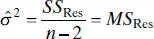
The quantity MS Resis called the residual mean square. The square root of  is sometimes called the standard error of regression, and it has the same units as the response variable y .
Because  depends on the residual sum of squares, any violation of the assumptions on the model errors or any misspecification of the model form may seriously damage the usefulness of
  as an estimate of σ 2. Because
  is computed from the regression model residuals, we say that it is a model-dependentestimate of σ 2.
Example 2.2 The Rocket Propellant Data
To estimate σ 2for the rocket propellant data in Example 2.1, first find
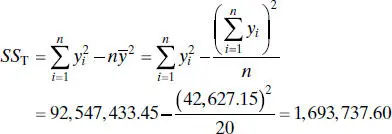
From Eq. (2.18)the residual sum of squares is

Therefore, the estimate of σ 2is computed from Eq. (2.19)as

Remember that this estimate of σ 2is model dependent. Note that this differs slightly from the value given in the Minitab output (Table 2.3) because of rounding.
2.2.4 Alternate Form of the Model
There is an alternate form of the simple linear regression model that is occasionally useful. Suppose that we redefine the regressor variable xi as the deviation from its own average, say  . The regression model then becomes
(2.20) 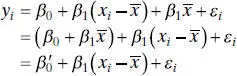
Note that redefining the regressor variable in Eq. (2.20)has shifted the origin of the x ’s from zero to  . In order to keep the fitted values the same in both the original and transformed models, it is necessary to modify the original intercept. The relationship between the original and transformed intercept is
(2.21) 
It is easy to show that the least-squares estimator of the transformed intercept is  . The estimator of the slope is unaffected by the transformation. This alternate form of the model has some advantages. First, the least-squares estimators
  and
and  are uncorrelated, that is,
 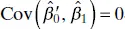 . This will make some applications of the model easier, such as finding confidence intervals on the mean of y (see Section 2.4.2). Finally, the fitted model is
(2.22) 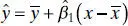
Although Eqs. (2.22)and (2.8)are equivalent (they both produce the same value of  for the same value of x ), Eq. (2.22)directly reminds the analyst that the regression model is only valid over the range of x in the original data. This region is centered at
  .
.
2.3 HYPOTHESIS TESTING ON THE SLOPE AND INTERCEPT
We are often interested in testing hypotheses and constructing confidence intervals about the model parameters. Hypothesis testing is discussed in this section, and Section 2.4deals with confidence intervals. These procedures require that we make the additional assumption that the model errors εi are normally distributed. Thus, the complete assumptions are that the errors are normally and independently distributed with mean 0 and variance σ 2, abbreviated NID(0, σ 2). In Chapter 4we discuss how these assumptions can be checked through residual analysis.
Читать дальшеИнтервал:
Закладка:
Похожие книги на «Introduction to Linear Regression Analysis»
Представляем Вашему вниманию похожие книги на «Introduction to Linear Regression Analysis» списком для выбора. Мы отобрали схожую по названию и смыслу литературу в надежде предоставить читателям больше вариантов отыскать новые, интересные, ещё непрочитанные произведения.








Обсуждение, отзывы о книге «Introduction to Linear Regression Analysis» и просто собственные мнения читателей. Оставьте ваши комментарии, напишите, что Вы думаете о произведении, его смысле или главных героях. Укажите что конкретно понравилось, а что нет, и почему Вы так считаете.