Patrick Muldowney - Gauge Integral Structures for Stochastic Calculus and Quantum Electrodynamics
Здесь есть возможность читать онлайн «Patrick Muldowney - Gauge Integral Structures for Stochastic Calculus and Quantum Electrodynamics» — ознакомительный отрывок электронной книги совершенно бесплатно, а после прочтения отрывка купить полную версию. В некоторых случаях можно слушать аудио, скачать через торрент в формате fb2 и присутствует краткое содержание. Жанр: unrecognised, на английском языке. Описание произведения, (предисловие) а так же отзывы посетителей доступны на портале библиотеки ЛибКат.
- Название:Gauge Integral Structures for Stochastic Calculus and Quantum Electrodynamics
- Автор:
- Жанр:
- Год:неизвестен
- ISBN:нет данных
- Рейтинг книги:3 / 5. Голосов: 1
-
Избранное:Добавить в избранное
- Отзывы:
-
Ваша оценка:
Gauge Integral Structures for Stochastic Calculus and Quantum Electrodynamics: краткое содержание, описание и аннотация
Предлагаем к чтению аннотацию, описание, краткое содержание или предисловие (зависит от того, что написал сам автор книги «Gauge Integral Structures for Stochastic Calculus and Quantum Electrodynamics»). Если вы не нашли необходимую информацию о книге — напишите в комментариях, мы постараемся отыскать её.
, left off,
introduces readers to particular problems of integration in the probability-like theory of quantum mechanics. Written as a motivational explanation of the key points of the underlying mathematical theory, and including ample illustrations of the calculus, this book relies heavily on the mathematical theory set out in the author’s previous work. That said, this work stands alone and does not require a reading of
in order to be understandable.
Gauge Integral Structures for Stochastic Calculus and Quantum Electrodynamics Stochastic calculus, including discussions of random variation, integration and probability, and stochastic processes. Field theory, including discussions of gauges for product spaces and quantum electrodynamics. Robust and thorough appendices, examples, illustrations, and introductions for each of the concepts discussed within. An introduction to basic gauge integral theory. The methods employed in this book show, for instance, that it is no longer necessary to resort to unreliable «Black Box» theory in financial calculus; that full mathematical rigor can now be combined with clarity and simplicity. Perfect for students and academics with even a passing interest in the application of the gauge integral technique pioneered by R. Henstock and J. Kurzweil,
is an illuminating and insightful exploration of the complex mathematical topics contained within.
Gauge Integral Structures for Stochastic Calculus and Quantum Electrodynamics — читать онлайн ознакомительный отрывок
Ниже представлен текст книги, разбитый по страницам. Система сохранения места последней прочитанной страницы, позволяет с удобством читать онлайн бесплатно книгу «Gauge Integral Structures for Stochastic Calculus and Quantum Electrodynamics», без необходимости каждый раз заново искать на чём Вы остановились. Поставьте закладку, и сможете в любой момент перейти на страницу, на которой закончили чтение.
Интервал:
Закладка:
If  is a deterministic or non‐random function
  of s , its value at time s is a definite (non‐random) number which, whenever necessary, can be regarded as a degenerate random variable. If
  is the same random variable for each s in
  , each j , then the process
  is a step function . (In textbooks, the term elementary function is often applied to this.)
The most important kind of stochastic integral is where  , is standard Brownian motion, and this particular case (called the Itô integral ) is outlined here. The main steps are as follows.
I1 Suppose the integrand is a step function, with constant random variable value for , . Then defineIn this case (that is, a step function), the Itô isometry holds for expected values:
I2 Suppose the process (not necessarily a step function) satisfiesThen there exists a sequence of step functions (processes) , such that
I3 For such , define its stochastic integral with respect to the process as
I4 If is Brownian motion the latter limit exists.
An objective of this book is to provide an alternative to the classical theory, not develop it. Thus the commentary, interpretation, and speculation of this section can be safely omitted by anybody who is either already familiar with, or is not interested in, the standard theory of stochastic integration.
Regarding notation, many textbooks use the symbol B for Brownian motion, whereas  is used above. Textbooks also use the symbol
  for the integrand, where
  is used above. The reason for using notation
  instead of
  ) is to emphasise that the value of the integrand function is generally a random variable depending on s , and not generally a single, definite real or complex number (such as the deterministic function
 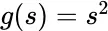 , for instance) of the kind which occurs in ordinary integration.
In classical probability theory, an underlying mathematical probability measure space 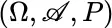 is assumed, such that, for all random variables and processes, the probability that any random variable has an outcome in a particular set
  can be calculated using the appropriate technical calculation 1 relevant to each random variable. If the random variables or processes have a time structure, then mathematical properties of filtration and adaptedness ensure that sets A which qualify as
  ‐measurable events at earlier times will still qualify as such at subsequent times.
The integrator  is a random variable. The integrand function
  or
or  is also a random variable. And the (stochastic) integral
  , is a random variable. This point is sometimes illustrated in textbooks by means of examples such as the following.
Example 1
Suppose  (a random quantity) is the price of an asset at time t . Then, for times
 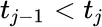 ,
,  is the change in the price of the asset, the change or difference also being random. Suppose the quantity of asset holding
  (sometimes denoted as
  ) is unpredictable or random. The product of these two,

is then a random variable representing the change in the value of the total asset holding. The stochastic integral  , represents the aggregate or sum of these changes over the period of time
  ; and is a random variable.
Интервал:
Закладка:
Похожие книги на «Gauge Integral Structures for Stochastic Calculus and Quantum Electrodynamics»
Представляем Вашему вниманию похожие книги на «Gauge Integral Structures for Stochastic Calculus and Quantum Electrodynamics» списком для выбора. Мы отобрали схожую по названию и смыслу литературу в надежде предоставить читателям больше вариантов отыскать новые, интересные, ещё непрочитанные произведения.










Обсуждение, отзывы о книге «Gauge Integral Structures for Stochastic Calculus and Quantum Electrodynamics» и просто собственные мнения читателей. Оставьте ваши комментарии, напишите, что Вы думаете о произведении, его смысле или главных героях. Укажите что конкретно понравилось, а что нет, и почему Вы так считаете.