Deep Adaptation
Здесь есть возможность читать онлайн «Deep Adaptation» — ознакомительный отрывок электронной книги совершенно бесплатно, а после прочтения отрывка купить полную версию. В некоторых случаях можно слушать аудио, скачать через торрент в формате fb2 и присутствует краткое содержание. Жанр: unrecognised, на английском языке. Описание произведения, (предисловие) а так же отзывы посетителей доступны на портале библиотеки ЛибКат.
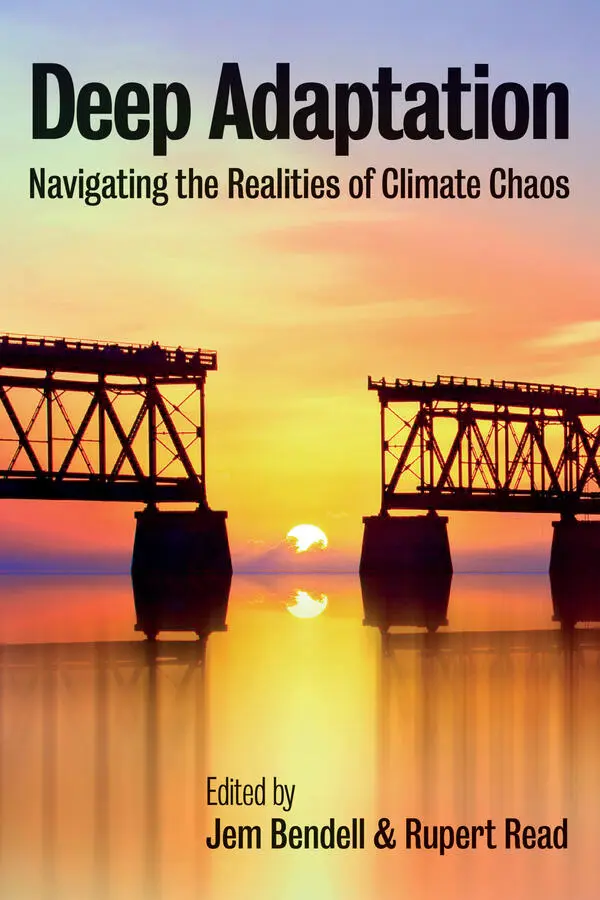
- Название:Deep Adaptation
- Автор:
- Жанр:
- Год:неизвестен
- ISBN:нет данных
- Рейтинг книги:4 / 5. Голосов: 1
-
Избранное:Добавить в избранное
- Отзывы:
-
Ваша оценка:
Deep Adaptation: краткое содержание, описание и аннотация
Предлагаем к чтению аннотацию, описание, краткое содержание или предисловие (зависит от того, что написал сам автор книги «Deep Adaptation»). Если вы не нашли необходимую информацию о книге — напишите в комментариях, мы постараемся отыскать её.
Edited by the originator of the concept of deep adaptation, Jem Bendell, and a leading climate activist and strategist, Rupert Read, this book is the essential introduction to the concept, practice and emerging global movement of Deep Adaptation to climate chaos.
Deep Adaptation — читать онлайн ознакомительный отрывок
Ниже представлен текст книги, разбитый по страницам. Система сохранения места последней прочитанной страницы, позволяет с удобством читать онлайн бесплатно книгу «Deep Adaptation», без необходимости каждый раз заново искать на чём Вы остановились. Поставьте закладку, и сможете в любой момент перейти на страницу, на которой закончили чтение.
Интервал:
Закладка:
How much more overheat will result if CO 2emissions alone stopped depends on both how rapidly the gas is removed from the atmosphere, and on the long-term climate response to the remaining CO 2level. Model results (Matthews and Zickfeld 2012) indicate that in such a scenario, two-thirds of the human-caused excess CO 2– i.e. above the pre-industrial level of 280 ppm – would still remain in the atmosphere after 190 years. For the case of stopping emissions in 2020 at a level of 415 ppm, this translates to more than 370 ppm by the year 2200. The earth during that time would continue to warm, but probably only by a few tenths of a degree. If all other greenhouse gas and aerosol emissions also stopped, the result might well be similar. However, the assumption that it would be excludes at least two further possibilities – possible stronger than expected carbon cycle feedback that we cannot reliably quantify, leading to higher than expected CO 2levels (Lenton et al. 2019); and the possibility of a higher long-term sensitivity of the earth’s temperature to CO 2(Bjordal et al. 2020).
Because of the limitations of models, a more prudent approach is to derive climate sensitivity from past climates. Most commonly, this is based on the temperature and CO 2changes during ice-age/warm-period fluctuations (Hansen et al. 2013). Results based on this approach generally support the model results (Sherwood et al. 2020). The problem, however, is that the earth is already in a different state from any time during those glacial cycles. Climate sensitivity could be higher in a warmer state due to positive climate system feedbacks, or tipping mechanisms, not yet quantified, which is the basis of the deeply alarming ‘Hothouse Earth’ hypothesis (Steffen et al. 2018). Support for this hypothesis comes from estimates for the Pliocene warm period, when CO 2was between 365 and 415 ppm and temperatures about 3°C warmer than during the pre-industrial era (Pagani et al. 2010; Sherwood et al. 2020). According to those data – from the last time earth was in a similar climate state to now – an immediate stop of CO 2emissions would still lead to substantial warming after today: about another 1°C for the higher end of the CO 2estimate for the Pliocene, and more than 2°C at the lower end. 2
The mechanisms that may have led to such a high climate sensitivity are unknown, but there is some evidence that Arctic sea-ice feedback could have contributed. It is possible that even if we stopped emitting CO 2now, we could still experience an ice-free Arctic in the near future that could lock in significant warming for decades to come because of additional energy absorbed by the ice-free ocean in the long Arctic summer days. In the latest round of climate model simulations, those models that correctly simulate past sea-ice loss tend to have a higher climate sensitivity than usually assumed. Remarkably, even models driven by an extremely low-emissions scenario, approaching a stopnow scenario, still show an ice-free Arctic before 2050 (SIMIP Community 2020). The principal mechanism here is that even at declining CO 2concentrations, excess heat stored in the oceans will only decline very slowly (Solomon et al. 2010).
It is important to stress that the scenario just discussed is largely speculative and only serves to illustrate how far we have already proceeded on a route to irreversibly altering our planet’s climate state. Computer simulations of possible future climate states using certain scenarios of greenhouse gas emissions can be used to gain a general impression of how this trend might continue – as there is still no evidence of a lowered CO 2level due to climate policy (Knorr 2019; Le Quéré et al. 2020).
A high-profile publication by a group of US scientists (Burke et al. 2018) confirms that we are indeed in the process of driving our climate system well into uncharted territory. Different to the approach followed by the IPCC (Hoegh-Guldberg et al. 2018), the group did not try to assess the impacts of projected changes directly by assessing impacts of past changes or using computer models. Instead, they compared expected climate warming patterns derived from model simulations with what we know from the geological past. They concluded that, at even ‘moderate’ degrees of warming, the climate in large parts of the planet will not resemble anything seen anywhere on earth since at least the onset of agricultural civilization. Instead, the combination of extreme heat and humidity due to be encountered in large parts of the world will have their closest analogue in deep time. In the case of a rapid and unprecedented decarbonization of the world economy, climate is expected to eventually stabilize at a state most closely resembling the already-discussed Mid-Pliocene warm period, some 3–5 million years ago. In a much more likely higher-emissions scenario, however, large parts of the earth will revert to a climate state last seen ‘just’ – in geological terms – after the demise of the dinosaurs: the early Eocene, some 50 million years ago.
This scary scenario is not all, because it only considers the start and end point of warming, but not the path on which we get there. If, within a few generations, we turn back the earth’s geological CO 2levels by tens of millions of years, then the rapidity of this change must surely have an impact on the way climate heating will play out. Unfortunately, this rate exceeds anything we know of from the deep geological past (Zeebe, Ridgwell and Zachos 2016), and therefore we cannot know in what ways dangerous anthropogenic climate change will occur in the coming decades. Which in itself is worrying (Read and O’Riordan 2017a). What is known, however, is that the large swings in temperature between ice ages and warm periods, bringing about temperature changes of up to 6°C peak to peak (Hansen et al. 2013), did not happen gradually – as the climate model runs underlying the above study suggest – but in bursts and bouts (Masson-Delmotte et al. 2005). Those climate oscillations were approximately as rapid as the warming we are seeing today and were created by various climate feedbacks, or tipping points. Then, about 10,000 years ago, a much more stable climate established itself. Some scholars argue that before this point, agriculture was impossible due to rapid climate fluctuations, but afterwards more or less unavoidable (Fagan 2004; Staubwasser and Weiss 2006).
In a recent commentary, prominent scientists have warned that tipping points and feedbacks similar to those that made the climate hostile to agriculture may have already been set in motion by the rapid increase in CO 2levels (Lenton et al. 2019). During times of change, rapid collapse rather than gradual change is quite common for both ecosystems (Cooper, Willcock and Dearing 2020; Williams and Lenton 2010) and societies (Fagan 2008; Lee 2009). This suggests a triple threat to human civilization: agriculture has never existed in a strongly fluctuating climate; it also has never existed in climate states resembling distant geological warm period; and complex systems, such as human societies, can collapse even more rapidly than the ongoing speed of climate warming.
Recognizing the severity of the threat and following on from increasingly vocal and civilly disobedient climate protesters, several countries and countless organizations – from local councils to universities – have recently declared a state of climate emergency. Among those is the European Parliament, the first parliamentary representative of a major global emitter of greenhouse gases. Unfortunately, if this state of alertness exists, it has not been followed up by actions. Human emissions of CO 2, which had just started to pick up during the time of Arrhenius, continue to rise, apart from a decline due to the recent pandemic likely to be temporary (Le Quéré et al. 2020). Continuing investments in fossil fuel exploration and production (Tong et al. 2019) and continuing subsidies for fossil fuels make it unlikely that the situation will change any time soon (Farand 2018; ODI 2019; Trinomics 2018). Using past climate records and with some minimal use of climate models, it has been inferred that if we burn all fossil fuels, most of the earth will become uninhabitable for humans (Hansen et al. 2013). That’s one reason for the name of the climate and ecological activism movement ‘Extinction Rebellion’.
Читать дальшеИнтервал:
Закладка:
Похожие книги на «Deep Adaptation»
Представляем Вашему вниманию похожие книги на «Deep Adaptation» списком для выбора. Мы отобрали схожую по названию и смыслу литературу в надежде предоставить читателям больше вариантов отыскать новые, интересные, ещё непрочитанные произведения.










Обсуждение, отзывы о книге «Deep Adaptation» и просто собственные мнения читателей. Оставьте ваши комментарии, напишите, что Вы думаете о произведении, его смысле или главных героях. Укажите что конкретно понравилось, а что нет, и почему Вы так считаете.