Deep Adaptation
Здесь есть возможность читать онлайн «Deep Adaptation» — ознакомительный отрывок электронной книги совершенно бесплатно, а после прочтения отрывка купить полную версию. В некоторых случаях можно слушать аудио, скачать через торрент в формате fb2 и присутствует краткое содержание. Жанр: unrecognised, на английском языке. Описание произведения, (предисловие) а так же отзывы посетителей доступны на портале библиотеки ЛибКат.
- Название:Deep Adaptation
- Автор:
- Жанр:
- Год:неизвестен
- ISBN:нет данных
- Рейтинг книги:4 / 5. Голосов: 1
-
Избранное:Добавить в избранное
- Отзывы:
-
Ваша оценка:
Deep Adaptation: краткое содержание, описание и аннотация
Предлагаем к чтению аннотацию, описание, краткое содержание или предисловие (зависит от того, что написал сам автор книги «Deep Adaptation»). Если вы не нашли необходимую информацию о книге — напишите в комментариях, мы постараемся отыскать её.
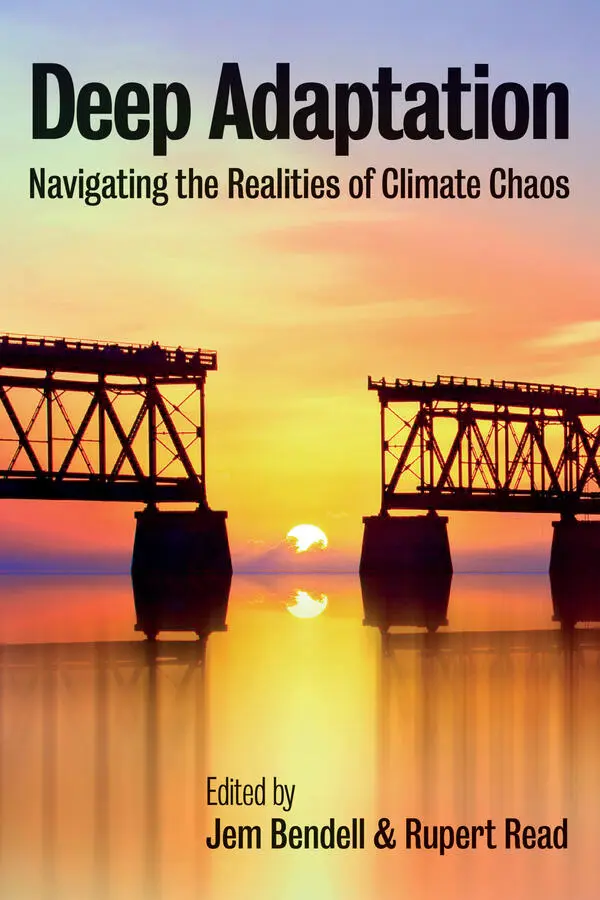
Edited by the originator of the concept of deep adaptation, Jem Bendell, and a leading climate activist and strategist, Rupert Read, this book is the essential introduction to the concept, practice and emerging global movement of Deep Adaptation to climate chaos.
Deep Adaptation — читать онлайн ознакомительный отрывок
Ниже представлен текст книги, разбитый по страницам. Система сохранения места последней прочитанной страницы, позволяет с удобством читать онлайн бесплатно книгу «Deep Adaptation», без необходимости каждый раз заново искать на чём Вы остановились. Поставьте закладку, и сможете в любой момент перейти на страницу, на которой закончили чтение.
Интервал:
Закладка:
Lenton, T. M. et al. (2019) ‘Climate Tipping Points – Too Risky to Bet Against: The Growing Threat of Abrupt and Irreversible Climate Changes Must Compel Political and Economic Action on Emissions’. Nature 575: 592–5.
Meadows, D. H., Meadows, D. L., Randers, J. and Behrens, W. W. (1972) The Limits to Growth . New York: Universe Books.
Moses, A. (2020) ‘“Collapse of Civilisation is the Most Likely Outcome”: Top Climate Scientists’. Voice of Action. Available at: https://voiceofaction.org/collapse-of-civilisation-is-the-most-likely-outcome-top-climate-scientists/
Nisbet, E. G. et al. (2019) ‘Very Strong Atmospheric Methane Growth in the Four Years 2014–2017: Implications for the Paris Agreement’. Global Biogeochemical Cycles 33(3): 318–42. Available at: https://doi.org/10.1029/2018GB006009
Read, R. (2020a) ‘Theses on the Coronavirus Crisis’, in Samuel Alexander (ed.), Extinction Rebellion: Insights from the Inside . Melbourne: Simplicity Institute Publishing. Available at: https://249897.e-junkie.com/product/1668648
Read, R. (2020b) ‘The Coronavirus Gives Humanity One Last Chance – but for What Exactly?’ Compass online. Available at: https://www.compassonline.org.uk/the-coronavirus-gives-humanity-one-last-chance-but-for-what-exactly/
Ripple, W. J., Wolf, C., Newsome, T. M., et al. (2019) ‘World Scientists’ Warning of a Climate Emergency’. BioScience 70(1): 8–12. Available at: https://doi.org/10.1093/biosci/biz088
Servigne, P. and Stevens, R. (2020) How Everything Can Collapse . Cambridge: Polity Press.
United Nations (2020) ‘Unite Human, Animal and Environmental Health to Prevent the Next Pandemic – UN Report’. Press release, 6 July. Available at: https://www.unenvironment.org/news-and-stories/press-release/unite-human-animal-and-environmental-health-prevent-next-pandemic-un
1 1. https://climate.copernicus.eu/surface-air-temperature-may-2020
2 2. See www.deepadaptation.info
1What Climate Science Can and Cannot Tell Us About Our Predicament
Jem Bendell and Rupert Read
Where we are after 125 years of climate science
Climate science was probably born in 1896 with the first, and still valid, calculation of how much the earth would warm if atmospheric CO 2content were to double from pre-industrial values (Arrhenius 2009 [1896]). Given the means of the day, without the use of electronic computers, the Swedish physicist Svante Arrhenius, famous for his contributions to thermodynamics and the understanding of chemical reactions, calculated that the earth would warm by about 4°C. His value still lies within the range of modern estimates, produced by hugely complicated computer models (Slingo 2017). Arrhenius even calculated that regions near the poles would warm much more than those near the equator, something that is still seen as a major finding of climate science.
Awareness of humanity’s vulnerability to changes in climate was high at the close of the nineteenth century. Arrhenius’s native Scandinavia and much of northern Europe had only recently come out of the Little Ice Age, a cold period that had led to frequent crop failure and starvation (Lee 2009). His hope was therefore that increasing amounts of ‘carbonic acid’ in the air – atmospheric carbon dioxide – would bring about better weather and increased crop yields for the colder regions of the earth.
Fast forward one and a quarter centuries, and the predicted climate heating has become obvious to almost everyone (WMO 2019). Even if we did not have the benefits of modern climate science, we would still be able to recognize that we are in a situation never seen by humanity since modern civilization started with the onset of agriculture. Essentially nineteenth-century technologies such as thermometers, the collection of data on emissions of carbon-containing fuels, in combination with Arrhenius’s science, already tell us a complete story: while rates of carbon dioxide emissions from human activities have been rising more or less exponentially (Global Carbon Project 2020), with no signs that this will change any time soon (Betts et al. 2020; Le Quéré et al. 2020), the earth is warming at an accelerating rate (NOAA 2020a). The climate system seems to be out of control, and human activity is the cause.
Human interest in understanding the geological past has created a different branch of climate science a long time ago, now called paleo-climatology. On its own, paleo-climatology can already tell us a compelling story of where we are and further help us understand the scale of our calamity. By drilling deep holes into Antarctic ice and analysing the composition of tiny bubbles found in them, researchers have been able to construct a continuous record of atmospheric carbon dioxide going back 800,000 years (Masson-Delmotte et al. 2010). The data show that CO 2levels have fluctuated between around 180 parts per million (ppm) during ice ages and 280 ppm during warm periods. Only once did they briefly increase slightly above 300 ppm. At the time of writing, the last estimate of global mean CO 2stood at 415 ppm, with an annual growth rate of almost 3 ppm over the last five years (NOAA 2020b). The last time atmospheric CO 2was about as high as now was around three million years ago, during the Middle Pliocene (Lunt et al. 2008). Even that was only a temporary excursion, and we have to go back a staggering 25 million years to find values exceeding 500 ppm (Pagani et al. 2005), a value that at current trends we will reach in about 30 years.
When a kettle is switched on, the water in it does not heat up instantaneously, but there is a delay. The same happens with the earth’s climate: according to the International Panel on Climate Change (IPCC 2019a), 90 per cent of the heat from the enhanced greenhouse effect is absorbed by the oceans’ water. This means that the warming we have seen so far lags behind the steep rise in atmospheric carbon dioxide levels, and that even if we suddenly managed to stop the rise, warming will continue (Huntingford, Williamson and Nijsse 2020). Earth’s surface is now over 1°C warmer than during the late nineteenth century (NOAA 2020a), which is comparable to or slightly warmer than during the last geological warm period between 10,000 and 5,000 years ago (Marcott et al. 2013). But during that time the warming was caused by changes in the way the earth circles and wobbles around the sun, with the result that tropical lands were slightly cooler than today. Nowadays, the (over)heating effect is seen universally across the globe, and as such differs decidedly from any climate fluctuations since the end of the last ice age more than 10,000 years ago (Barbuzano 2019; Neukom et al. 2019).
Currently the enhanced greenhouse effect is created only to about two-thirds by CO 2and one third by other gases, of which about half by methane. 1Countering this warming to a certain extent are several other human-caused effects, notably from atmospheric pollution through aerosols, which cause some cooling (Myhre et al. 2013). These cooling effects probably approximately cancel out the warming effect of the non-CO 2greenhouse gases. CO 2, however, is by far the most important greenhouse gas because its lifetime vastly exceeds almost all of the other greenhouse gases or aerosols. A question of substantial theoretical value is what would happen if we not only prevented a further rise of CO 2but stopped all emissions of CO 2and other greenhouse gases tomorrow. Because the oceans and land tend to take up more than half of human-made CO 2emissions (Global Carbon Project 2020), such an instantaneous net-zero balance of man-made carbon fluxes would lead to some drawdown of CO 2by natural sinks, and a lowering of atmospheric CO 2levels. The extent of the drawdown, however, is by no means understood and could easily be overestimated. Forests are responsible for a large part of that sink (Global Carbon Project 2020), but are increasingly being fragmented and damaged (Grantham et al. 2020). Some recent research also suggests that we already observe a declining efficiency of the sinks (Wang et al. 2020). Furthermore, even if such lowering occurs, it may not lead to a cessation of heating: because of the possible acceleration of overheating once the ‘global dimming effect’ (from aerosols) is reduced (Xu, Ramanathan and Victor 2018); and because of vicious climate feedbacks that may already be underway (Lenton et al. 2019).
Читать дальшеИнтервал:
Закладка:
Похожие книги на «Deep Adaptation»
Представляем Вашему вниманию похожие книги на «Deep Adaptation» списком для выбора. Мы отобрали схожую по названию и смыслу литературу в надежде предоставить читателям больше вариантов отыскать новые, интересные, ещё непрочитанные произведения.









Обсуждение, отзывы о книге «Deep Adaptation» и просто собственные мнения читателей. Оставьте ваши комментарии, напишите, что Вы думаете о произведении, его смысле или главных героях. Укажите что конкретно понравилось, а что нет, и почему Вы так считаете.