Deep Adaptation
Здесь есть возможность читать онлайн «Deep Adaptation» — ознакомительный отрывок электронной книги совершенно бесплатно, а после прочтения отрывка купить полную версию. В некоторых случаях можно слушать аудио, скачать через торрент в формате fb2 и присутствует краткое содержание. Жанр: unrecognised, на английском языке. Описание произведения, (предисловие) а так же отзывы посетителей доступны на портале библиотеки ЛибКат.
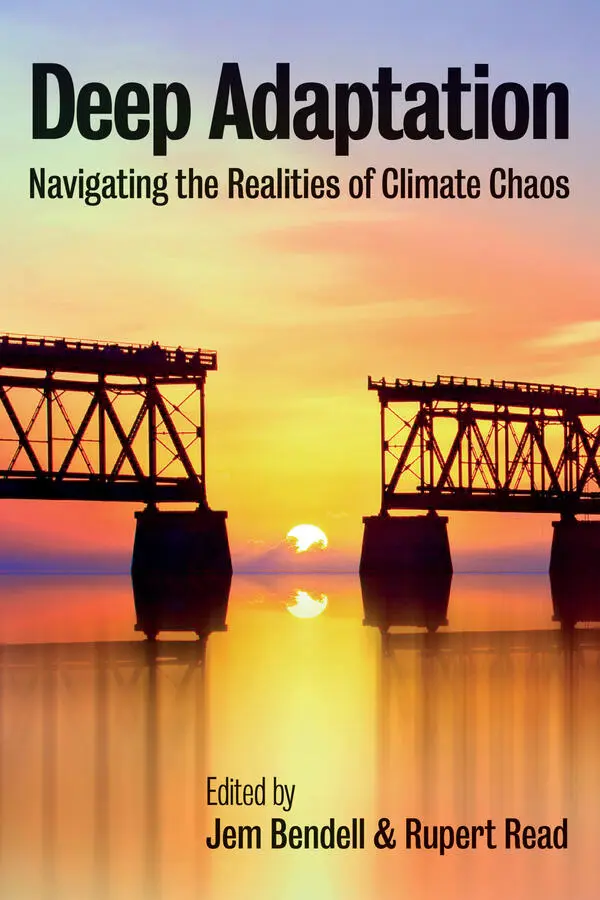
- Название:Deep Adaptation
- Автор:
- Жанр:
- Год:неизвестен
- ISBN:нет данных
- Рейтинг книги:4 / 5. Голосов: 1
-
Избранное:Добавить в избранное
- Отзывы:
-
Ваша оценка:
Deep Adaptation: краткое содержание, описание и аннотация
Предлагаем к чтению аннотацию, описание, краткое содержание или предисловие (зависит от того, что написал сам автор книги «Deep Adaptation»). Если вы не нашли необходимую информацию о книге — напишите в комментариях, мы постараемся отыскать её.
Edited by the originator of the concept of deep adaptation, Jem Bendell, and a leading climate activist and strategist, Rupert Read, this book is the essential introduction to the concept, practice and emerging global movement of Deep Adaptation to climate chaos.
Deep Adaptation — читать онлайн ознакомительный отрывок
Ниже представлен текст книги, разбитый по страницам. Система сохранения места последней прочитанной страницы, позволяет с удобством читать онлайн бесплатно книгу «Deep Adaptation», без необходимости каждый раз заново искать на чём Вы остановились. Поставьте закладку, и сможете в любой момент перейти на страницу, на которой закончили чтение.
Интервал:
Закладка:
IntroductionWhat Next, Now That the Limits Have Been Breached?
Jem Bendell and Rupert Read
Are you confused and concerned about what seems like the disruption or even breakdown of normal life? Do you worry about becoming stuck, not knowing what to do? Do you want to explore with others how to respond creatively at this difficult time? If so, then you share that intention with the contributors to this book. Until recently, most people in modern societies have not had much reason or opportunity to explore what an anticipation of greater societal disruption – or even collapse – might mean for their life choices. It has been a taboo subject, policed by the argument that to even discuss it would be unhelpful to individuals and society. To have any level of anticipation of societal breakdown or collapse, whether from a range of environmental, economic, political or technological factors, has been labelled as pessimism, alarmism, doomism, fatalism or defeatism. Such negative dismissals can discourage us from engaging in this topic any further. Unfortunately, such avoidance could lose us all precious time to explore what can be done and learned at this difficult moment, especially if our aim is to reduce harm while saving more of society and the natural world. It might mean we postpone the opportunity to rethink what is most important to us and align the rest of our lives with that. Therefore, we consider it would be defeatist to not even begin exploring what we can do to help in the face of massive societal disruption.
That is why we believe it is time for a book that discusses various implications of anticipating societal collapse. Deep Adaptation is an agenda and framework for responding to the potential, probable or inevitable collapse of industrial consumer societies, due to the direct and indirect impacts of human-caused climate change and environmental degradation. With the term ‘societal collapse’, we mean an uneven ending of industrial consumer modes of sustenance, shelter, health, security, pleasure, identity and meaning. Rather than an environmental, economic or political collapse, the word ‘societal’ is important as these uneven endings pervade society and challenge our place within it. The term ‘collapse’ does not necessarily mean that suddenness is likely but rather implies a form of breakdown in systems that is comprehensive and cannot be reversed to what it was before. The word ‘deep’ is intended to contrast the agenda with mainstream approaches to adaptation to climate impacts (Klein et al. 2015) by going deeper into the causes and potential responses within ourselves, our organizations and societies. People who engage in dialogue and initiative for deep adaptation believe that societal collapse in most or all countries of the world is likely, inevitable or already unfolding. Typically, such people believe that they will experience this disruption themselves or have already begun to do so, while recognizing that the disruptions may be first and worst in the global South. Deep adaptation describes the inner and outer, personal and collective, responses to either the anticipation or experience of societal collapse, worsened by the direct or indirect impacts of climate change.
The vulnerability of our normal ways of life was highlighted in 2020 when a virus triggered a series of cascading effects beyond its initial health impacts. To begin with, there were shortages of medicines, protective gear and food, then a slowdown of economic activity, domestic political upheavals, diplomatic and geopolitical conflicts, and the creation of large amounts of national debt to reduce, or postpone, economic shock. The sprouting of volunteer-led mutual aid in many locations is an indicator of the capacity of people to respond positively. While Covid-19 has posed a stress test for the globalized economy, it is also a stark reminder of what deeply matters in our daily lives and is a real-time dress rehearsal for future disasters and psychological unease (Read 2020: ch. 26; Gray 2020). When some people consider societal collapse to be an abstract and theoretical matter, it is worth noting that the United Nations has warned us that outbreaks of coronaviruses, including potentially ones more serious than Covid-19, are more likely because of both environmental destruction and climate change (United Nations 2020). That analysis means that disruptions from the indirect impacts of climate change are already being felt by most societies around the world.
To assess the probability and processes of societal collapse is a complex endeavour, as described by expert ‘collapsologists’ in chapter 3of this book. Such assessments can draw on many disciplines of scholarship, including sociology, economics, politics, psychology, philosophy and agronomy, as well as composite fields such as climate science, environmental studies, futures studies, catastrophic risks, emergency management and disaster reduction (Servigne and Stevens 2020). This complexity therefore means that any commentary on the likelihood of societal collapse will derive from the specialism, mentality, identity and lived experience of the scholar. Most scholars are not experiencing the climate-worsened hunger and displacement that hundreds of millions of people are at the time of our writing (FAO 2018). Despite the inevitable bias towards normality within the many fields of scholarship that could give us an assessment of the likelihood of societal collapse, in recent years more experts have come forward with warnings. One of the fields where such warnings are now coming from is climate science (Moses 2020).
In November 2019, seven leading climate scientists published a review in the journal Nature which said that a collapse of society may be inevitable because nine of the fifteen known global climate tipping points that regulate the state of the planet may have already been activated (Lenton et al. 2019). Soon after, an opinion from five scientists on our climate situation was published in the journal Biosciences and signed by more than 11,000 scientists worldwide as a warning to humanity: ‘The climate crisis has arrived and is accelerating faster than most scientists expected . . . It is more severe than anticipated, threatening natural ecosystems and the fate of humanity . . .’ (Ripple et al. 2019). The reasons why climate change is so dangerous to humanity are described in chapter 2, and the reasons why climate scientists have been conservative in their statement of that risk are explained in chapter 1.
In 2020, two hundred scientists warned of ‘global systemic collapse’ becoming likely due to the way different climate and environmental stressors can interact and amplify each other. They explained that the true situation is not being understood or communicated well enough because ‘many scientists and policy-makers are embedded in institutions that are used to thinking and acting on isolated risks, one at a time’ (Future Earth 2020). Research analysts that are experienced in integrating multiple forms of information on multiple risks are to be found in the financial sector. An internal report by analysts from the largest bank in the United States, JP Morgan, is therefore relevant to the question of whether humanity will make the changes to avoid disaster. They assessed that
to meet the Paris 2ºC objective on the global temperature . . . would require the immediate elimination of 34% of the global coal-fired production capacity. The cost would involve not only the premature scrapping of these coal-fired power stations but also the increased investment in renewables. The end result could be energy shortages and higher electricity prices for consumers. It isn’t going to happen. ( Guardian 2020)
Although we can and must increase efforts for significant reductions in carbon emissions and effective natural drawdown of carbon from the atmosphere, the recent science and analysis should not be ignored because it is too painful to consider. Unfortunately, new climate models are predicting much greater climate change than past models did (Johnson 2019). Already we are witnessing temperature changes in air and ocean that are at the extreme end of previous predictions, and with impacts on ecosystems that are in advance of what was anticipated (Nisbet et al. 2019). For instance, in May 2020 the previous 12 months were 1.3 degrees warmer than pre-industrial temperatures. 1Such rapid climate change is a massive stress on ecological and human systems and is not something that humans can stop entirely. We must try to slow it down, but our efforts might not be very successful. Dangerous climate change is therefore in one important sense an unsolvable predicament which in our view will probably, or inevitably, lead to the collapse of industrial consumer societies. It is for this reason that we consider it useful in the title of this book to describe the instability we are creating as ‘climate chaos’ and that we will need to learn to ‘navigate’ varying levels of that chaos, rather than being able to ‘solve’ the ‘problem’ outright. For this is more than a problem, more even than a ‘wicked’ one. It is a tragedy and an ongoing series of disasters that provide a new condition for humankind along with the rest of life on earth (Foster 2015).
Читать дальшеИнтервал:
Закладка:
Похожие книги на «Deep Adaptation»
Представляем Вашему вниманию похожие книги на «Deep Adaptation» списком для выбора. Мы отобрали схожую по названию и смыслу литературу в надежде предоставить читателям больше вариантов отыскать новые, интересные, ещё непрочитанные произведения.









Обсуждение, отзывы о книге «Deep Adaptation» и просто собственные мнения читателей. Оставьте ваши комментарии, напишите, что Вы думаете о произведении, его смысле или главных героях. Укажите что конкретно понравилось, а что нет, и почему Вы так считаете.