Deep Adaptation
Здесь есть возможность читать онлайн «Deep Adaptation» — ознакомительный отрывок электронной книги совершенно бесплатно, а после прочтения отрывка купить полную версию. В некоторых случаях можно слушать аудио, скачать через торрент в формате fb2 и присутствует краткое содержание. Жанр: unrecognised, на английском языке. Описание произведения, (предисловие) а так же отзывы посетителей доступны на портале библиотеки ЛибКат.
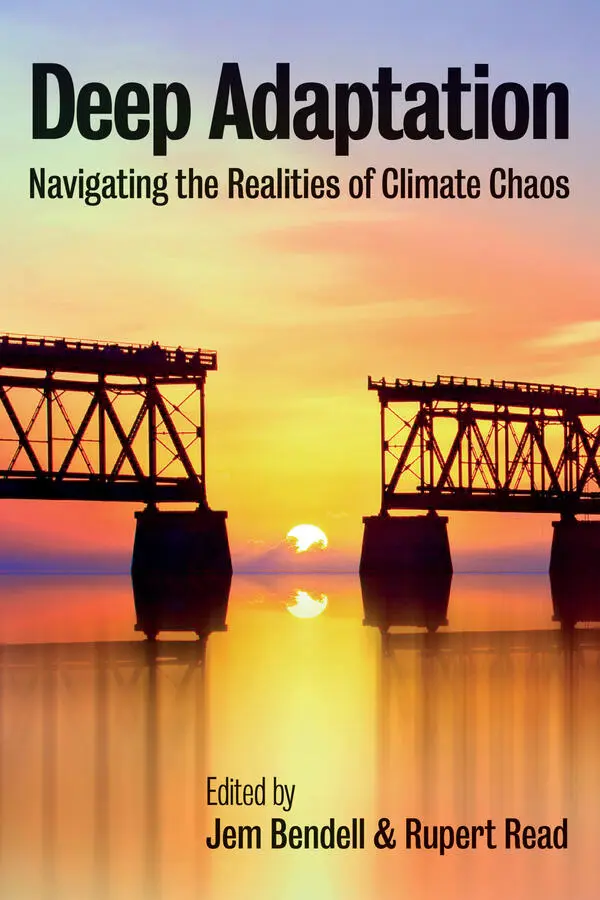
- Название:Deep Adaptation
- Автор:
- Жанр:
- Год:неизвестен
- ISBN:нет данных
- Рейтинг книги:4 / 5. Голосов: 1
-
Избранное:Добавить в избранное
- Отзывы:
-
Ваша оценка:
Deep Adaptation: краткое содержание, описание и аннотация
Предлагаем к чтению аннотацию, описание, краткое содержание или предисловие (зависит от того, что написал сам автор книги «Deep Adaptation»). Если вы не нашли необходимую информацию о книге — напишите в комментариях, мы постараемся отыскать её.
Edited by the originator of the concept of deep adaptation, Jem Bendell, and a leading climate activist and strategist, Rupert Read, this book is the essential introduction to the concept, practice and emerging global movement of Deep Adaptation to climate chaos.
Deep Adaptation — читать онлайн ознакомительный отрывок
Ниже представлен текст книги, разбитый по страницам. Система сохранения места последней прочитанной страницы, позволяет с удобством читать онлайн бесплатно книгу «Deep Adaptation», без необходимости каждый раз заново искать на чём Вы остановились. Поставьте закладку, и сможете в любой момент перейти на страницу, на которой закончили чтение.
Интервал:
Закладка:
In Part II, the ‘shifts in being’ that can occur – and be supported – as we anticipate societal collapse are explored in five chapters. In chapter 4, psychologist and co-founder of the Climate Psychology Alliance Dr Adrian Tait describes the ways in which the psychotherapy profession must – and is beginning to – change in response to growing public eco-distress. In chapter 5, Jem Bendell tackles the subject of how we can avoid making our bad situation worse by sharing insights on the ideology that he believes is at the root of our predicament. He explains how this destructive ideology has been mainstreamed and maintained by the monetary system. A similar theme is developed further in chapter 6by Rene Suša and her colleagues, who work on developing and articulating their analysis of indigenous persons in the global predicament. They argue that people have become addicted to patterns of thought which will hamper our abilities to respond to collapse, and they offer some ideas to help break those addictions. How to apply these critiques in new ways of organizing interactions on deep adaptation is important. Therefore, in chapter 7, the senior facilitator of the Deep Adaptation Forum joins Jem Bendell to explain the rationale and some modalities for facilitating connection and conversation about our predicament. This part of the book is completed in chapter 8by environmental philosopher Joanna Macy and her colleague Professor Sean Kelly. In a more informal and heartfelt discussion of the topic, they draw on ancient wisdom to provide some reflections on how we might discover strength during the difficult times ahead.
In Part III, some of the ‘shifts in doing’ that occur when people anticipate societal collapse are explored in four chapters. In chapter 9, renowned leadership scholar Professor Jonathan Gosling explores possible ways of leading in response to increasing turbulence in society. He explains how traditional understandings and enactments of leadership will be unhelpful. Instead, leadership of adaptation is diverse and sometimes hardly recognizable as leadership. One of its key effects, he argues, is enabling equanimity in anxiety-provoking circumstances. In chapter 10, education specialist Dr Charlotte von Bülow explores new approaches to schooling and education that are necessary in the face of the climate emergency. In chapter 11, by drawing on his experience as a spokesperson and political advisor with the activist group Extinction Rebellion, as well as his work as a political philosopher, Professor Rupert Read shares his ideas on the future of politics and activism in the face of societal collapse. He explains how the systemic economic and political drivers of the ecological and climate crisis mean that a radical and transformative political agenda is essential for the future of deep adaptation. In chapter 12, community currency expert Matthew Slater and Extinction Rebellion founder member Skeena Rathor explain why and how ‘relocalization’ of economies and societies is an important part of the response to climate chaos. They describe how future relocalization efforts could benefit from incorporating a co-liberation philosophy and supporting international action for policies that enable localization and climate justice.
As a first edited collection on this huge topic, we realize that the coverage of issues and the diversity of voices will be insufficient. We are particularly aware that at the time of writing, like most readers of this book, we are not involved in high-intensity situations of societal disruption and collapse. Over time, we intend to both hear and support more diverse voices and participate in more practical solidarity for people who are suffering the consequences of societal disruption and collapse. Therefore, in the concluding chapter, we discuss a range of live issues within the emerging field of deep adaptation.
As you read this book, it is likely you will be witnessing situations where lifestyles, livelihoods and outlooks are being disrupted. Those disruptions will probably be reported in most mass media without foregrounding our degrading environment. Looking behind the headlines, there is credible evidence that all manner of disruptions, including rising prices, coronaviruses, financial instability, mental illness, displaced persons and xenophobia, are being made worse by the declining health and stability of our natural world. Unfortunately, the Club of Rome was right. In 1972, their bestselling report on the Limits to Growth predicted that humanity would be experiencing difficulties now due to our impact on the natural world (Meadows et al. 1972). Unless more people today make the connections between the many difficulties faced and ask questions about how modern humans have generated them, societies will lose the opportunity to learn and change. We intend this book to help you make fuller sense of the many disruptions around you so you can invite your friends, colleagues and community members to join you in reconsidering the fundamentals of our societies and our relationship with the natural world. Whatever happens, the opportunity to learn from this unfolding global disaster is still ours to seize.
References
Bendell, J. (2018) ‘Deep Adaptation: A Map for Navigating Climate Tragedy’. IFLAS Occasional Paper 2. Available at: http://www.lifeworth.com/deepadaptation.pdf
Bendell, J. (2019) ‘Doom and Bloom? Adapting Deeply to Likely Collapse’, in C. Farrell, A. Green, S. Knights and W. Skeaping (eds), This is Not a Drill: Extinction Rebellion Handbook , 1st edn. London: Penguin Random House.
Bendell, J. and Cave, D. (2020) ‘Does Anticipating Societal Collapse Motivate Pro-Social Behaviours?’ IFLAS website. Available at: http://iflas.blogspot.com/2020/06/does-anticipating-societal-collapse.html
Bendell, J., Sutherland, N. and Little, R. (2017) ‘Beyond Unsustainable Leadership: Critical Social Theory for Sustainable Leadership’. Sustainability Accounting, Management and Policy Journal 8(4): 418–44.
Coulter, L., Serrao-Neumann, S. and Coiacetto, E. (2019) ‘Climate Change Adaptation Narratives: Linking Climate Knowledge and Future Thinking’. Futures 111: 57–70.
FAO (Food and Agriculture Organization) (2018) Disasters Causing Billions in Agricultural Losses, with Drought Leading the Way . Press release, 15 March.
Foster, J. (2015) After Sustainability . Abingdon: Earthscan/Routledge.
Foster, J. (ed.) (2019) Post-Sustainability: Tragedy and Transformation . London: Routledge.
Foster, J. et al. (2019) Facing Up to Climate Reality . London: London Publishing Partnership/Green House.
Future Earth (2020) ‘Our Future on Earth 2020’. Available at: www.futureearth.org/publications/our-future-on-earth
Gray, J. (2020 ‘Why This Crisis is a Turning Point in History’. Available at: https://www.newstatesman.com/international/2020/04/why-crisis-turning-point-history
Green, M. (2019) ‘Extinction Rebellion: Inside the New Climate Resistance’. Financial Times Magazine . Available at: https://www.ft.com/content/9bcb1bf8-5b20-11e9-9dde-7aedca0a081a
Guardian (2020) ‘JP Morgan Economists Warn Climate Crisis is Threat to Human Race’. Available at: https://www.theguardian.com/environment/2020/feb/21/jp-morgan-economists-warn-climate-crisis-threat-human-race
Johnson , J. (2019) ‘“Terrifying” New Climate Models Warn of 6–7°C of Warming by 2100 if Emissions Not Slashed’. Common Dreams. Available at: https://www.commondreams.org/news/2019/09/17/terrifying-new-climate-models-warn-6-7degc-warming-2100-if-emissions-not-slashed
Klein, R. J. T. et al. (2015) ‘Adaptation Opportunities, Constraints, and Limits’, in C. B. Field (ed.), Climate Change 2014: Impacts, Adaptation and Vulnerability: Part A: Global and Sectoral Aspects , 1st edn. New York: Cambridge University Press.
Читать дальшеИнтервал:
Закладка:
Похожие книги на «Deep Adaptation»
Представляем Вашему вниманию похожие книги на «Deep Adaptation» списком для выбора. Мы отобрали схожую по названию и смыслу литературу в надежде предоставить читателям больше вариантов отыскать новые, интересные, ещё непрочитанные произведения.







Обсуждение, отзывы о книге «Deep Adaptation» и просто собственные мнения читателей. Оставьте ваши комментарии, напишите, что Вы думаете о произведении, его смысле или главных героях. Укажите что конкретно понравилось, а что нет, и почему Вы так считаете.