Deep Adaptation
Здесь есть возможность читать онлайн «Deep Adaptation» — ознакомительный отрывок электронной книги совершенно бесплатно, а после прочтения отрывка купить полную версию. В некоторых случаях можно слушать аудио, скачать через торрент в формате fb2 и присутствует краткое содержание. Жанр: unrecognised, на английском языке. Описание произведения, (предисловие) а так же отзывы посетителей доступны на портале библиотеки ЛибКат.
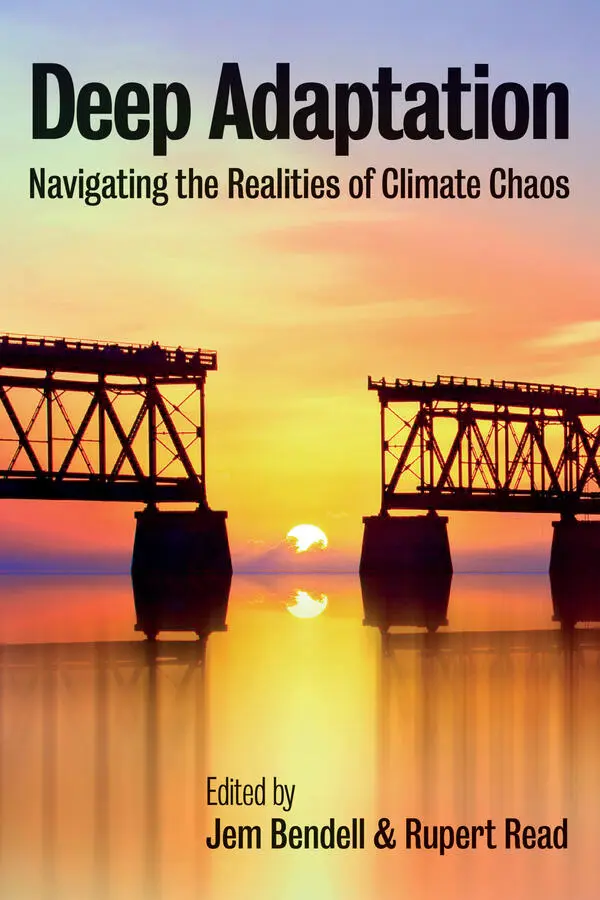
- Название:Deep Adaptation
- Автор:
- Жанр:
- Год:неизвестен
- ISBN:нет данных
- Рейтинг книги:4 / 5. Голосов: 1
-
Избранное:Добавить в избранное
- Отзывы:
-
Ваша оценка:
Deep Adaptation: краткое содержание, описание и аннотация
Предлагаем к чтению аннотацию, описание, краткое содержание или предисловие (зависит от того, что написал сам автор книги «Deep Adaptation»). Если вы не нашли необходимую информацию о книге — напишите в комментариях, мы постараемся отыскать её.
Edited by the originator of the concept of deep adaptation, Jem Bendell, and a leading climate activist and strategist, Rupert Read, this book is the essential introduction to the concept, practice and emerging global movement of Deep Adaptation to climate chaos.
Deep Adaptation — читать онлайн ознакомительный отрывок
Ниже представлен текст книги, разбитый по страницам. Система сохранения места последней прочитанной страницы, позволяет с удобством читать онлайн бесплатно книгу «Deep Adaptation», без необходимости каждый раз заново искать на чём Вы остановились. Поставьте закладку, и сможете в любой момент перейти на страницу, на которой закончили чтение.
Интервал:
Закладка:
The remainder of this chapter will lay out the case that, when it comes to global heating, there is still no sign of any action that would resemble a true case of emergency. It will then be devoted to the question of why the gravity of the climate threat has largely been ignored or downplayed, even by many climate scientists themselves (Spratt and Dunlop 2018).
The root of denial may be found in the workings of climate science
The ownership of a story can best be judged by the prevailing news cycle. When it comes to global heating, there are three instances when the news machinery responds: publication of some groundbreaking scientific result, a climate policy decision or major climate policy meeting, or mass protests. Of the three groups that can trigger such news alerts – the scientists, the policy makers and the activists – only the first, at best, can generate news without the help of at least one of the others. Climate policy generally revolves around resolutions of the IPCC, a body of climate scientists (and politicians and civil servants). Climate protesters repeatedly cite scientific evidence to further their case. Therefore, rather than seeing climate heating as a symptom of industrial society and overconsumption, a framing many others could take part in, society typically views climate as an issue ‘owned’ by natural scientists.
The way in which the scientific community has approached the problem of global heating is therefore of primary importance for understanding the failure of climate policy to date. Physical scientists tend to see their role as to gain and ascertain new insights about the physical world we live in. Correspondingly, there are two principal ways for a scientist to rise in esteem: either being the first to make a significant discovery, or, something which can be much longer lasting, the first to propose a new theory that later withstands repeated attempts at proving it wrong.
Being disproven or having to retract a finding, on the other hand, is associated with a significant penalty in terms of loss of professional esteem. Consequently, scientists have been trained to be cautious before accepting new evidence or, even more so, new theories. This constitutes a certain type of ‘precautionary principle’: there is a certain fear of being seen to be exaggerating findings and promoting the possibility of less likely outcomes. ‘False positives’ are seen as worse than ‘false negatives’. Unfortunately, this precautionary principle tends to point in the exact opposite direction from the needs of broader society: from, in other words, the Precautionary Principle proper (Read and O’Riordan 2017b). For, in ‘post-normal’ science, where the stakes for the broader society are high, ‘false positives’ are much less bad than ‘false negatives’. 3It is much worse for society if scientists fail to warn of an existential threat than if they end up sometimes having cried wolf.
When it comes to climate heating, the fear of being a scientist who goes well ahead of the pack has generally, and very unfortunately, proven stronger than the fear of catastrophic consequences of human-triggered climate change itself (Hansen 2007). How this mentality affects the way results are presented in major scientific assessments of societal threats is now well documented; it leads to a tendency to ‘err on the side of least drama’ (Brysse et al. 2013), i.e. to report only those threats where the scientist is fairly sure not to be refuted by his or her peers.
Ethical guidelines of certain professions, as for example emergency department physicians, can teach us what actions are required in a true emergency situation (Peacock 2018). The central piece of the applicable code of conduct is the application of the precautionary principle without delay, always with an eye on the worst-case outcome for the many, not just the few – for all those with a stake in the matter, not just those with a professional interest to defend. This type of precautionary principle works then, as we have said, in the exact opposite direction to the one followed by the scientific community; it demands being more tolerant, in particular where the stakes are high/existential, to erring strongly on the side of ‘maximum drama’, rather than the opposite (Read and O’Riordan 2017a; Taleb et al. 2014).
Some processes that climate scientists study, such as the physics of atmospheric motion, of the earth’s planetary energy balance or the chemistry of CO 2dissolving in ocean water, are fundamentally understood, and we can safely assume that the same principles will apply in a warming/chaoticizing climate. But other processes, such as the melting and eventual collapse of ice sheets, or the reaction of crops and ecosystems to drought and warming and their possible collapse, are much less understood. There are often no analogues from the past, very limited experiments of necessarily small scale and computer models trained on severely limited data. It is thus a matter of precaution to rely mostly on theories and observations that are well established, that leave open the possibility of unforeseen developments where we know little, and that seek to implement ‘no-regrets’ policies of protection and precaution (and adaptation). The description of the current state of climate science given in the previous section therefore emphasizes the unknown character of even our immediate future and limits itself to what we know about past climate changes and a few findings that make use of climate model simulations in a limited way.
In order to tackle the problem of global heating, the United Nations instituted the IPCC and tasked it to provide regular comprehensive assessments of the state of climate science. The scientists writing those assessments are confronted with at least two big problems. First, that their normal model of conducting science contradicts the ethics of emergency situations; and second, that there are reasons to believe large parts of climate science necessarily remain speculative, for lack of known precedents or experimental techniques. Single plants or a small plot of land can be subject to artificially altered climates, but not entire societies or ecosystems.
But if predicting the impacts of a fundamentally novel climate state is impossible in principle, and given the stated reluctance of scientists to discuss findings that are highly uncertain, how could such reports even be attempted? And if global heating constitutes an emergency situation, how should the IPCC respond to it? Evidence suggests that that the IPCC in its assessments has on balance not tried to address those problems but has maintained a conservative attitude when dealing with less understood but plausible high-impact outcomes (Brysse et al. 2013). It may have split into three working groups, of which the first tackles the more tractable physical basis of climate change, but even here there are many processes we do not understand, such as the collapse of ice sheets that can lead to sea-level rise of several metres (Grégoire, Payne and Valdes 2012). In fact, the IPCC’s reported range of 0.3–1.1 metres of sea-level rise by 2100 (IPCC 2019b) is much lower than the 2.4-metre rise that has been identified as the worst-case scenario (Bamber et al. 2019). All of the IPCC’s scenarios of future man-made climate change tend to have one thing in common: the assumption that change happens smoothly and gradually, without any major disruptions. The possibility of such large-scale disruptions – such as ice-sheet collapse, dieback of the Amazon rainforest, or large-scale carbon release from permafrost – is acknowledged by the IPCC. But when the IPCC calculates a possible safe amount of CO 2that could still be emitted, the possibility of such events actually happening is either not taken into account, relegated to footnotes, or labelled ‘low confidence’ in such a way as to make it seem as if those events need not be greatly worried about (Rogelj et al. 2018). But as we have stressed, and as those relatively few (but growing in number) climate scientists attest who speak out openly about the way their fears for the future exceed what they can conservatively prove, that is getting things the wrong way around. To be an effective early warning system, the IPCC or something like it would need to focus pretty strongly on making stark, and as rapidly as possible (rather than after years of slow deliberation), the risks inherent in allegedly low-probability but undoubtedly high-impact events or cascades.
Читать дальшеИнтервал:
Закладка:
Похожие книги на «Deep Adaptation»
Представляем Вашему вниманию похожие книги на «Deep Adaptation» списком для выбора. Мы отобрали схожую по названию и смыслу литературу в надежде предоставить читателям больше вариантов отыскать новые, интересные, ещё непрочитанные произведения.








Обсуждение, отзывы о книге «Deep Adaptation» и просто собственные мнения читателей. Оставьте ваши комментарии, напишите, что Вы думаете о произведении, его смысле или главных героях. Укажите что конкретно понравилось, а что нет, и почему Вы так считаете.