Deep Adaptation
Здесь есть возможность читать онлайн «Deep Adaptation» — ознакомительный отрывок электронной книги совершенно бесплатно, а после прочтения отрывка купить полную версию. В некоторых случаях можно слушать аудио, скачать через торрент в формате fb2 и присутствует краткое содержание. Жанр: unrecognised, на английском языке. Описание произведения, (предисловие) а так же отзывы посетителей доступны на портале библиотеки ЛибКат.
- Название:Deep Adaptation
- Автор:
- Жанр:
- Год:неизвестен
- ISBN:нет данных
- Рейтинг книги:4 / 5. Голосов: 1
-
Избранное:Добавить в избранное
- Отзывы:
-
Ваша оценка:
Deep Adaptation: краткое содержание, описание и аннотация
Предлагаем к чтению аннотацию, описание, краткое содержание или предисловие (зависит от того, что написал сам автор книги «Deep Adaptation»). Если вы не нашли необходимую информацию о книге — напишите в комментариях, мы постараемся отыскать её.
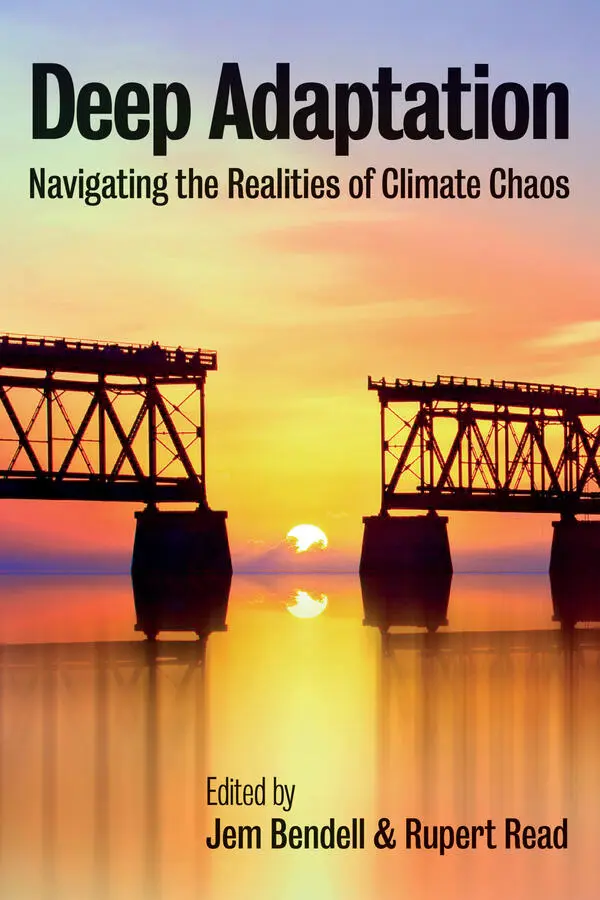
Edited by the originator of the concept of deep adaptation, Jem Bendell, and a leading climate activist and strategist, Rupert Read, this book is the essential introduction to the concept, practice and emerging global movement of Deep Adaptation to climate chaos.
Deep Adaptation — читать онлайн ознакомительный отрывок
Ниже представлен текст книги, разбитый по страницам. Система сохранения места последней прочитанной страницы, позволяет с удобством читать онлайн бесплатно книгу «Deep Adaptation», без необходимости каждый раз заново искать на чём Вы остановились. Поставьте закладку, и сможете в любой момент перейти на страницу, на которой закончили чтение.
Интервал:
Закладка:
Two possible new approaches for survival and compassion
As our anxieties grow, it can be reassuring to work harder with the tools we have at our disposal. However, measuring ever more closely the nature of our predicament will deliver neither greater control nor safety. Rather, if the deeper assumptions and intentions underpinning those projects of measurement are not questioned, then they risk being the means for mass distraction. Therefore, we wonder if a new and happier approach to the climate crisis might emerge if one of the two following possibilities were to be attempted:
1 Society has been relying on scientists to blow the whistle on climate collapse. Mostly, scientists haven’t yet done so (with honourable exceptions such as Hansen and Knorr). Scientists should admit that their approach, of trusting in the system, gradualism and reformism, and basically seeking to maintain the system (a system which enables them to be well paid, to feel important, to feel righteous, to travel the world giving warnings of how bad things are, while continuing to live well: Anderson 2018) has, on balance, badly failed. Now, scientists admitting this would have vertiginous consequences. The curtain would be pulled back, the veil removed, the pretence would be over. Many ordinary citizens would suddenly be scared. Might this have bad consequences?Yes it might. But right now we are driving ourselves over a cliff. So it is time to take a few risks with communications (as we discuss further in the concluding chapter).Imagine if more climate scientists stopped acting just as scientists, and started acting as citizens, as storytellers, as people. What would this look like? It might look like them breaking down with emotion on live TV. It might look like them doing civil disobedience en masse – and practising transformative or deep adaptation. It would look like them denouncing the absurdities not just of the Trumps but of the Nordhauses of this world – and of their own funders. 4Why hasn’t this already happened at scale? No doubt there are many reasons, including some good ones; but we think the widespread mostly unspoken perception is that private feelings of terror are not supposed to enter professional conduct or judgement. We believe that that is a convention outside of science itself; and we are describing what it has led to.We suspect that the desperate maintenance, to a large extent, of a veneer of normality as our civilization drives over a cliff edge indeed comes from despair – and from the desperate management of that despair. We suspect that the reason why professional facades are maintained through virtually all of this situation is not mainly because of a (highly and increasingly questionable) belief that that is the most pragmatically effective way to leverage change (through maintaining ‘neutrality’), but mainly because such maintenance assists with terror management. A denial of death: in this case of the likely death of our civilization (which would of course almost certainly mean the death of many within it: Moses 2020; Read and Alexander 2019; and ch. 2 of this book).The point can be made in terms of the concept of incongruence. It’s incongruent to calmly announce potential apocalypse and then go back to work. It undermines the seriousness of the announcement. It’s incongruent to speak of some horrendous eco-catastrophe and not get emotional – or political.It is incumbent upon scientists to seek to stop being incongruent.
2 Failing (1), another potential avenue to explore would be if climate scientists were to step back from their assumed role as the chief guardians of the climate debate. This would allow scholars, activists and policy makers to widen the view (as we hope is occurring in this very book) from the restrictions of a mechanistic scientific paradigm in which what counts are only quantifications suitable for the inclusion into mathematical models. Then people might give more attention to the known scientific fact that changes in complex systems often come about in an abrupt and unpredictable fashion (Servigne and Stevens 2020). Perhaps the climate agenda could better include other approaches and world views, in particular indigenous knowledge, as practised by the Intergovernmental Platform on Biodiversity and Ecosystem Services (Díaz et al. 2015). This would allow us to start learning from past breakdown and catastrophe, to thus better prepare for the inevitable disruptions ahead, and to start thinking about how to avoid the worst-case scenarios. Most importantly, we would stop underestimating the risks by overestimating the primacy of one means of knowing, and finally come to accept how precarious most human, animal and plant life has become on this planet.In that epochal context, one might argue that it isn’t good enough any more to restrict to a particular nexus of scientists and (especially) economists the ability to decide the kind of questions that issue from the climate-industrial complex. The talent pool should be considerably enlarged. It should include a range of philosophers, experts in precaution, ethicists. It should include systems thinkers and social scientists. It should go further still: it should include writers of imaginative fiction concerning the future. Further still: it should certainly, as we noted above, include indigenous people who have access to wisdom self-evidently little present in our civilization. Furthest of all: it should not be restricted to adults. Nordhaus, Stern, Mendessohn and Tol should for example consult with representatives of the young generation still at school about which future discount rate to use in their economic modelling. And not just that: the younger generation, who are not old enough to vote yet (which should be reconsidered) but aren’t too young to die in climate disasters, should be given a role in deciding questions such as this.There is no solid case, we are saying, given the failure around which this chapter revolves, for the climate debate to be taking place within nearly as restricted a group as it has been. Citizens’ assemblies which include the young and the indigenous, the colonized and the marginalized, and which are empowered to make decisions about mitigation, adaptation, habitat-preservation, ecocide, discount rates and suchlike, are therefore one attractive way of reorienting the entire terrain.
Best of all, of course, would be to have a synthesis of both (1) and (2): climate scientists telling the truth, in the souped-up manner we outline above, and accepting the need to step aside somewhat to provide more space that the rest of us can rush into. We are encouraged, therefore, that many climatologists joined hundreds of other scholars in signing an international scholars’ warning on collapse risk.
Box 1.1The international scholars warning on collapse risk
As scientists and scholars from around the world, we call on policymakers to engage with the risk of disruption and even of collapse of societies. After five years failing to reduce emissions in line with the Paris climate accord, we must now face the consequences. While bold and fair efforts to cut emissions and naturally draw down carbon are essential, researchers in many areas consider societal collapse a credible scenario this century. Different views exist on the location, extent, timing, permanence and cause of disruptions, but the way modern societies exploit people and nature is a common concern. Only if policy makers begin to discuss this threat of societal collapse might we begin to reduce its likelihood, speed, severity, harm to the most vulnerable – and to nature.
Some armed services already see collapse as an important scenario. Surveys show many people now anticipate societal collapse. Sadly, that is the experience of many communities in the global South. However, it is not well reported in the media and mostly absent from civil society and politics. People who care about environmental and humanitarian issues should not be discouraged from discussing the risks of societal disruption or collapse. Ill-informed speculations about impacts on mental health and motivation will not support serious discussion. That risks betraying thousands of activists whose anticipation of collapse is part of their motivation to push for change on climate, ecology and social justice.
Читать дальшеИнтервал:
Закладка:
Похожие книги на «Deep Adaptation»
Представляем Вашему вниманию похожие книги на «Deep Adaptation» списком для выбора. Мы отобрали схожую по названию и смыслу литературу в надежде предоставить читателям больше вариантов отыскать новые, интересные, ещё непрочитанные произведения.








Обсуждение, отзывы о книге «Deep Adaptation» и просто собственные мнения читателей. Оставьте ваши комментарии, напишите, что Вы думаете о произведении, его смысле или главных героях. Укажите что конкретно понравилось, а что нет, и почему Вы так считаете.