Deep Adaptation
Здесь есть возможность читать онлайн «Deep Adaptation» — ознакомительный отрывок электронной книги совершенно бесплатно, а после прочтения отрывка купить полную версию. В некоторых случаях можно слушать аудио, скачать через торрент в формате fb2 и присутствует краткое содержание. Жанр: unrecognised, на английском языке. Описание произведения, (предисловие) а так же отзывы посетителей доступны на портале библиотеки ЛибКат.
- Название:Deep Adaptation
- Автор:
- Жанр:
- Год:неизвестен
- ISBN:нет данных
- Рейтинг книги:4 / 5. Голосов: 1
-
Избранное:Добавить в избранное
- Отзывы:
-
Ваша оценка:
Deep Adaptation: краткое содержание, описание и аннотация
Предлагаем к чтению аннотацию, описание, краткое содержание или предисловие (зависит от того, что написал сам автор книги «Deep Adaptation»). Если вы не нашли необходимую информацию о книге — напишите в комментариях, мы постараемся отыскать её.
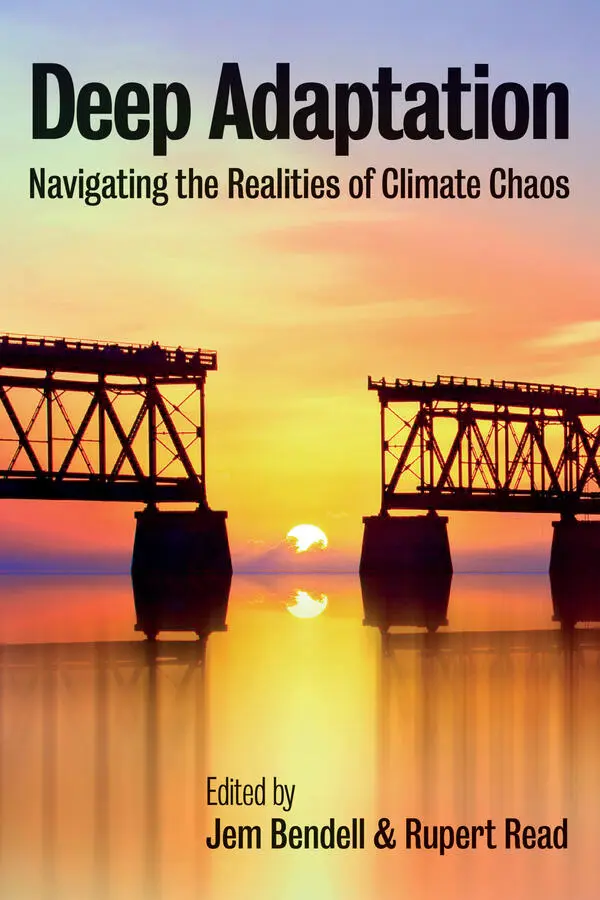
Edited by the originator of the concept of deep adaptation, Jem Bendell, and a leading climate activist and strategist, Rupert Read, this book is the essential introduction to the concept, practice and emerging global movement of Deep Adaptation to climate chaos.
Deep Adaptation — читать онлайн ознакомительный отрывок
Ниже представлен текст книги, разбитый по страницам. Система сохранения места последней прочитанной страницы, позволяет с удобством читать онлайн бесплатно книгу «Deep Adaptation», без необходимости каждый раз заново искать на чём Вы остановились. Поставьте закладку, и сможете в любой момент перейти на страницу, на которой закончили чтение.
Интервал:
Закладка:
CONTENTS
1 Cover
2 Endorsement Praise for Deep Adaptation ‘The authors of this book have courage to recognise the reality of our time and face the uncomfortable facts of climate calamity. The theme of this book is indeed scary. But it’s full of bright ideas for how to transmute both fear and difficulty into kind and wise ways of living and working. The thinkers, academics and activists who have contributed to this book embody the wisdom to adapt to this unprecedented catastrophe. They also show the practical ways and means to live and act with the imagination and resilience. Not everyone would agree to these radical ideas but everyone needs to know about them. So, I recommend this book to all.’ Satish Kumar, Editor Emeritus for Resurgence & Ecologist and Founder of Schumacher College ‘Collapse followed by transformation is a common way that complex systems evolve. Perhaps collapse of our high consumption, climate-destabilising society can lead to transformation towards a brighter human future. The Deep Adaptation framework outlined in this book is a helpful way to seek that transformation.’ Professor Will Steffen, Australian National University Climate Change Institute
3 Title Page DEEP ADAPTATION Navigating the Realities of Climate Chaos Edited by Jem Bendell and Rupert Read polity
4 Copyright Copyright © Jem Bendell and Rupert Read 2021 The right of Jem Bendell and Rupert Read to be identified as Editors of this Work has been asserted in accordance with the UK Copyright, Designs and Patents Act 1988. First published in 2021 by Polity Press Polity Press 65 Bridge Street Cambridge CB2 1UR, UK Polity Press 101 Station Landing Suite 300 Medford, MA 02155, USA All rights reserved. Except for the quotation of short passages for the purpose of criticism and review, no part of this publication may be reproduced, stored in a retrieval system or transmitted, in any form or by any means, electronic, mechanical, photocopying, recording or otherwise, without the prior permission of the publisher. ISBN-13: 978-1-5095-4685-5 A catalogue record for this book is available from the British Library. Names: Bendell, Jem, editor. | Read, Rupert J., 1966- editor.¬† Title: Deep adaptation : navigating the realities of climate chaos / edited by Jem Bendell & Rupert Read.¬† Description: Cambridge, UK ; Medford, MA : Polity Press, 2021. | Includes bibliographical references. | Summary: “A new agenda for how we can prepare for societal collapse in an age of climate chaos”-- Provided by publisher.¬† Identifiers: LCCN 2020052406 (print) | LCCN 2020052407 (ebook) | ISBN 9781509546831 (hardback) | ISBN 9781509546848 (paperback) | ISBN 9781509546855 (epub)¬† Subjects: LCSH: Climatic changes--Social aspects. | Climate change mitigation--Social aspects. | Climate change mitigation--Social aspects. Classification: LCC QC903 .D443 2021¬† (print) | LCC QC903¬† (ebook) | DDC 304.2/5--dc23 LC record available at https://lccn.loc.gov/2020052406 LC ebook record available at https://lccn.loc.gov/2020052407 The publisher has used its best endeavours to ensure that the URLs for external websites referred to in this book are correct and active at the time of going to press. However, the publisher has no responsibility for the websites and can make no guarantee that a site will remain live or that the content is or will remain appropriate. Every effort has been made to trace all copyright holders, but if any have been overlooked the publisher will be pleased to include any necessary credits in any subsequent reprint or edition. For further information on Polity, visit our website: politybooks.com
5 Acknowledgements Acknowledgements The editors thank Katie Carr for providing editorial support for this book and the Griffith Centre for Sustainable Enterprise (Griffith University, Australia), with its director Dr Rob Hales, for helping to finance that support. We also thank Atus Mariqueo-Russell for editorial help and each chapter contributor for responding courageously to our call to apply their hearts and minds to this difficult topic. We also thank the Club of Rome for their enthusiasm for this book, which joins the vital and vast conversation they began in 1972 when they warned of societal collapse. Jorgen Randers helped us in the earliest stages of the planning. We hope that our focus in this book about preparing to soften the impact and harm of any and all such collapses will be a useful, though unfortunate and stressful, addition to their ongoing dialogue and policy initiatives. Jem Bendell : I thank the many volunteers in the Deep Adaptation Forum around the world, most of whom I have never met in person and yet feel admiration and affection for. Your decision to step up and help people come together in new ways for new initiatives at this difficult time has felt like a balm for my soul. I also thank the people who have been important to my intellectual journey in recent years, including Katie Carr, Richard Little, Matthew Slater, Zori Tomova, Vanessa Andreotti and all the authors cited in chapter 5 . Rupert Read : I thank many colleagues in and beyond Extinction Rebellion: the journey of transformative and deep adaptations will be a defining one of the 2020s; thanks to the post-XR ‘TrAd’ group for helping me pathfind (especially Oona, April, Simon, Skeena). And I thank my academic colleagues (and next-door neighbours) Jo Clarke and Nick Brooks for invaluable discussions on the same topics: what starts in Merton Road doesn’t stay in Merton Road. Thanks finally to the AHRC for grant support that helped provide some time and resources for me for this book.
6 About the Contributors
7 Introduction: What Next, Now That the Limits Have Been Breached? References
8 Part I The Predicament 1 What Climate Science Can and Cannot Tell Us About Our Predicament Where we are after 125 years of climate science The root of denial may be found in the workings of climate science A case for the virtue of scientific ignorance Two possible new approaches for survival and compassion References 2 Deep Adaptation: A Map for Navigating Climate Tragedy Preamble Introduction Locating this study within academia Our non-linear world Looking ahead Apocalypse uncertain Systems of denial Framing after denial The deep adaptation agenda Research futures in the face of climate tragedy Conclusions References 3 Reasons for Anticipating Societal Collapse Introduction What do we do with this? References
9 Part II Shifts in Being 4 Climate Psychology and its Relevance to Deep Adaptation Why climate psychology? Shiva – seeing what we need to see from inside a sick culture Formation The devil has the best tunes Denial Forms of denial Denialism Disavowal A nexus of denial The psychotherapy profession – another case study? References 5 Deeper Implications of Societal Collapse: Co-liberation from the Ideology of E-s-c-a-p-e Entitlement in E-s-c-a-p-e ideology Surety in e-S-c-a-p-e ideology Control in e-s-C-a-p-e ideology Autonomy in e-s-c-A-p-e ideology Progress in e-s-c-a-P-e ideology Exceptionalism in e-s-c-a-p-E ideology Habits of e-s-c-a-p-e in the climate change field The economic reproduction of e-s-c-a-p-e Moving beyond e-s-c-a-p-e to c-o-s-m-o-s Considerations for co-liberation from destructive ideology References 6 Unconscious Addictions: Mapping Common Responses to Climate Change and Potential Climate Collapse Introduction Climate collapse denial The house of modernity and its four constitutive denials Responses to the possibility of climate collapse The rehab References 7 Facilitating Deep Adaptation: Enabling More Loving Conversations about Our Predicament The importance of facilitating groups in the face of collapse Understanding ‘othering’ and its remedy with facilitation Aspects of facilitating deep adaptation Containment Denial and radical uncertainty Grief Examples of deep adaptation modalities and facilitated processes Deep listening Conclusion References 8 The Great Turning: Reconnecting Through Collapse Natural allies Facing collapse Doing the work Meaning and hope in a time of collapse Conclusion: People of the Passage References
Читать дальшеИнтервал:
Закладка:
Похожие книги на «Deep Adaptation»
Представляем Вашему вниманию похожие книги на «Deep Adaptation» списком для выбора. Мы отобрали схожую по названию и смыслу литературу в надежде предоставить читателям больше вариантов отыскать новые, интересные, ещё непрочитанные произведения.











Обсуждение, отзывы о книге «Deep Adaptation» и просто собственные мнения читателей. Оставьте ваши комментарии, напишите, что Вы думаете о произведении, его смысле или главных героях. Укажите что конкретно понравилось, а что нет, и почему Вы так считаете.