Deep Adaptation
Здесь есть возможность читать онлайн «Deep Adaptation» — ознакомительный отрывок электронной книги совершенно бесплатно, а после прочтения отрывка купить полную версию. В некоторых случаях можно слушать аудио, скачать через торрент в формате fb2 и присутствует краткое содержание. Жанр: unrecognised, на английском языке. Описание произведения, (предисловие) а так же отзывы посетителей доступны на портале библиотеки ЛибКат.
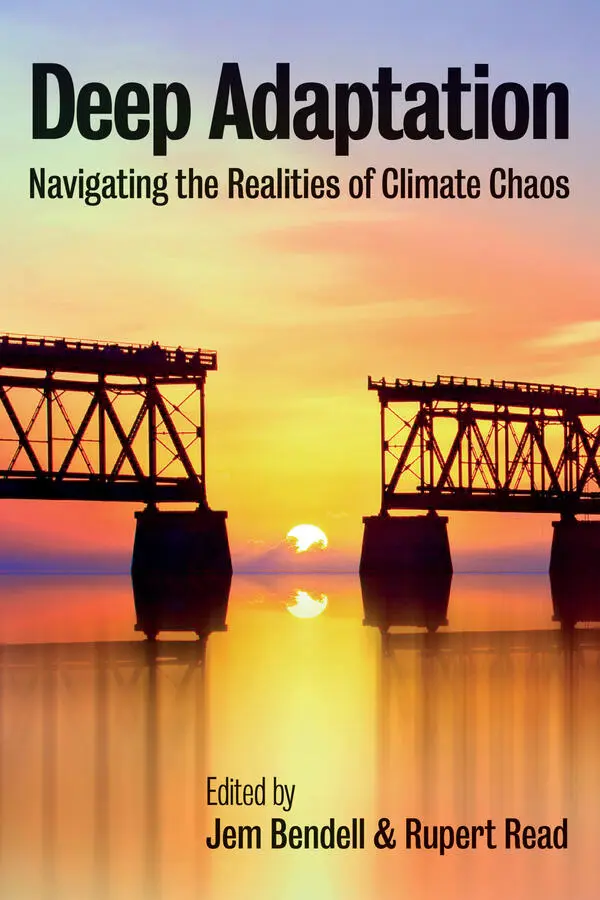
- Название:Deep Adaptation
- Автор:
- Жанр:
- Год:неизвестен
- ISBN:нет данных
- Рейтинг книги:4 / 5. Голосов: 1
-
Избранное:Добавить в избранное
- Отзывы:
-
Ваша оценка:
Deep Adaptation: краткое содержание, описание и аннотация
Предлагаем к чтению аннотацию, описание, краткое содержание или предисловие (зависит от того, что написал сам автор книги «Deep Adaptation»). Если вы не нашли необходимую информацию о книге — напишите в комментариях, мы постараемся отыскать её.
Edited by the originator of the concept of deep adaptation, Jem Bendell, and a leading climate activist and strategist, Rupert Read, this book is the essential introduction to the concept, practice and emerging global movement of Deep Adaptation to climate chaos.
Deep Adaptation — читать онлайн ознакомительный отрывок
Ниже представлен текст книги, разбитый по страницам. Система сохранения места последней прочитанной страницы, позволяет с удобством читать онлайн бесплатно книгу «Deep Adaptation», без необходимости каждый раз заново искать на чём Вы остановились. Поставьте закладку, и сможете в любой момент перейти на страницу, на которой закончили чтение.
Интервал:
Закладка:
Some communities are already experiencing breakdowns due to direct or indirect impacts of climate change, as well as issues relating to epidemics, the failures of capitalism, and racial inequality, to name but a few stressors on societies (Future Earth 2020). More research is being done on assessing when and where societal breakdowns may occur, though that is very difficult to predict and such work could become a distraction from inquiry into the root causes and into rapid meaningful action. With this book, we wish to contribute to the field of inquiry and action that starts from an anticipation of societal collapse. In other words: what if we were actually to look the very real prospect of such collapse in the face, rather than always shying away from it or only attempting to prevent it? What might happen? What might we feel? What might shift? How might our plans and struggles – including perhaps those intended to mitigate the chaos – be transformed or energized?
We know first-hand how it is psychologically challenging to reach the conclusion that there will be massive disruption, or even collapse, of societies around the world, including the ones we live in. Not only is it difficult to allow this outlook into one’s awareness, it is difficult to live with it because to anticipate societal collapse means we feel personally vulnerable as well as afraid for the future of people dear to us. That psychological distress occurs even before we experience specific disruptions from the direct and indirect impacts of a degrading environment and growing public anxieties. The matter of emotional well-being is important within the deep adaptation agenda, as explored in chapter 4on insights from psychology, as well as in chapter 8on some of the psycho-spiritual implications. There are particular concerns about children and young people. We are acutely aware of how young people are growing up into a climate-disturbed future. For us, real solidarity with them must include efforts at practical and psychological adaptation to that future, rather than suppressing this difficult agenda. Some of the initial implications for education and schools are discussed in chapter 10.
The concept of deep adaptation and an associated framework for dialogue was created by the transdisciplinary sociologist and co-editor of this book, Professor Jem Bendell. It became popular in a paper released by the University of Cumbria in the United Kingdom (Bendell 2018). That paper was downloaded around a million times within a couple of years and influenced many people to join and lead climate activist groups (Green 2019). To support this movement, the Deep Adaptation Forum was launched in April 2019 to freely connect people who believe that deep adaptation provides a useful framework for them to respond to this predicament. 2The Forum explains an intention to embody and enable loving responses to our predicament where we can help each other prepare in ways that may reduce harm, especially by reducing conflict and trauma. It is founded on a collective leadership philosophy, where generative dialogue is both a key modality and aim (Bendell, Sutherland and Little 2017). To help with that, Deep Adaptation involves a framework of four questions, providing people with a way of exploring those potential changes together. Outlined in chapter 2, they are called the 4Rs. What do we most value that we want to keep and how? That is a question of resilience. What could we let go of so as not to make matters worse? That is a question of relinquishment. What could we bring back to help us in these difficult times? That is a question of restoration. With what and with whom shall we make peace as we awaken to our common mortality? That is a question of reconciliation.
We continue to meet people who believe an anticipation of societal collapse is a credible perspective but who think it is unhelpful to articulate that or work from that basis. Our experience has been the opposite. After concluding that collapse is likely or inevitable, many people become very engaged in social and political action to slow dangerous climate change, reduce impacts, help each other and reverse injustices (Bendell and Cave 2020). Additionally, the more time we have to try to adapt, the more likely we can hold societies together to keep one another safe while cutting and drawing down carbon emissions (Read 2020a, 2020b; Foster et al. 2019).
Some of the resistance to deep adaptation may arise because it represents a fundamental break with the international policy paradigm of the past 30 years. Adopted at the UN in 1987, the concept of sustainable development suggests that it is possible to maintain capitalism while integrating concerns about the environment and society (Foster 2019). The deep adaptation perspective sees the pace and scale of dangerous levels of climate change and ecological degradation to be so fast that neither a reform of capitalism nor of modern society is realistic. Therefore, deep adaptation is a form of ‘post-sustainability’ thinking (ibid.). However, the concept does not equate societal collapse with ‘the end of the world’ or with near-term human extinction. It does not imply lessening our efforts at carbon cuts (mitigation) and drawdown (natural sequestration) but implies that efforts on those aims within the current system must pragmatically be considered likely to continue to fail to significantly reduce atmospheric levels of greenhouse gases; so now we must prepare for societal breakdown and ultimate collapse. If we fail to prepare for such failure, then we are preparing to fail ourselves and our children even more.
By inviting attention to whether an assumption of the continuation of modern society is tenable, a deep adaptation perspective suggests rethinking mainstream approaches to climate change adaptation (CCA). The most resonance with mainstream climate adaptation is in the field of ideas and practices becoming known as ‘transformative adaptation’. Such approaches anticipate the need for systemic change in modes of production, trade and lifestyle to both reduce carbon and be less reliant on the stability of existing ecosystems (Coulter, Serrao-Neumann and Coiacetto 2019). In future, we anticipate a coming together of transformative and deep adaptation as a complement to bolder attempts at carbon cuts and drawdown.
In any future dialogue between people working with different analyses of the predicament we are in, it will be important to recognize how ‘collapse anticipation’ produces a distinctly original paradigm for reflection, learning and action. So much of what people have hitherto taken for granted can be questioned. Therefore, the chapters in this book are merely illustrative of an agenda which offers no simple answers but hopefully provides ways of reaching meaningful answers for your own context.
In Part I, the predicament of facing societal collapse is presented in three chapters. We explain in chapter 1how, for decades, the field of climate science has been conservative in its assessment of the risks facing humanity. The situation is now far worse than tends to be reported in individual climate studies or by the Intergovernmental Panel on Climate Change (IPCC). In chapter 2, a revised version of the original deep adaptation paper by Dr Jem Bendell presents the case for human-triggered climate change having become unavoidably dangerous and explains why the contemporary environmental movement and profession have remained in denial of that reality. The original paper was intended for people researching, educating and practising within the corporate sustainability field, and the chapter retains the original focus and style. In chapter 3, Dr Pablo Servigne and a group of scholars who focus on the science of societal collapse, or ‘collapsology’, provide an overview of the state of knowledge to make the case that collapse anticipation is a credible starting point for both research and policy development.
Читать дальшеИнтервал:
Закладка:
Похожие книги на «Deep Adaptation»
Представляем Вашему вниманию похожие книги на «Deep Adaptation» списком для выбора. Мы отобрали схожую по названию и смыслу литературу в надежде предоставить читателям больше вариантов отыскать новые, интересные, ещё непрочитанные произведения.










Обсуждение, отзывы о книге «Deep Adaptation» и просто собственные мнения читателей. Оставьте ваши комментарии, напишите, что Вы думаете о произведении, его смысле или главных героях. Укажите что конкретно понравилось, а что нет, и почему Вы так считаете.