Deep Adaptation
Здесь есть возможность читать онлайн «Deep Adaptation» — ознакомительный отрывок электронной книги совершенно бесплатно, а после прочтения отрывка купить полную версию. В некоторых случаях можно слушать аудио, скачать через торрент в формате fb2 и присутствует краткое содержание. Жанр: unrecognised, на английском языке. Описание произведения, (предисловие) а так же отзывы посетителей доступны на портале библиотеки ЛибКат.
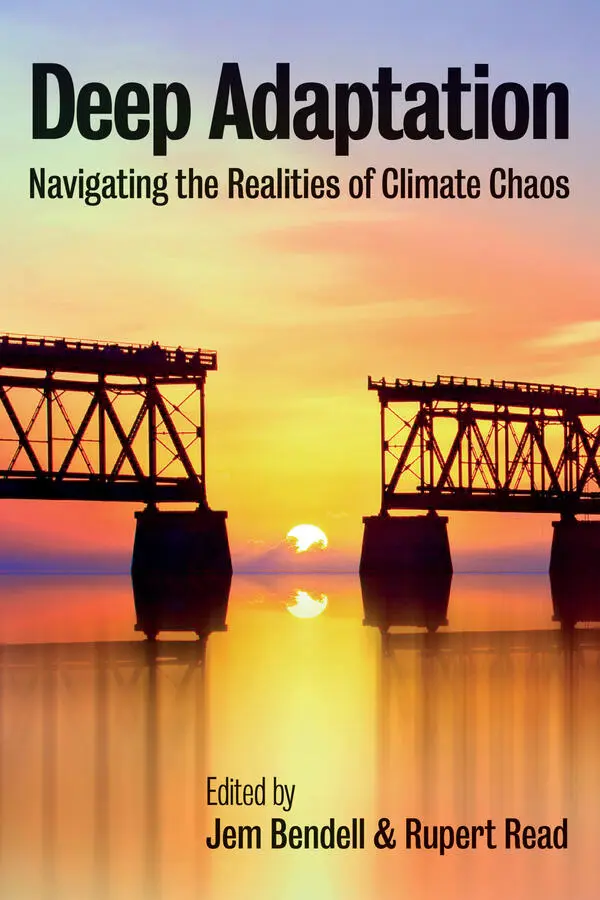
- Название:Deep Adaptation
- Автор:
- Жанр:
- Год:неизвестен
- ISBN:нет данных
- Рейтинг книги:4 / 5. Голосов: 1
-
Избранное:Добавить в избранное
- Отзывы:
-
Ваша оценка:
Deep Adaptation: краткое содержание, описание и аннотация
Предлагаем к чтению аннотацию, описание, краткое содержание или предисловие (зависит от того, что написал сам автор книги «Deep Adaptation»). Если вы не нашли необходимую информацию о книге — напишите в комментариях, мы постараемся отыскать её.
Edited by the originator of the concept of deep adaptation, Jem Bendell, and a leading climate activist and strategist, Rupert Read, this book is the essential introduction to the concept, practice and emerging global movement of Deep Adaptation to climate chaos.
Deep Adaptation — читать онлайн ознакомительный отрывок
Ниже представлен текст книги, разбитый по страницам. Система сохранения места последней прочитанной страницы, позволяет с удобством читать онлайн бесплатно книгу «Deep Adaptation», без необходимости каждый раз заново искать на чём Вы остановились. Поставьте закладку, и сможете в любой момент перейти на страницу, на которой закончили чтение.
Интервал:
Закладка:
Read, R. (2020) ‘Imagining the World after Covid-19’. ABC Religion and Ethics . Available at: https://www.abc.net.au/religion/rupert-read-imagining-a-world-after-coronavirus/12380676
Read, R. and Alexander, S. (2019) This Civilization is Finished . Melbourne: Simplicity Institute.
Read, R. and O’Riordan, T. (2017a) ‘Understanding, Strengthening and Safeguarding the Precautionary Principle’. APPG Limits to Growth . Available at: http://limits2growth.org.uk/wp-content/uploads/2017/11/APPG-Brieffing-Precautionary-Principle-online.pdf
Read, R. and O’Riordan, T. (2017b) ‘The Precautionary Principle Under Fire’. Environment 59: 4–15.
Rockström, J. (2015) Bounding the Planetary Future: Why We Need a Great Transition . Great Transition Initiative. Available at: https://greattransition.org/publication/bounding-the-planetary-future-why-we-need-a-great-transition
Rogelj, J., Shindell, D., Jiang, K., et al. (2018) ‘Mitigation Pathways Compatible with 1.5°C in the Context of Sustainable Development’, in V. Masson-Delmotte, P. Zhai, H.-O. Pörtner, et al. (eds), Global Warming of 1.5°C. An IPCC Special Report on the Impacts of Global Warming of 1.5°C above Pre-industrial levels and Related Global Greenhouse Gas Emission Pathways, in the context of Strengthening the Global Response to the Threat of Climate Change, Sustainable Development, and Efforts to Eradicate Poverty . Cambridge: Cambridge University Press.
Schmidt, J. (2000) Disciplined Minds: A Critical Look at Salaried Professionals and the Soul-Battering System that Shapes their Lives . Oxford: Rowman & Littlefield.
Servigne, P and Stevens, R. (2020) How Everything Can Collapse . Cambridge: Polity Press.
Sherwood, S. et al. (2020) ‘An Assessment of Earth’s Climate Sensitivity Using Multiple Lines of Evidence’. Reviews of Geophysics . Available at: https://agupubs.onlinelibrary.wiley.com/doi/full/10.1029/2019RG000678
SIMIP (Sea Ice Model Intercomparison Project) Community (2020) ‘Arctic Sea Ice in CMIP6’. Geophysical Research Letters 47: e2019GL086749. Available at: doi.org/10.1029/2019GL086749
Slingo, J. (2017) ‘The Evolution of Climate Science: A Personal View from Julia Slingo’. World Meteorological Organization Bulletin 66(1). Available at: https://public.wmo.int/en/resources/bulletin/evolution-of-climate-science-personal-view-from-julia-slingo
Solomon, S., Daniel, J. S., Sanford, T. J., et al. (2010) ‘Persistence of Climate Changes Due to a Range of Greenhouse Gases’. Proceedings of the National Academy of Sciences 107: 18354–9.
Spratt, D. and Dunlop, I. (2018) ‘What Lies Beneath: The Understatement of Existential Climate Risk’. Breakthrough [National Centre for Climate Restoration]. Available at: https://www.breakthroughonline.org.au/whatliesbeneath
Staubwasser, M. and Weiss, H. (2006) ‘Holocene Climate and Cultural Evolution in Late Prehistoric–Early Historic West Asia’. Quaternary Research 66: 372–87.
Steffen, W., Rockström, J., Richardson, K., et al. (2018) ‘Trajectories of the Earth System in the Anthropocene’. Proceedings of the National Academy of Science 115: 8252–9.
Taleb, N., Read, R., Douady, R., Norman, J. and Bar-Yam, Y. (2014) ‘The Precautionary Principle’. Extreme Risk Initiative: NYU School of Engineering Working Paper Series . Available at: https://arxiv.org/abs/1410.5787
Tol, R. S. (2009) ‘The Economic Effects of Climate Change’. Journal of Economic Perspectives 23: 29–51.
Tong, D., Zhang, Q., Zheng, Y., et al. (2019) ‘Committed Emissions from Existing Energy Infrastructure Jeopardize 1.5°C Climate Target’. Nature 572: 373–7.
Trinomics (2018) Study on Energy Prices, Costs and Subsidies and their Impact on Industry and Households, Final Report . European Commission Directorate General for Energy. Available at: https://ec.europa.eu/energy/sites/ener/ffiles/documents/energy_prices_and_costs_-final_report-v12.3.pdf
Wang, S. et al. (2020) ‘Recent Global Decline of CO 2Fertilization Effects on Vegetation Photosynthesis’. Science 370(6522): 1295–1300.
Williams, H. T. and Lenton, T. M. (2010) ‘Evolutionary Regime Shifts in Simulated Ecosystems’. Oikos 119(12): 1887–99.
WMO (World Meteorological Organization) (2019) ‘2019 Concludes a Decade of Exceptional Global Heat and High-impact Weather’. Press release. Available at: https://public.wmo.int/en/media/press-release/2019-concludes-decade-of-exceptional-global-heat-and-high-impact-weather
Xu, Y., Ramanathan, V. and Victor, D. G. (2018) ‘Global Warming Will Happen Faster Than We Think’. Nature 564: 30–2.
Zeebe, R. E., Ridgwell, A. and Zachos, J. C. (2016) ‘Anthropogenic Carbon Release Rate Unprecedented During the Past 66 Million Years’. Nature Geoscience 9: 325–9.
1 1. https://www.esrl.noaa.gov/gmd/aggi/aggi.html
2 2. The above 370 ppm CO2 level would translate to about 3°C overall heating if we assume Pliocene CO2 to be close to the lower estimate, 365 ppm, or 2°C further heating as we have already reached 1°C. At the high end of the estimate, 415 ppm, we assume that 415 – 280 =135 ppm excess CO2 would lead to 3°C warming, but 370 – 280 = 90 ppm excess CO2 to 90/135*3 = 2°C total, or 1°C additional warming.
3 3. In normal science contexts, scientists tell the truth by being careful to avoid ‘type 1’ errors, ‘false positives’. But in post-normal science, it is much more important to avoid ‘type 2’ errors, ‘false negatives’. As we have explained, scientists find this very uncomfortable. They are desperate to avoid being dubbed ‘alarmists’, while they are happy to allow that ‘more research is needed’. This means that science is virtually always behind the curve – whereas in post-normal science we need to be always, precautionarily, ahead of the curve. Otherwise, we don’t get to crush the curve, which is what we need to do: in regard to climate just as much as to epidemics.
4 4.Reframed in terms of the agenda of Extinction Rebellion, what we are talking about in this chapter comes of course under the general heading of XR’s first demand, ‘Tell the truth’. We are saying: you aren’t telling the truth unless you get serious about avoiding type 2 errors. You aren’t telling the truth unless you sketch scenarios, especially of/from fat-tails, to avoid at all costs. You aren’t telling the truth, furthermore, if you undermine in the manner of your presentation the gravity of its content. If you describe a fat tail completely emotionlessly and with no suggestion that this impending scenario may require one to do something other than just keep turning up to work, then you aren’t telling the truth.
Конец ознакомительного фрагмента.
Текст предоставлен ООО «ЛитРес».
Прочитайте эту книгу целиком, купив полную легальную версию на ЛитРес.
Безопасно оплатить книгу можно банковской картой Visa, MasterCard, Maestro, со счета мобильного телефона, с платежного терминала, в салоне МТС или Связной, через PayPal, WebMoney, Яндекс.Деньги, QIWI Кошелек, бонусными картами или другим удобным Вам способом.
Интервал:
Закладка:
Похожие книги на «Deep Adaptation»
Представляем Вашему вниманию похожие книги на «Deep Adaptation» списком для выбора. Мы отобрали схожую по названию и смыслу литературу в надежде предоставить читателям больше вариантов отыскать новые, интересные, ещё непрочитанные произведения.









Обсуждение, отзывы о книге «Deep Adaptation» и просто собственные мнения читателей. Оставьте ваши комментарии, напишите, что Вы думаете о произведении, его смысле или главных героях. Укажите что конкретно понравилось, а что нет, и почему Вы так считаете.