Lee G. Bolman - Reframing Organizations
Здесь есть возможность читать онлайн «Lee G. Bolman - Reframing Organizations» — ознакомительный отрывок электронной книги совершенно бесплатно, а после прочтения отрывка купить полную версию. В некоторых случаях можно слушать аудио, скачать через торрент в формате fb2 и присутствует краткое содержание. Жанр: unrecognised, на английском языке. Описание произведения, (предисловие) а так же отзывы посетителей доступны на портале библиотеки ЛибКат.
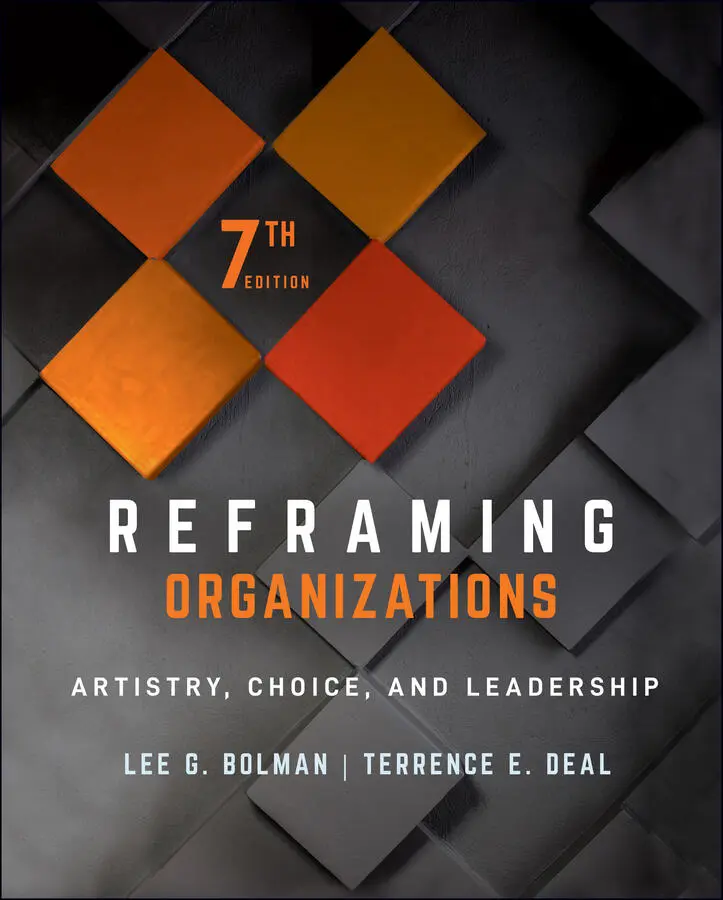
- Название:Reframing Organizations
- Автор:
- Жанр:
- Год:неизвестен
- ISBN:нет данных
- Рейтинг книги:4 / 5. Голосов: 1
-
Избранное:Добавить в избранное
- Отзывы:
-
Ваша оценка:
Reframing Organizations: краткое содержание, описание и аннотация
Предлагаем к чтению аннотацию, описание, краткое содержание или предисловие (зависит от того, что написал сам автор книги «Reframing Organizations»). Если вы не нашли необходимую информацию о книге — напишите в комментариях, мы постараемся отыскать её.
The Structural Frame The Human Resource Frame The Political Frame The Symbolic Frame The
has been updated with new information on cross-sector collaboration, generational differences, virtual environments, globalization, cross-cultural communication, and more, with an expanded Instructor’s Guide that includes summaries, mini-assessments, videos, and extra resources.
Reframing Organizations — читать онлайн ознакомительный отрывок
Ниже представлен текст книги, разбитый по страницам. Система сохранения места последней прочитанной страницы, позволяет с удобством читать онлайн бесплатно книгу «Reframing Organizations», без необходимости каждый раз заново искать на чём Вы остановились. Поставьте закладку, и сможете в любой момент перейти на страницу, на которой закончили чтение.
Интервал:
Закладка:
Managers and employees of McDonald's restaurants have limited discretion about how to do their jobs. Their work is controlled by technology; machines time the preparation of French fries and measure soft drinks. The parent company uses powerful systems to ensure that customers get what they expect and a Big Mac tastes about the same whether purchased in New York, Beijing, or Moscow. Cooks are not expected to develop creative new versions of the Big Mac or Quarter Pounder. In 2019, the company began to experiment with the logical next step: robots that can take orders and flip burgers faster and with fewer errors than humans. Creative departures from standard product lines are neither encouraged nor tolerated on a day‐to‐day basis, though the company has adapted to growth and globalization with a mantra of “freedom within a framework,” increasing its receptivity to new ideas from the field. The Big Mac and Egg McMuffin were both created by local franchisees, and burgers‐on‐wheels home delivery was pioneered in traffic‐choked cities like Cairo and Taipei (Arndt, 2007).
All that structure might sound oppressive, but a major McDonald's miscue in the 1990s resulted from trying to loosen up. Responding to pressure from some frustrated franchisees, McDonald's in 1993 stopped sending out inspectors to grade restaurants on service, food, and ambience. When left to police themselves, some restaurants slipped badly. Customers noticed, and the company's image sagged. Ten years later, a new CEO brought the inspectors back to correct lagging standards (David, 2003).
Year after year, Harvard University appears at or near the top of lists of the world's best universities. Like McDonald's, it has a small administrative group at the top, but in most other respects the two organizations diverge. Even though Harvard is more geographically concentrated than McDonald's, it is significantly more decentralized. Most of Harvard's activities occur within a few square miles of Boston and Cambridge, Massachusetts. Most employees are housed in the university's several schools: Harvard College (the undergraduate school), the graduate faculty of arts and sciences, and various professional schools. Each school has its own dean, its own endowment and, in accordance with Harvard's philosophy of “every tub on its own bottom,” largely controls its own destiny. Schools have fiscal autonomy, and individual professors have enormous discretion. They have substantial control over what courses they teach, what research they do, and which university activities they pursue, if any. Faculty meetings are typically sparsely attended. If a dean or a department head wants a faculty member to chair a committee or offer a new course, the request is more often a humble entreaty than an authoritative command.
The contrast between McDonald's and Harvard is particularly strong at the level of service delivery. Individual personality is not supposed to influence the quality of McDonald's hamburgers, but Harvard courses are the unique creations of individual professors. Two schools might offer courses with the same title but different content and widely divergent teaching styles. Efforts to develop standardized core curricula founder on the autonomy of individual professors.
Structural Differences in the Same Industry
Harvard and McDonald's operate in very different industries, but you will sometimes find very different structures among enterprises operating in a similar business environment. Take Amazon and Zappos.
Both companies are online retailers who ship a variety of goods to customers across America. Both are successful and known for their customer service. We have noted that Amazon gets it done with a tight structure that relies on sophisticated technology, precise measurement, close supervision, and zealous focus on customers, often to the exclusion of employees' satisfaction and welfare.
Contrast this with the Zappos structure, erected on a “culture of happiness” rather than a “culture of metrics.” Tony Hsieh, Zappos' long‐time CEO (now deceased), was just as focused on the customer as Amazon CEO Jeff Bezos (now retired), but he chose a very different structure to get there. Structurally, Amazon and Zappos are mirror images of one another. Amazon steers customers toward interaction with its website rather than its employees. Zappos wants highly motivated, happy employees, immersed in an environment of “weirdness and fun,” who will create a personal, emotional contact with customers.
Zappos' fulfillment operations take place in two large warehouses in Kentucky, where goods are received and merchandise is shelved, picked, packed, and shipped. Work is fast‐paced, intense, and often strenuous. Amazon's warehouse workers have been known to say they are “treated like a piece of crap” (Soper, 2011, p. 1), but Zappos makes working conditions a primary concern. The warehouses are air‐conditioned, and lunch breaks are embellished with free food, video games, and karaoke—the equivalent of adding several dollars to the hourly rate. One employee summed it up: “It's a hot boring job, and we may not get paid top dollar, but with our benefits and free food, it really makes a difference.”
In 2013, Hsieh concluded that Zappos was developing too much bureaucracy and proposed a “holacratic” form that eliminated jobs and the organization chart. Managers were replaced by “lead links” of self‐managing teams, and individuals were charged to use the “Role Marketplace” (Bernstein et al., 2016, p. 10) to look for work that interested them and needed to be done. The new system turned off some employees, and Zappos lost almost a fifth of its workforce. The transition to holacracy required major investments of time and energy as everyone struggled to figure out how the new system was supposed to work. Things got worse before they got better, as is typical of structural change. Most efforts fail. But, working within the holacracy framework, by 2015, Zappos achieved a 75 percent year‐over‐year increase in profits (Bernstein et al., 2016). The long‐term impact on Zappos' free‐wheeling culture remains to be seen, and Zappos has modified the model to make it more consistent with the company's human values, but this experiment may turn out to be less crazy than critics expected (Groth, 2020).
Zappos and Amazon achieve customer satisfaction through entirely different structural arrangements. What makes the story even more interesting is that Amazon paid over $1 billion to buy Zappos in November 2009. More than a year later, Zappos CEO Tony Hsieh sent a memo to employees saying the culture was still intact, Zappos was still in charge of its own destiny, and business was better than ever (Lashinsky, 2010). That was still true a decade later in 2020.
Exhibit 3.3. Structural Imperatives.
| Dimension | Structural Implications |
|---|---|
| Size and age | Complexity and formality typically increase with size and age |
| Core process | Structure must align with core processes or technologies |
| Environment | Stable environment rewards simpler structure; uncertain, turbulent environment requires a more complex, flexible structure |
| Strategy and goals | Variation in clarity and consistency of strategy requires appropriate structural adaptations |
| Information technology | Information technology permits flatter, more flexible, and more decentralized structures |
| Nature of the workforce | More educated and professional workers need and want greater autonomy and discretion |
Structural Imperatives
Why do McDonald's and Harvard or Zappos and Amazon have such different structures? Is one more effective than the other? Or has each evolved to fit its unique circumstances? In fact, there is no such thing as an ideal structure. Every organization needs to respond to a universal set of internal and external parameters (outlined in Exhibit 3.3). These parameters, or contingencies, include the organization's size, age, core process, environment, strategy and goals, information technology, and workforce characteristics. All these combine to point toward an optimal social architecture.
Читать дальшеИнтервал:
Закладка:
Похожие книги на «Reframing Organizations»
Представляем Вашему вниманию похожие книги на «Reframing Organizations» списком для выбора. Мы отобрали схожую по названию и смыслу литературу в надежде предоставить читателям больше вариантов отыскать новые, интересные, ещё непрочитанные произведения.
![Lee Jungmin - Хвала Орку 1-128 [некоммерческий перевод с корейского]](/books/33159/lee-jungmin-hvala-orku-1-thumb.webp)










Обсуждение, отзывы о книге «Reframing Organizations» и просто собственные мнения читателей. Оставьте ваши комментарии, напишите, что Вы думаете о произведении, его смысле или главных героях. Укажите что конкретно понравилось, а что нет, и почему Вы так считаете.