Confucius - The Five Classics
Здесь есть возможность читать онлайн «Confucius - The Five Classics» — ознакомительный отрывок электронной книги совершенно бесплатно, а после прочтения отрывка купить полную версию. В некоторых случаях можно слушать аудио, скачать через торрент в формате fb2 и присутствует краткое содержание. Жанр: unrecognised, на английском языке. Описание произведения, (предисловие) а так же отзывы посетителей доступны на портале библиотеки ЛибКат.
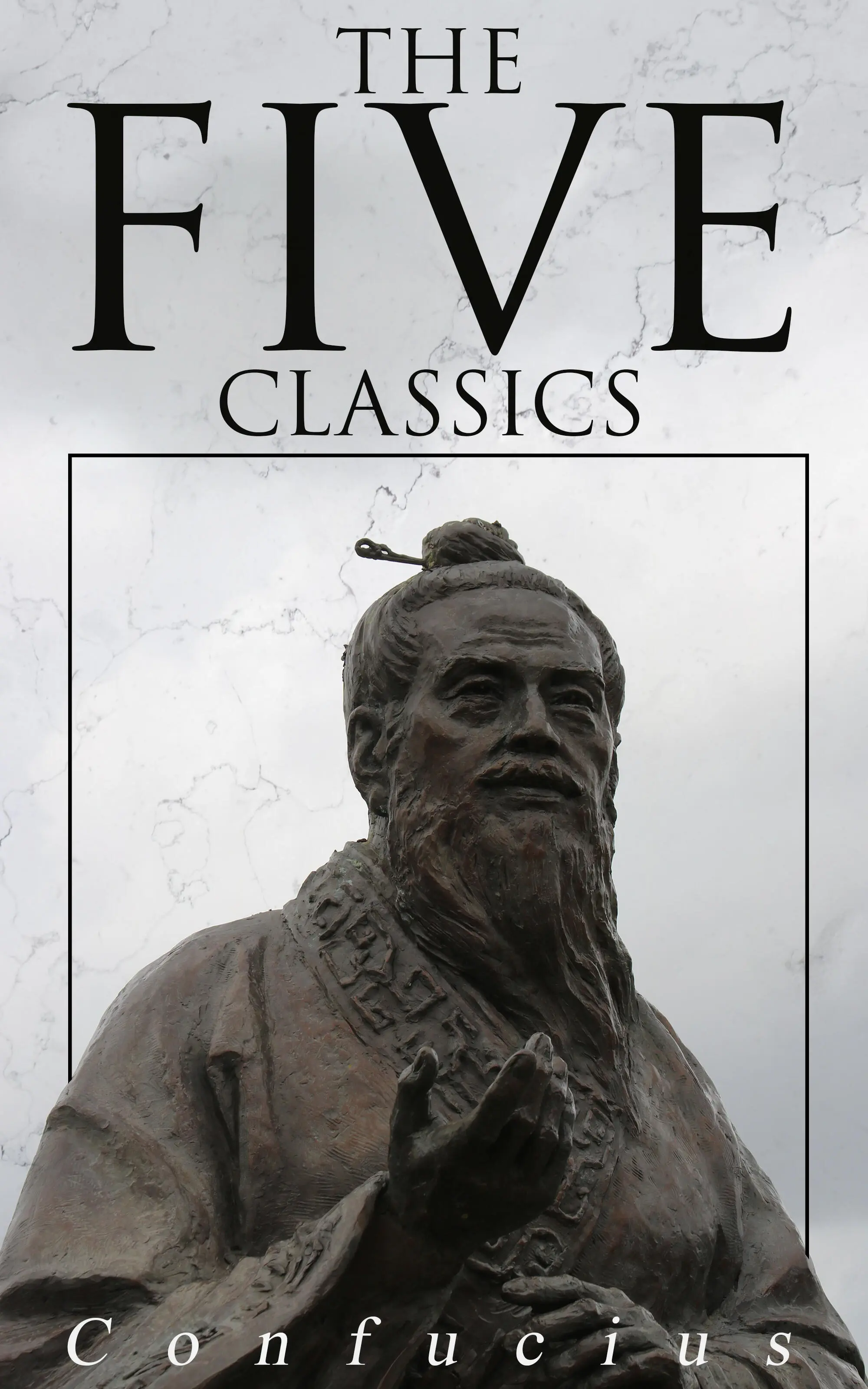
- Название:The Five Classics
- Автор:
- Жанр:
- Год:неизвестен
- ISBN:нет данных
- Рейтинг книги:5 / 5. Голосов: 1
-
Избранное:Добавить в избранное
- Отзывы:
-
Ваша оценка:
The Five Classics: краткое содержание, описание и аннотация
Предлагаем к чтению аннотацию, описание, краткое содержание или предисловие (зависит от того, что написал сам автор книги «The Five Classics»). Если вы не нашли необходимую информацию о книге — напишите в комментариях, мы постараемся отыскать её.
I Ching – The book contains a divination system comparable to Western geomancy or the West African Ifá system. In Western cultures and modern East Asia, it is still widely used for this purpose.
Shu King – A collection of documents and speeches alleged to have been written by rulers and officials of the early Zhou period and before. It is possibly the oldest Chinese narrative, and may date from the 6th century BC. It includes examples of early Chinese prose.
The Shih King – A collection of 305 poems divided into 160 folk songs, 105 festal songs sung at court ceremonies, and 40 hymns and eulogies sung at sacrifices to heroes and ancestral spirits of the royal house.
The Li Ki – Describes ancient rites, social forms and court ceremonies. The version studied today is a re-worked version compiled by scholars in the third century BC rather than the original text, which is said to have been edited by Confucius himself.
Spring and Autumn Annals – A historical record of the State of Lu, Confucius's native state, 722–481 BC.
The Five Classics — читать онлайн ознакомительный отрывок
Ниже представлен текст книги, разбитый по страницам. Система сохранения места последней прочитанной страницы, позволяет с удобством читать онлайн бесплатно книгу «The Five Classics», без необходимости каждый раз заново искать на чём Вы остановились. Поставьте закладку, и сможете в любой момент перейти на страницу, на которой закончили чтение.
Интервал:
Закладка:
2. The second line, undivided, shows its subject full of apprehension and appealing (for sympathy and help). Late at night hostile measures may be (taken against him), but he need not be anxious about them.
3. The third line, undivided, shows its subject (about to advance) with strong (and determined) looks. There will be evil. (But) the superior man, bent on cutting off (the criminal), will walk alone and encounter the rain, (till he be hated by his proper associates) as if he were contaminated (by the others). (In the end) there will be no blame against him.
4. The fourth line, undivided, shows one from whose buttocks the skin has been stripped, and who walks slowly and with difficulty. (If he could act) like. a sheep led (after its companions), occasion for repentance would disappear. But though he hear these words, he will not believe them.
5. The fifth line, undivided, shows (the small men like) a bed of purslain, which ought to be uprooted with the utmost determination. (The subject of the line having such determination), his action, in harmony with his central position, will lead to no error or blame.
6. The sixth line, divided, shows its subject without any (helpers) on whom to call. His end will be evil.
Footnotes
43.In Kwâi we have the hexagram of the third month, when the last remnant, cold and dark, of winter, represented by the sixth line, is about to disappear before the advance of the warm and bright days of the approaching summer. In the yin line at the top king Wăn saw the symbol of a small or bad man, a feudal prince or high minister, lending his power to maintain a corrupt government, or, it might be, a dynasty that was waxen old and ready to vanish away; and in the five undivided lines he saw the representatives of good order, or, it might be, the dynasty which was to supersede the other. This then is the subject of the hexagram,--how bad men, statesmen corrupt and yet powerful, are to be put out of the way. And he who would accomplish the task must do so by the force of his character more than by force of arms, and by producing a general sympathy on his side.
The Thwan says that he must openly denounce the criminal in the court, seek to awaken general sympathy, and at the same time go about his enterprise, conscious of its difficulty and danger. Among his own adherents, moreover, as if it were in his own city, he must make it understood how unwillingly he takes up arms. Then let him go forward, and success will attend him.
Line 1 is strong, the first line of that trigram, which expresses the idea of strength. But it is in the lowest place. The stage of p. 154 the enterprise is too early, and the preparation too small to make victory certain. Its subject had better not take the field.
Line 2 is strong, and central, and its subject is possessed with the determination to do his part in the work of removal. But his eagerness is tempered by his occupancy of an even place; and he is cautious, and no attempts, however artful, to harm him will take effect.
Line 3 is strong, and its subject displays his purpose too eagerly. Being beyond the central position, moreover, gives an indication of evil. Lines 3 and 6 are also proper correlates; and, as elsewhere in the Yî, the meeting of yin and yang lines is associated with falling rain. The subject of 3, therefore, communicates with 6, in a way that annoys his associates; but nevertheless he commits no error, and, in the end, incurs no blame.
Line 4 is not in the centre, nor in an odd place, appropriate to it as undivided. Its subject therefore will not be at rest, nor able to do anything to accomplish the idea of the hexagram. He is symbolised by a culprit, who, according to the ancient and modern custom of Chinese courts, has been bastinadoed till he presents the appearance in the Text. Alone he can do nothing; if he could follow others, like a sheep led along, he might accomplish something, but he will not listen to advice.
Purslain grows in shady places, and hence we find it here in close contiguity to the topmost line, which is yin. As 5 is the ruler's seat, evil may come to him from such contiguity, and strenuous efforts must be made to prevent such an evil. The subject of the line, the ruler in the central place, will commit no error. It must be allowed that the symbolism in this line is not easily managed.
The subject of the 6th line, standing alone, may be easily disposed of.
Hexagram XLIV. 44Kâu
Table of Contents

Kâu shows a female who is bold and strong. It will not be good to marry (such) a female.
1. The first line, divided, shows how its subject should be kept (like a carriage) tied and fastened to a metal drag, in which case with firm correctness there will be good fortune. (But) if he move in any direction, evil will appear. He will be (like) a lean pig, which is sure to keep jumping about.
2. The second line, undivided, shows its subject with a wallet of fish. There will be no error. But it will not be well to let (the subject of the first line) go forward to the guests.
3. The third line, undivided, shows one from whose buttocks the skin has been stripped so that he walks with difficulty. The position is perilous, but there will be no great error.
4. The fourth line, undivided, shows its subject with his wallet, but no fish in it. This will give rise to evil.
5. The fifth line, undivided, (shows its subject as) a medlar tree overspreading the gourd (beneath it). If he keep his brilliant qualities concealed, (a good issue) will descend (as) from Heaven.
6. The sixth line, undivided, shows its subject receiving others on his horns. There will be occasion for regret, but there will be no error.
Footnotes
44.The single, divided, line at the top of Kwâi, the hexagram of the third month, has been displaced, and Kh ien has ruled over the fourth month of the year. But the innings of the divided line commence again; and here we have in Kâu the hexagram of the fifth month, when light and heat are supposed both to begin to be less.
In that divided line Wăn saw the symbol of the small or unworthy man, beginning to insinuate himself into the government p. 156 of the country. His influence, if unchecked, would go on to grow, and he would displace one good man after another, and fill the vacant seats with others like-minded with himself. The object of Wăn in his Thwan, therefore, was to enjoin resistance to the encroachment of this bad man.
K âu is defined as giving the idea of suddenly and casually encountering or meeting with. So does the divided line appear all at once in the figure. And this significance of the name rules in the interpretation of the lines, so as to set on one side the more common interpretation of them according to the correlation; showing how the meaning of the figures was put into them from the minds of Wăn and Tan in the first place. The sentiments of the Text are not learned from them; but they are forced and twisted, often fantastically, and made to appear to give those sentiments forth of themselves.
Here the first line, divided, where it ought to be the contrary, becomes the symbol of a bold, bad woman, who appears unexpectedly on the scene, and wishes to subdue or win all the five strong lines to herself. No one would contract a marriage with such a female; and every good servant of his country will try to repel the entrance into the government of every officer who can be so symbolised.
Line 1 represents the bête noire of the figure. If its subject can be kept back, the method of firm government and order will proceed. If he cannot be restrained, he will become disgusting and dangerous. It is not enough for the carriage to be stopt by the metal drag; it is also tied or bound to some steadfast object. Internal and external restraints should be opposed to the bad man.
Читать дальшеИнтервал:
Закладка:
Похожие книги на «The Five Classics»
Представляем Вашему вниманию похожие книги на «The Five Classics» списком для выбора. Мы отобрали схожую по названию и смыслу литературу в надежде предоставить читателям больше вариантов отыскать новые, интересные, ещё непрочитанные произведения.






Обсуждение, отзывы о книге «The Five Classics» и просто собственные мнения читателей. Оставьте ваши комментарии, напишите, что Вы думаете о произведении, его смысле или главных героях. Укажите что конкретно понравилось, а что нет, и почему Вы так считаете.