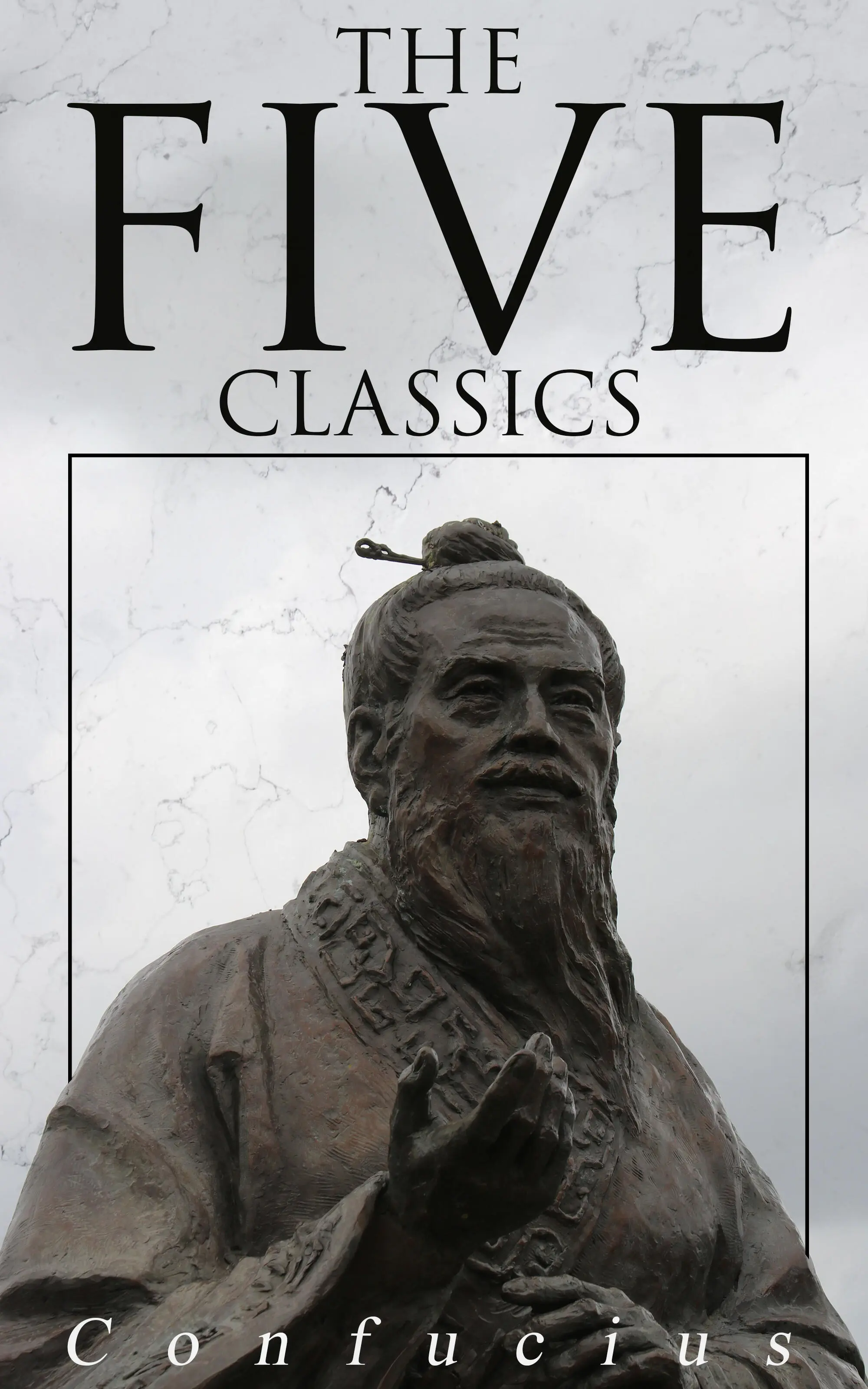
Confucius - The Five Classics
Здесь есть возможность читать онлайн «Confucius - The Five Classics» — ознакомительный отрывок электронной книги совершенно бесплатно, а после прочтения отрывка купить полную версию. В некоторых случаях можно слушать аудио, скачать через торрент в формате fb2 и присутствует краткое содержание. Жанр: unrecognised, на английском языке. Описание произведения, (предисловие) а так же отзывы посетителей доступны на портале библиотеки ЛибКат.
- Название:The Five Classics
- Автор:
- Жанр:
- Год:неизвестен
- ISBN:нет данных
- Рейтинг книги:5 / 5. Голосов: 1
-
Избранное:Добавить в избранное
- Отзывы:
-
Ваша оценка:
The Five Classics: краткое содержание, описание и аннотация
Предлагаем к чтению аннотацию, описание, краткое содержание или предисловие (зависит от того, что написал сам автор книги «The Five Classics»). Если вы не нашли необходимую информацию о книге — напишите в комментариях, мы постараемся отыскать её.
I Ching – The book contains a divination system comparable to Western geomancy or the West African Ifá system. In Western cultures and modern East Asia, it is still widely used for this purpose.
Shu King – A collection of documents and speeches alleged to have been written by rulers and officials of the early Zhou period and before. It is possibly the oldest Chinese narrative, and may date from the 6th century BC. It includes examples of early Chinese prose.
The Shih King – A collection of 305 poems divided into 160 folk songs, 105 festal songs sung at court ceremonies, and 40 hymns and eulogies sung at sacrifices to heroes and ancestral spirits of the royal house.
The Li Ki – Describes ancient rites, social forms and court ceremonies. The version studied today is a re-worked version compiled by scholars in the third century BC rather than the original text, which is said to have been edited by Confucius himself.
Spring and Autumn Annals – A historical record of the State of Lu, Confucius's native state, 722–481 BC.
The Five Classics — читать онлайн ознакомительный отрывок
Ниже представлен текст книги, разбитый по страницам. Система сохранения места последней прочитанной страницы, позволяет с удобством читать онлайн бесплатно книгу «The Five Classics», без необходимости каждый раз заново искать на чём Вы остановились. Поставьте закладку, и сможете в любой момент перейти на страницу, на которой закончили чтение.
Интервал:
Закладка:
The 'wallet of fish' under line 2 is supposed to symbolise the p. 157 subject of line r. It has come into the possession of the subject of 2, by virtue of the meaning of the name Kâu, which I have pointed out. With his strength therefore he can repress the advance of 1. He becomes in fact 'the lord of the hexagram,' and all the other strong lines are merely guests; and especially is it important that he should prevent 1 from approaching them. This is a common explanation of what is said under this second line. It seems farfetched; but I can neither find nor devise anything better.
With what is said on line 3, compare the fourth paragraph of the duke's Text on the preceding hexagram. Line 3 is strong, but has gone beyond the central place; has no correlate above; and is cut off from 1 by the intervening 2. It cannot do much therefore against 1; but its aim being to repress that, there will be no great error.
Line 1 is the proper correlate of 4; but it has already met and associated with 2. The subject of 4 therefore stands alone; and evil to him may be looked for.
Line 5 is strong, and in the ruler's place. Its relation to 1 is like that of a forest tree to the spreading gourd. But let not its subject use force to destroy or repress the growth of 1; but let him restrain himself and keep his excellence concealed, and Heaven will set its seal to his virtue.
The symbolism of line 6 is difficult to understand, though the meaning of what is said is pretty clear. The Khang-hsî editors observe:--'The subject of this line is like an officer who has withdrawn from the world. He can accomplish no service for the time; but his person is removed from the workers of disorder.'
Hexagram XLV. 45Ȝhui
Table of Contents

In (the state denoted by) Ȝhui, the king will repair to his ancestral temple. It will be advantageous (also) to meet with the great man; and then there will be progress and success, though the advantage must come through firm correctness. The use of great victims will conduce to good fortune; and in whatever direction movement is made, it will be advantageous.
1. The first line, divided, shows its subject with a sincere desire (for union), but unable to carry it out, so that disorder is brought into the sphere of his union. If he cry out (for help to his proper correlate), all at once (his tears) will give place to smiles. He need not mind (the temporary difficulty); as he goes forward, there will be no error.
2. The second line, divided, shows its subject led forward (by his correlate). There will be good fortune, and freedom from error. There is entire sincerity, and in that case (even the small offerings of) the vernal sacrifice are acceptable.
3. The third line, divided, shows its subject striving after union and seeming to sigh, yet nowhere finding any advantage. If he go forward, he will not err, though there may be some small cause for regret.
4. The fourth line, undivided, shows its subject in such a state that, if he be greatly fortunate, he will receive no blame.
5. The fifth line, undivided, shows the union (of all) under its subject in the place of dignity. There will be no error. If any do not have confidence in him, let him see to it that (his virtue) be great, long-continued, and firmly correct, and all occasion for repentance will disappear.
6. The topmost line, divided, shows its subject sighing and weeping; but there will be no error.
Footnotes
45.Ȝhui denotes collecting together, or things so collected and hence this hexagram concerns the state of the kingdom when a happy union prevails between the sovereign and his ministers, between high and low; and replies in a vague way to the question how this state is to be preserved; by the influence of religion, and the great man, who is a sage upon the throne.
He, 'the king,' will repair to his ancestral temple, and meet in spirit there with the spirits of his ancestors. Whatever he does, being correct and right, will succeed. His religious services will be distinguished by their dignity and splendour. His victims will p. 159 he the best that can be obtained, and other things will be in harmony with them.
Line 1 is weak, and in the place of a strong line. It has a proper correlate in 4, but is separated from him by the intervention of two weak lines. The consequence of these things is supposed to be expressed in the first part of the symbolism; but the subject of the line is possessed by the desire for union, which is the theme of the hexagram. Calling out to his correlate for help, he obtains it, and his sorrow is turned into joy.
Line 2 is in its proper place, and responds to the strong ruler in 5, who encourages and helps the advance of its subject. He possesses also the sincerity, proper to him in his central position; and though he were able to offer only the sacrifice of the spring, small compared with the fulness of the sacrifices in summer and autumn, it would be accepted.
Line 3 is weak, in the place of a strong line, and advanced from the central place. The topmost line, moreover, is no proper correlate. But its subject is possessed by the desire for union; and though 2 and 4 decline to associate with him, he presses on to 6, which is also desirous of union. That common desire brings them together, notwithstanding 3 and 6 are both divided lines; and with difficulty the subject of 3 accomplishes his object.
[But that an ordinary rule for interpreting the lineal indications may be thus overruled by extraordinary considerations shows how much of fancy there is in the symbolism or in the commentaries on it.]
Line 4 has its correlate in 1, and is near to the ruling line in 5. We may expect a good auspice for it; but its being strong in an odd place, calls for the caution which is insinuated.
Line 5 is strong, central, and in its correct position. Through p. 160 its subject there may be expected the full realisation of the idea of the hexagram.
Line 6, weak, and at the extremity of the figure, is still anxious for union; but he has no proper correlate, and all below are united in 5. Its subject mourns his solitary condition; and his good feeling will preserve him from error and blame.
Hexagram XLVI. 46Shăng
Table of Contents

Shăng indicates that (under its conditions) there will be great progress and success. Seeking by (the qualities implied in it) to meet with the great man, its subject need have no anxiety. Advance to the south will be fortunate.
1. The first line, divided, shows its subject advancing upwards with the welcome (of those above him). There will be great good fortune.
2. The second line, undivided, shows its subject with that sincerity which will make even the (small) offerings of the vernal sacrifice acceptable. There will be no error.
3. The third line, undivided, shows its subject ascending upwards (as into) an empty city.
4. The fourth line, divided, shows its subject employed by the king to present his offerings on mount Kh î. There will be good fortune; there will be no mistake.
5. The fifth six, divided, shows its subject firmly correct, and therefore enjoying good fortune. He ascends the stairs (with all due ceremony).
6. The sixth six, divided, shows its subject advancing upwards blindly. Advantage will be found in a ceaseless maintenance of firm correctness.
Footnotes
46.The character Shăng is used of advancing in an upward direction, 'advancing and ascending.' And here, as the name of the hexagram, it denotes the advance of a good officer to the highest pinnacle of distinction. The second line, in the centre of the lower trigram, is strong, but the strength is tempered by its being in an even place. As the representative of the subject of the p. 161 hexagram, it shows him to be possessed of modesty and force. Then the ruler's seat, the fifth place, is occupied by a divided line, indicating that he will welcome the advance of 2. The officer therefore both has the qualities that fit him to advance, and a favourable opportunity to do so. The result of his advance will be fortunate.
Читать дальшеИнтервал:
Закладка:
Похожие книги на «The Five Classics»
Представляем Вашему вниманию похожие книги на «The Five Classics» списком для выбора. Мы отобрали схожую по названию и смыслу литературу в надежде предоставить читателям больше вариантов отыскать новые, интересные, ещё непрочитанные произведения.






Обсуждение, отзывы о книге «The Five Classics» и просто собственные мнения читателей. Оставьте ваши комментарии, напишите, что Вы думаете о произведении, его смысле или главных героях. Укажите что конкретно понравилось, а что нет, и почему Вы так считаете.