Confucius - The Five Classics
Здесь есть возможность читать онлайн «Confucius - The Five Classics» — ознакомительный отрывок электронной книги совершенно бесплатно, а после прочтения отрывка купить полную версию. В некоторых случаях можно слушать аудио, скачать через торрент в формате fb2 и присутствует краткое содержание. Жанр: unrecognised, на английском языке. Описание произведения, (предисловие) а так же отзывы посетителей доступны на портале библиотеки ЛибКат.
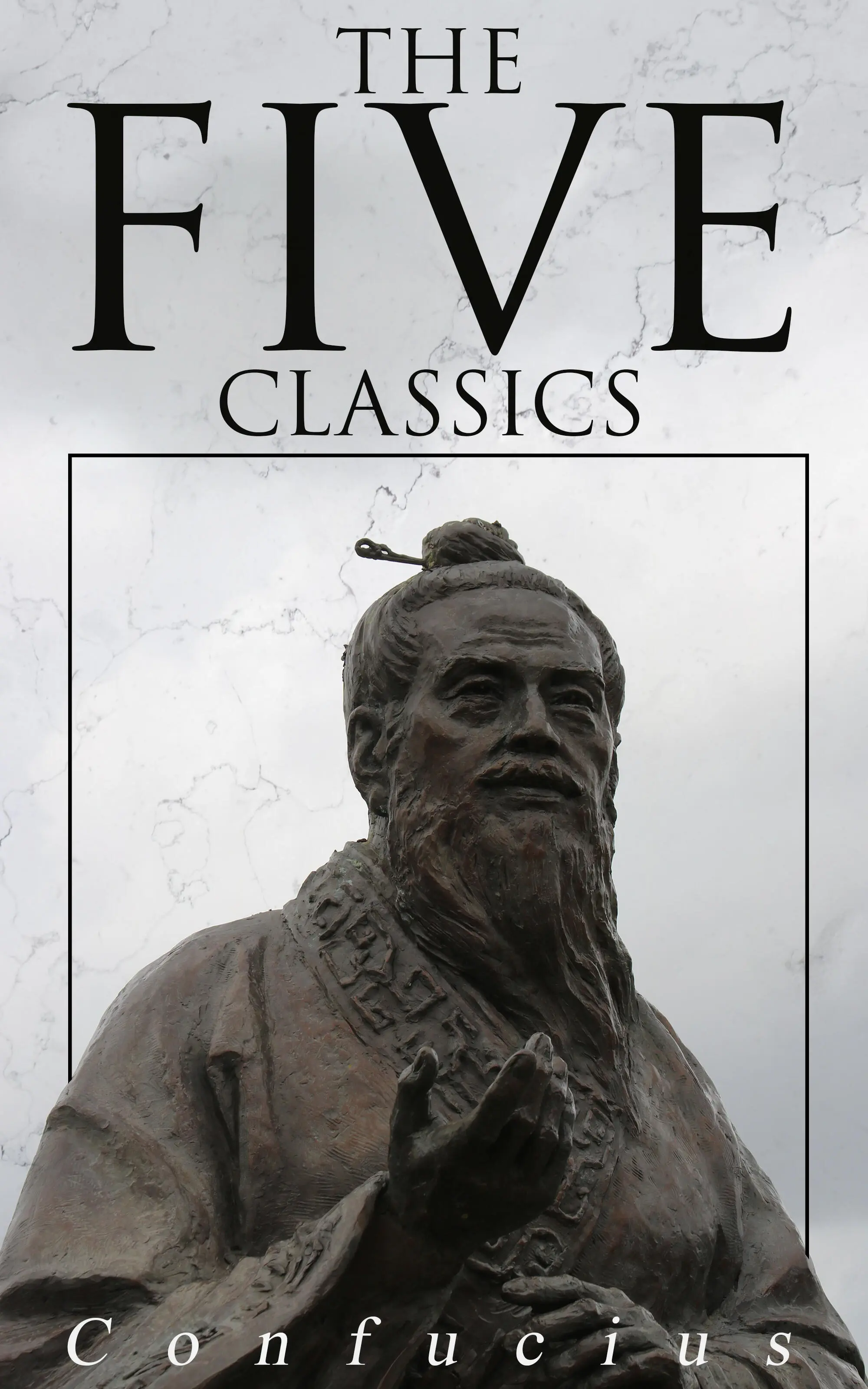
- Название:The Five Classics
- Автор:
- Жанр:
- Год:неизвестен
- ISBN:нет данных
- Рейтинг книги:5 / 5. Голосов: 1
-
Избранное:Добавить в избранное
- Отзывы:
-
Ваша оценка:
The Five Classics: краткое содержание, описание и аннотация
Предлагаем к чтению аннотацию, описание, краткое содержание или предисловие (зависит от того, что написал сам автор книги «The Five Classics»). Если вы не нашли необходимую информацию о книге — напишите в комментариях, мы постараемся отыскать её.
I Ching – The book contains a divination system comparable to Western geomancy or the West African Ifá system. In Western cultures and modern East Asia, it is still widely used for this purpose.
Shu King – A collection of documents and speeches alleged to have been written by rulers and officials of the early Zhou period and before. It is possibly the oldest Chinese narrative, and may date from the 6th century BC. It includes examples of early Chinese prose.
The Shih King – A collection of 305 poems divided into 160 folk songs, 105 festal songs sung at court ceremonies, and 40 hymns and eulogies sung at sacrifices to heroes and ancestral spirits of the royal house.
The Li Ki – Describes ancient rites, social forms and court ceremonies. The version studied today is a re-worked version compiled by scholars in the third century BC rather than the original text, which is said to have been edited by Confucius himself.
Spring and Autumn Annals – A historical record of the State of Lu, Confucius's native state, 722–481 BC.
The Five Classics — читать онлайн ознакомительный отрывок
Ниже представлен текст книги, разбитый по страницам. Система сохранения места последней прочитанной страницы, позволяет с удобством читать онлайн бесплатно книгу «The Five Classics», без необходимости каждый раз заново искать на чём Вы остановились. Поставьте закладку, и сможете в любой момент перейти на страницу, на которой закончили чтение.
Интервал:
Закладка:
It is said that after he has met with the ruler, 'the great man' in 5, 'advance to the south will be fortunate.' K û Hsî and other critics say that 'advancing to the south' is equivalent simply to 'advancing forwards.' The south is the region of brightness and warmth; advance towards it will be a joyful progress. As P. Regis explains the phrase, the traveller will proceed 'via recta simillima illi qua itur ad austrates felicesque plagas.'
Line 1 is weak, where it should be strong; its subject, that is, is humble and docile. Those above him, therefore, welcome his advance. Another interpretation of the line is suggested by Appendix I; which deserves consideration. As the first line of Sun, moreover, it may be supposed to concentrate in itself its attribute of docility, and be the lord of the trigram.
See on the second line of Ȝhui. Line 2 is strong, and the weak 5 is its proper correlate. We have a strong officer serving a weak ruler; he could not do so unless he were penetrated with a sincere and devoted loyalty.
Paragraph 3 describes the boldness and fearlessness of the advance of the third line. According to the Khang-hsî editors, who, I think, are right, there is a shade of condemnation in the line. Its subject is too bold.
Line 4 occupies the place of a great minister, in immediate contiguity to his ruler, who confides in him, and raises him to the highest distinction as a feudal prince. The mention of mount p. 162 Kh î, at the foot of which was the capital of the lords of K âu, seems to take the paragraph out of the sphere of symbolism into that of history. 'The king' in it is the last sovereign of Shang; the feudal prince in it is Wăn.
In line 5 the advance has reached the highest point of dignity, and firm correctness is specially called for. 'Ascending the steps of a stair' may intimate, as K û Hsî says, the ease of the advance; or according to others (the Khang-hsî editors among them), its ceremonious manner.
What can the subject of the hexagram want more? He has gained all his wishes, and still he is for going onwards. His advance is blind and foolish; and only the most exact correctness will save him from the consequences.
Hexagram XLVII. 47Khwăn
Table of Contents

In (the condition denoted by) Khwăn there may (yet be) progress and success. For the firm and correct, the (really) great man, there will be good fortune. He will fall into no error. If he make speeches, his words cannot be made good.
1. The first line, divided, shows its subject with bare buttocks straitened under the stump of a tree. He enters a dark valley, and for three years has no prospect (of deliverance).
2. The second line, undivided, shows its subject straitened amidst his wine and viands. There come to him anon the red knee-covers (of the ruler). It will be well for him (to maintain his sincerity as) in sacrificing. Active operations (on his part) will lead to evil, but he will be free from blame.
3. The third line, divided, shows its subject straitened before a (frowning) rock. He lays hold of thorns. He enters his palace, and does not see his wife. There will be evil.
4. The fourth line, undivided shows its subject proceeding very slowly (to help the subject of the first line), who is straitened by the carriage adorned with metal in front of him. There will be occasion for regret, but the end will be good.
5. The fifth line, undivided, shows its subject with his nose and feet cut off. He is straitened by (his ministers in their) scarlet aprons. He is leisurely in his movements, however, and is satisfied. It will be well for him to be (as sincere) as in sacrificing (to spiritual beings).
6. The sixth line, divided, shows its subject straitened, as if bound with creepers; or n a high and dangerous position, and saying (to himself), 'If I move, I shall repent it.' If he do repent of former errors, there will be good fortune in his going forward.
Footnotes
47.The character Khwăn presents us with the picture of a tree within an enclosure; 'a plant,' according to Williams, 'fading for want of room;' 'a tree,' according to Tai Tung, 'not allowed to spread its branches.' However this be, the term conveys the idea of being straitened and distressed; and this hexagram indicates a state of things in which the order and government that would conduce to the well-being of the country can hardly get the development, which, by skilful management on the part of 'the great man' and others, is finally secured for them.
Looking at the figure we see that the two central places are occupied by strong lines; but 2 is confined between 1 and 3, both of which are weak, and 5 (the ruler), as well as 4 (his minister), is covered by the weak 6; all which peculiarities are held to indicate the repression or straitening of good men by bad. For the way in which the same view is derived from the great symbolism, see Appendix II, in loc.
The concluding sentence of the Thwan is literally, 'If he speak, he will not be believed;' but the Khang-hsî editors give sufficient reasons for changing one character so as to give the meaning in the translation. 'Actions,' not words, are what are required in the case.
The symbolism of 'buttocks' is rather a favourite with the duke of K âu;--'chacun à son goût.' The poor subject of line 1 sitting on a mere stump, which affords him no shelter, is indeed badly off. The line is at the bottom of the trigram indicating peril, and 4, which is its proper correlate, is so circumstanced as not to be able p. 164 to render it help; hence comes the unfavourable auspice. 'Three years' is used, as often, for a long time.
The three strong lines in the figure (2, 4, and 5) are all held to represent 'superior men;' and their being straitened is not in their persons or estates, but in their principles which are denied development. Hence the subject of 2 is straitened while he fares sumptuously. His correlate in 5, though not quite proper, occupies the ruler's place, and comes to his help. That it is the ruler who comes appears from his red or vermillion knee-covers, different from the scarlet knee-covers worn by nobles, as in paragraph 5. Let 2 cultivate his sincerity and do the work of the hexagram as if he were sacrificing to spiritual beings; and then, if he keep quiet, all will be well.
For I a full explanation' of paragraph 3 K û Hsî refers his readers to what Confucius is made to say on it in Appendix III, ii, 35. The reader, however, will probably not find much light in that passage. The Khang-hsî editors say here:--'The subjects of the three divided lines (1, 3, and 6) are all unable to deal aright with the straitened state indicated by the figure. The first is at the bottom, sitting and distressed. The second, occupies the third place, where he may either advance or retreat; and he advances and is distressed. Wounded abroad, he returns to his family, and finds none to receive him; so graphically is there set forth the distress which reckless action brings.'
Line 4 is the proper correlate of 1, but it is a strong line in an even place, and its assistance is given dilatorily. Then 1 is overridden by 2, which is represented by 'a chariot of metal.' It is difficult for the subjects of 1 and 4 to come together, and effect much; but 4 is near 5, which is also a strong line. Through a p. 165 common sympathy, the subject of 5 will have a measure of success. So the symbolism of this line has been explained,--not very satisfactorily.
Line 5 is repressed by 6, and pressed on by 4. Above and below its subject is wounded. Especially is he straitened by the minister in 4, with his scarlet knee-covers. But the upper trigram is Tui, with the quality of complacent satisfaction. And this indicates, it is said, that the subject of 5 gets on notwithstanding his straits, especially by his sincerity. This explanation is not more satisfactory than the last.
Читать дальшеИнтервал:
Закладка:
Похожие книги на «The Five Classics»
Представляем Вашему вниманию похожие книги на «The Five Classics» списком для выбора. Мы отобрали схожую по названию и смыслу литературу в надежде предоставить читателям больше вариантов отыскать новые, интересные, ещё непрочитанные произведения.






Обсуждение, отзывы о книге «The Five Classics» и просто собственные мнения читателей. Оставьте ваши комментарии, напишите, что Вы думаете о произведении, его смысле или главных героях. Укажите что конкретно понравилось, а что нет, и почему Вы так считаете.