Confucius - The Five Classics
Здесь есть возможность читать онлайн «Confucius - The Five Classics» — ознакомительный отрывок электронной книги совершенно бесплатно, а после прочтения отрывка купить полную версию. В некоторых случаях можно слушать аудио, скачать через торрент в формате fb2 и присутствует краткое содержание. Жанр: unrecognised, на английском языке. Описание произведения, (предисловие) а так же отзывы посетителей доступны на портале библиотеки ЛибКат.
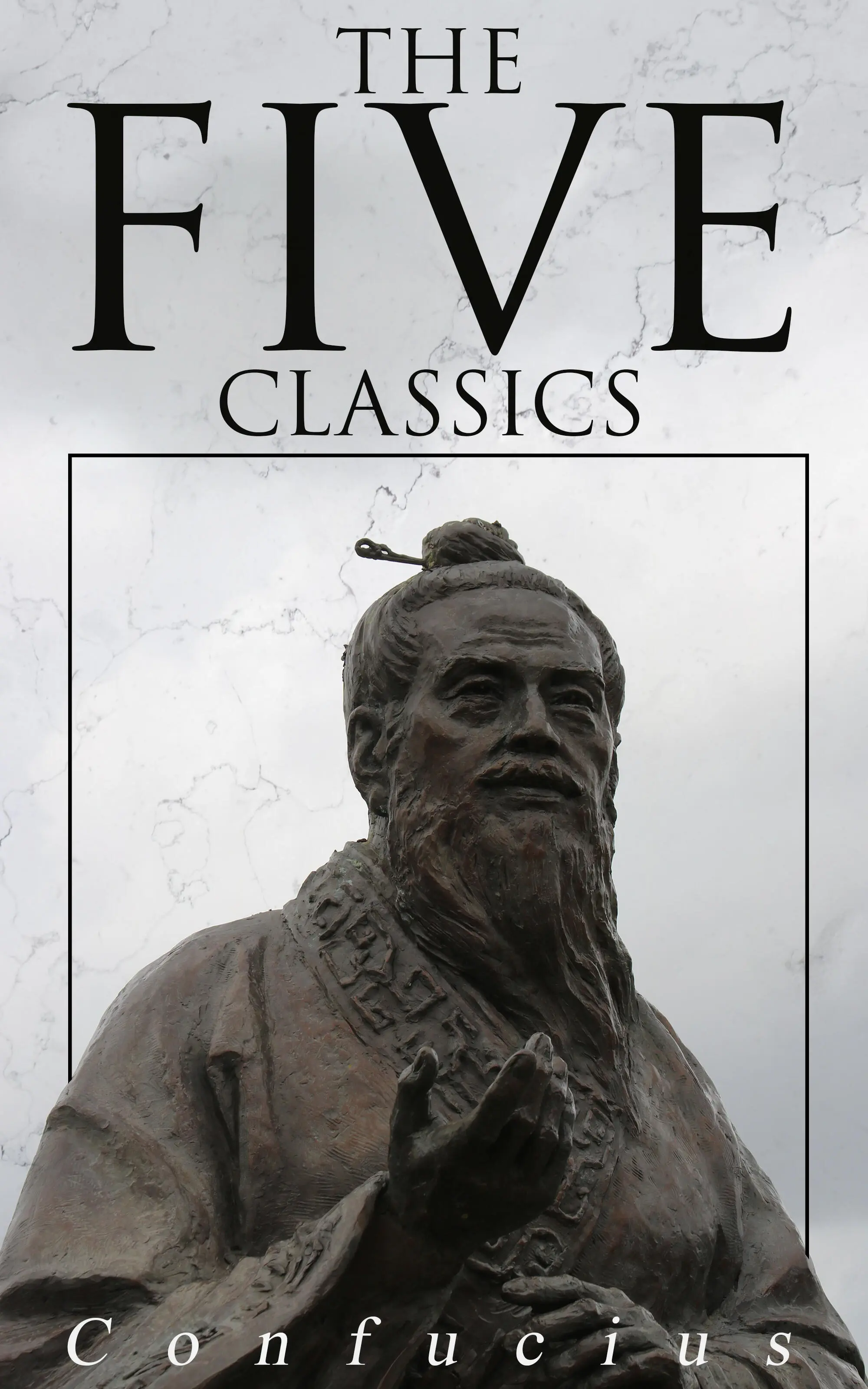
- Название:The Five Classics
- Автор:
- Жанр:
- Год:неизвестен
- ISBN:нет данных
- Рейтинг книги:5 / 5. Голосов: 1
-
Избранное:Добавить в избранное
- Отзывы:
-
Ваша оценка:
The Five Classics: краткое содержание, описание и аннотация
Предлагаем к чтению аннотацию, описание, краткое содержание или предисловие (зависит от того, что написал сам автор книги «The Five Classics»). Если вы не нашли необходимую информацию о книге — напишите в комментариях, мы постараемся отыскать её.
I Ching – The book contains a divination system comparable to Western geomancy or the West African Ifá system. In Western cultures and modern East Asia, it is still widely used for this purpose.
Shu King – A collection of documents and speeches alleged to have been written by rulers and officials of the early Zhou period and before. It is possibly the oldest Chinese narrative, and may date from the 6th century BC. It includes examples of early Chinese prose.
The Shih King – A collection of 305 poems divided into 160 folk songs, 105 festal songs sung at court ceremonies, and 40 hymns and eulogies sung at sacrifices to heroes and ancestral spirits of the royal house.
The Li Ki – Describes ancient rites, social forms and court ceremonies. The version studied today is a re-worked version compiled by scholars in the third century BC rather than the original text, which is said to have been edited by Confucius himself.
Spring and Autumn Annals – A historical record of the State of Lu, Confucius's native state, 722–481 BC.
The Five Classics — читать онлайн ознакомительный отрывок
Ниже представлен текст книги, разбитый по страницам. Система сохранения места последней прочитанной страницы, позволяет с удобством читать онлайн бесплатно книгу «The Five Classics», без необходимости каждый раз заново искать на чём Вы остановились. Поставьте закладку, и сможете в любой момент перейти на страницу, на которой закончили чтение.
Интервал:
Закладка:
Line 6 is at the top of the figure, where the distress may be supposed to reach its height. Its subject appears bound and on a perilous summit. But his extremity is also his opportunity. He is moved to think of repenting; and if he do repent, and go forward, his doing so will be fortunate.
Hexagram XLVIII. 48Ȝing Hexagram
Table of Contents

(Looking at) Ȝing, (we think of) how (the site of) a town may be changed, while (the fashion of) its wells undergoes no change. (The water of a well) never disappears and never receives (any great) increase, and those who come and those who go can draw and enjoy the benefit. If (the drawing) have nearly been accomplished, but, before the rope has quite reached the water, the bucket is broken, this is evil.
1. The first line, divided, shows a well so muddy that men will not drink of it; or an old well to which neither birds (nor other creatures) resort.
2. The second line, undivided, shows a well from which by a hole the water escapes and flows away to the shrimps (and such small creatures among the grass), or one the water of which leaks away from a broken basket.
3. The third line, undivided, shows a well, which has been cleared out, but is not used. Our hearts are sorry for this, for the water might be drawn out and used. If the king were (only) intelligent, both he and we might receive the benefit of it.
4. The fourth line, divided, shows a well, the lining of which is well laid. There will be no error.
5. The fifth line, undivided, shows a clear, limpid well, (the waters from) whose cold spring are (freely) drunk.
6. The topmost line, divided, shows (the water from) the well brought to the top, which is not allowed to be covered. This suggests the idea of sincerity. There will be great good fortune.
Footnotes
48.Ȝing, which gives its name to this hexagram, is the symbol of a well. The character originally was pictorial (  ), intended to represent a portion of land, divided into nine parts, the central portion belonging to the government, and being cultivated by the joint labour of the eight families settled on the other divisions. In the centre of it, moreover, was a well, which was the joint property of all the occupants.
What is said on Ȝing might be styled 'Moralisings on a well,' or Lessons to be learned from a well for the good order and government of a country.' What a well is to those in its neighbourhood, and indeed to men in general, that is government to a people. If rulers would only rightly appreciate the principles of government handed down from the good ages of the past, and faithfully apply them to the regulation of the present, they would be blessed themselves and their people with them.
In the Thwan we have the well, substantially the same through many changes of society; a sure source of dependance to men, for their refreshment and for use in their cultivation of the ground. Its form is what I have seen in the plains of northern China; what may be seen among ourselves in many places in Europe. It is deep, and the water is drawn up by a vessel let down from the top; and the value of the well depends on the water being actually raised. And so the principles of government must be actually carried out.
Line 1, being weak, and at the very bottom of the figure, suggests, or is made to suggest, the symbolism of it. Many men in authority are like such a well; corrupt, useless, unregarded.
Line 2 is strong, and might very well symbolise an active spring, ever feeding the well and, through it, the ground and its cultivators; but it is in an inappropriate place, and has no proper correlate. p. 167 Its cool waters cannot be brought to the top. So important is it that the ministers of a country should be able and willing rightly to administer its government. In the account of the ancient Shun it is stated that he once saved his life by an opening in the lining of a well.
Line 3 is a strong line, in its proper place; and must represent an able minister or officer. But though the well is clear, no use is made of it. I do not find anything in the figure that can be connected with this fact. The author was wise beyond his lines. After the first sentence of the paragraph, the duke of K âu ceases from his function of making emblems; reflects and moralises.
Line 4 is weak, but in its proper place. Its subject is not to be condemned, but neither is he to be praised. He takes care of himself, but does nothing for others.
Line 5 is strong, and in its right place. The place is that of the ruler, and suggests the well, full of clear water, which is drawn up, and performs its useful work. Such is the good Head of government to his people.
Line 6 is in its proper place, but weak. If the general idea of the figure was different, a bad auspice might be drawn from it. But here we see in it the symbol of the water drawn up, and the top uncovered so that the use of the well is free to all. Then the mention of 'sincerity' suggests the inexhaustibleness of the elemental supply.
Hexagram XLIX. 49Ko
Table of Contents

(What takes place as indicated by) Ko is believed in only after it has been accomplished. There will be great progress and success. Advantage will come from being firm and correct. (In that case) occasion for repentance will disappear.
1. The first line, undivided, shows its subject (as if he were) bound with the skin of a yellow ox.
2. The second line, divided, shows its subject making his changes after some time has passed. Action taken will be fortunate. There will be no error.
3. The third line, undivided, shows that action taken by its subject will be evil. Though he be firm and correct, his position is perilous. If the change (he contemplates) have been three times fully discussed, he will be believed in.
4. The fourth line, undivided, shows occasion for repentance disappearing (from its subject). Let him be believed in; and though he change (existing) ordinances, there will be good fortune.
5. The fifth line, undivided, shows the great man (producing his changes) as the tiger (does when he) changes (his stripes). Before he divines (and proceeds to action), faith has been reposed in him.
6. The sixth line, divided, shows the superior man producing his changes as the leopard (does when he) changes (his spots), while small men change their faces (and show their obedience). To go forward (now) would lead to evil, but there will be good fortune in abiding firm and correct.
Footnotes
49.The character called Ko or Keh is used here in the sense of changing. Originally used for the skin of an animal or bird, alive or dead, it received the significance of changing at a very early time. Its earliest appearance, indeed, in the first Book of the Shû, is in that sense. How the transition was made from the idea of a skin or hide to that of change is a subject that need not be entered on here. The author has before him the subject of changes occurring--called for--in the state of the country; it may be on the greatest scale. The necessity of them is recognised, and hints are p. 169 given as to the spirit and manner in which they should be brought about.
For the way in which the notion of change is brought out of the trigrams of the figure, see Appendixes I and II. It is assumed in the Thwan that change is viewed by people generally with suspicion and dislike, and should not be made hastily. When made as a necessity, and its good effects appear, the issues will be great and good. A proved necessity for them beforehand; and a firm correctness in the conduct of them:--these are the conditions by which changes should be regulated.
Читать дальшеИнтервал:
Закладка:
Похожие книги на «The Five Classics»
Представляем Вашему вниманию похожие книги на «The Five Classics» списком для выбора. Мы отобрали схожую по названию и смыслу литературу в надежде предоставить читателям больше вариантов отыскать новые, интересные, ещё непрочитанные произведения.






Обсуждение, отзывы о книге «The Five Classics» и просто собственные мнения читателей. Оставьте ваши комментарии, напишите, что Вы думаете о произведении, его смысле или главных героях. Укажите что конкретно понравилось, а что нет, и почему Вы так считаете.