Confucius - The Five Classics
Здесь есть возможность читать онлайн «Confucius - The Five Classics» — ознакомительный отрывок электронной книги совершенно бесплатно, а после прочтения отрывка купить полную версию. В некоторых случаях можно слушать аудио, скачать через торрент в формате fb2 и присутствует краткое содержание. Жанр: unrecognised, на английском языке. Описание произведения, (предисловие) а так же отзывы посетителей доступны на портале библиотеки ЛибКат.
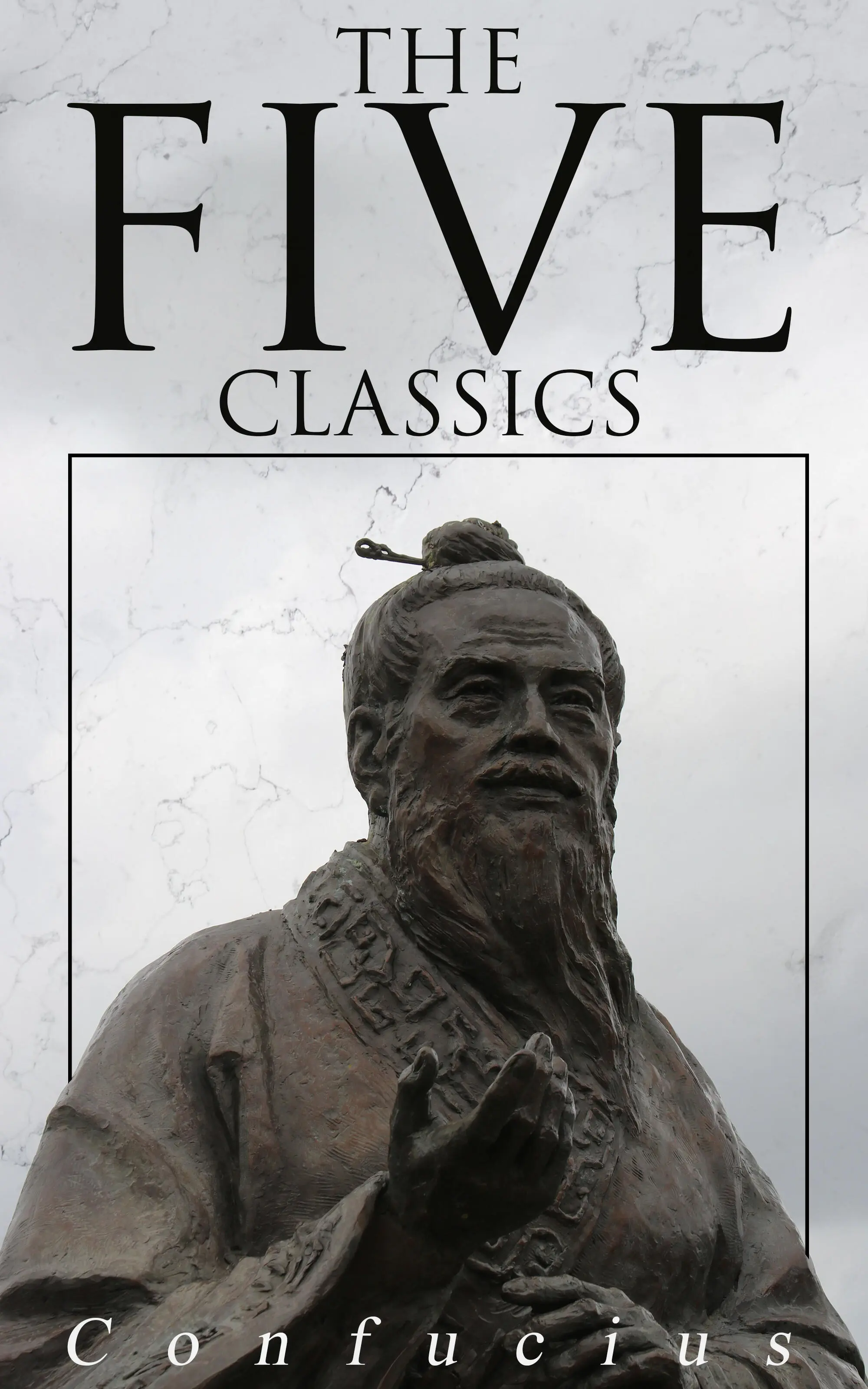
- Название:The Five Classics
- Автор:
- Жанр:
- Год:неизвестен
- ISBN:нет данных
- Рейтинг книги:5 / 5. Голосов: 1
-
Избранное:Добавить в избранное
- Отзывы:
-
Ваша оценка:
The Five Classics: краткое содержание, описание и аннотация
Предлагаем к чтению аннотацию, описание, краткое содержание или предисловие (зависит от того, что написал сам автор книги «The Five Classics»). Если вы не нашли необходимую информацию о книге — напишите в комментариях, мы постараемся отыскать её.
I Ching – The book contains a divination system comparable to Western geomancy or the West African Ifá system. In Western cultures and modern East Asia, it is still widely used for this purpose.
Shu King – A collection of documents and speeches alleged to have been written by rulers and officials of the early Zhou period and before. It is possibly the oldest Chinese narrative, and may date from the 6th century BC. It includes examples of early Chinese prose.
The Shih King – A collection of 305 poems divided into 160 folk songs, 105 festal songs sung at court ceremonies, and 40 hymns and eulogies sung at sacrifices to heroes and ancestral spirits of the royal house.
The Li Ki – Describes ancient rites, social forms and court ceremonies. The version studied today is a re-worked version compiled by scholars in the third century BC rather than the original text, which is said to have been edited by Confucius himself.
Spring and Autumn Annals – A historical record of the State of Lu, Confucius's native state, 722–481 BC.
The Five Classics — читать онлайн ознакомительный отрывок
Ниже представлен текст книги, разбитый по страницам. Система сохранения места последней прочитанной страницы, позволяет с удобством читать онлайн бесплатно книгу «The Five Classics», без необходимости каждый раз заново искать на чём Вы остановились. Поставьте закладку, и сможете в любой момент перейти на страницу, на которой закончили чтение.
Интервал:
Закладка:
Let there be sincerity in doing this, and it will lead to the happiest results. It will lead to great success in great things; and if the correction, or it may be a contribution towards it, appear to be very small, yet it will be accepted;--as in the most solemn religious service. This is substantially the view of the hexagram approved by the Khang-hsî editors.
Line 1 is strong, and its correlate in 4 is weak. Its subject will wish to help the subject of 4; but will not leave anything of his own undone in (loin. so. Nor will he diminish of his own for the other without due deliberation.
Line 2 is strong, and in the central place. But it is in the place of a weak line, and its subject should maintain his position without moving to help his correlate in 5. Maintaining his own firm correctness is the best way to help him.
Paragraph 3 is to my mind full of obscurity. K û Hsî, adopting the view in Appendix I, says that the lower trigram was originally Kh ien, three undivided lines, like 'three men walking together,' p. 149 and that the third line, taken away and made to be the topmost line, or the third, in what was originally Khwăn, three divided lines, was 'the putting away of one man;' and that then the change of place by 3 and 6, while they continued their proper correlation, was, one going away, and finding his friend. I cannot lay hold of any thread of reason in this.
Line 4 is weak, and in an even place; like an individual ailing and unable to perform his proper work. But the correlate in 1 is strong; and is made to hasten to its relief. The 'joy' of the line shows the desire of its subject to do his part in the work of the hexagram.
Line 5 is the seat of the ruler, who is here humble, and welcomes the assistance of his correlate, the subject of 2. He is a ruler whom all his subjects of ability will rejoice to serve in every possible way; and the result will be great good fortune.
Line 6 has been changed from a weak into a strong line from line 3; has received therefore the greatest increase, and will carry out the idea of the hexagram in the highest degree and style. But he can give increase to others without diminishing his own resources, and of course the benefit he will confer will be incalculable. Ministers will come to serve him; and not one from each clan merely, but many. Such is the substance of what is said on this last paragraph. I confess that I only discern the meaning darkly.
Hexagram XLII. 42Yî
Table of Contents

Yî indicates that (in the state which it denotes) there will be advantage in every movement which shall be undertaken, that it will be advantageous (even) to cross the great stream.
1. The first line, undivided, shows that it will be advantageous for its subject in his position to make a great movement. If it be greatly fortunate, no blame will be imputed to him.
2. The second line, divided, shows parties adding to the stores of its subject ten pairs of tortoise shells whose oracles cannot be opposed. Let him persevere in being firm and correct, and there will be good fortune. Let the king, (having the virtues thus distinguished), employ them in presenting his offerings to God, and there will be good fortune.
3. The third line, divided, shows increase given to its subject by means of what is evil, so that he shall (be led to good), and be without blame. Let him be sincere and pursue the path of the Mean, (so shall he secure the recognition of the ruler, like) an officer who announces himself to his prince by the symbol of his rank.
4. The fourth line, divided, shows its subject pursuing the due course. His advice to his prince is followed. He can with advantage be relied on in such a movement as that of removing the capital.
5. The fifth line, undivided, shows its subject with sincere heart seeking to benefit (all below). There need be no question about it; the result will be great good fortune. (All below) will with sincere heart acknowledge his goodness.
6. In the sixth line, undivided, we see one to whose increase none will contribute, while many will seek to assail him. He observes no regular rule in the ordering of his heart. There will be evil.
Footnotes
42.Yî has the opposite meaning to Sun, and is the symbol of addition or increasing. What king Wăn had in his mind, in connexion with the hexagram, was a ruler or a government operating p. 151 so as to dispense benefits to, and increase the resources of all the people. Two indications are evident in the lines;--the strong line in the ruler's seat, or the fifth line, and the weak line in the correlative place of 2. Whether there be other indications in the figure or its component trigrams will be considered in dealing with the Appendixes. The writer might well say, on general grounds, of the ruler whom he had in mind, that he would be successful in his enterprises and overcome the greatest difficulties.
Line 1 is strong, but its low position might seem to debar its subject from any great enterprise. Favoured as he is, however, according to the general idea of the hexagram, and specially responding to the proper correlate in 4, it is natural that he should make a movement; and great success will make his rashness be forgotten.
With paragraph 2 compare paragraph 5 of the preceding hexagram. Line 2 is weak, but in the centre, and is the correlate of 5. Friends give its subject the valuable gifts mentioned; 'that is,' says Kwo Yung (Sung dynasty), 'men benefit him; the oracles of the divination are in his favour,--spirits, that is, benefit him; and finally, when the king sacrifices to God, He accepts. Heaven confers benefit from above.'
Line 3 is weak, neither central, nor in its correct position. It would seem therefore that its subject should have no increase given to him. But it is the time for giving increase, and the idea of his receiving it by means of evil things is put into the line. That such things serve for reproof and correction is well known to Chinese moralists. But the paragraph goes on also to caution and admonish.
Line 4 is the place for a minister, near to that of the ruler. Its subject is weak, but his place is appropriate, and as he follows the p. 152 due course, his ruler will listen to him, and he will be a support in the most critical movements. Changing the capital from place to place was frequent in the feudal times of China. That of Shang, which preceded K âu, was changed five times.
Line 5 is strong, in its fitting position, and central. It is the seat of the ruler, who has his proper correlate in 2. Everything good, according to the conditions of the hexagram, therefore, may be said of him;--as is done.
Line 6 is also strong; but it should be weak. Occupying the topmost place of the figure, its subject will concentrate his powers in the increase of himself, and not think of benefiting those below him; and the consequence will be as described.
Hexagram XLIII. 43Kwâi
Table of Contents

Kwâi requires (in him who would fulfil its meaning) the exhibition (of the culprit's guilt) in the royal court, and a sincere and earnest appeal (for sympathy and support), with a consciousness of the peril (involved in cutting off the criminal). He should (also) make announcement in his own city, and show that it will not be well to have recourse at once to arms. (In this way) there will be advantage in whatever he shall go forward to.
1. The first line, undivided, shows its subject in (the pride of) strength advancing with his toes. He goes forward, but will not succeed. There will be ground for blame.
Читать дальшеИнтервал:
Закладка:
Похожие книги на «The Five Classics»
Представляем Вашему вниманию похожие книги на «The Five Classics» списком для выбора. Мы отобрали схожую по названию и смыслу литературу в надежде предоставить читателям больше вариантов отыскать новые, интересные, ещё непрочитанные произведения.






Обсуждение, отзывы о книге «The Five Classics» и просто собственные мнения читателей. Оставьте ваши комментарии, напишите, что Вы думаете о произведении, его смысле или главных героях. Укажите что конкретно понравилось, а что нет, и почему Вы так считаете.