Confucius - The Five Classics
Здесь есть возможность читать онлайн «Confucius - The Five Classics» — ознакомительный отрывок электронной книги совершенно бесплатно, а после прочтения отрывка купить полную версию. В некоторых случаях можно слушать аудио, скачать через торрент в формате fb2 и присутствует краткое содержание. Жанр: unrecognised, на английском языке. Описание произведения, (предисловие) а так же отзывы посетителей доступны на портале библиотеки ЛибКат.
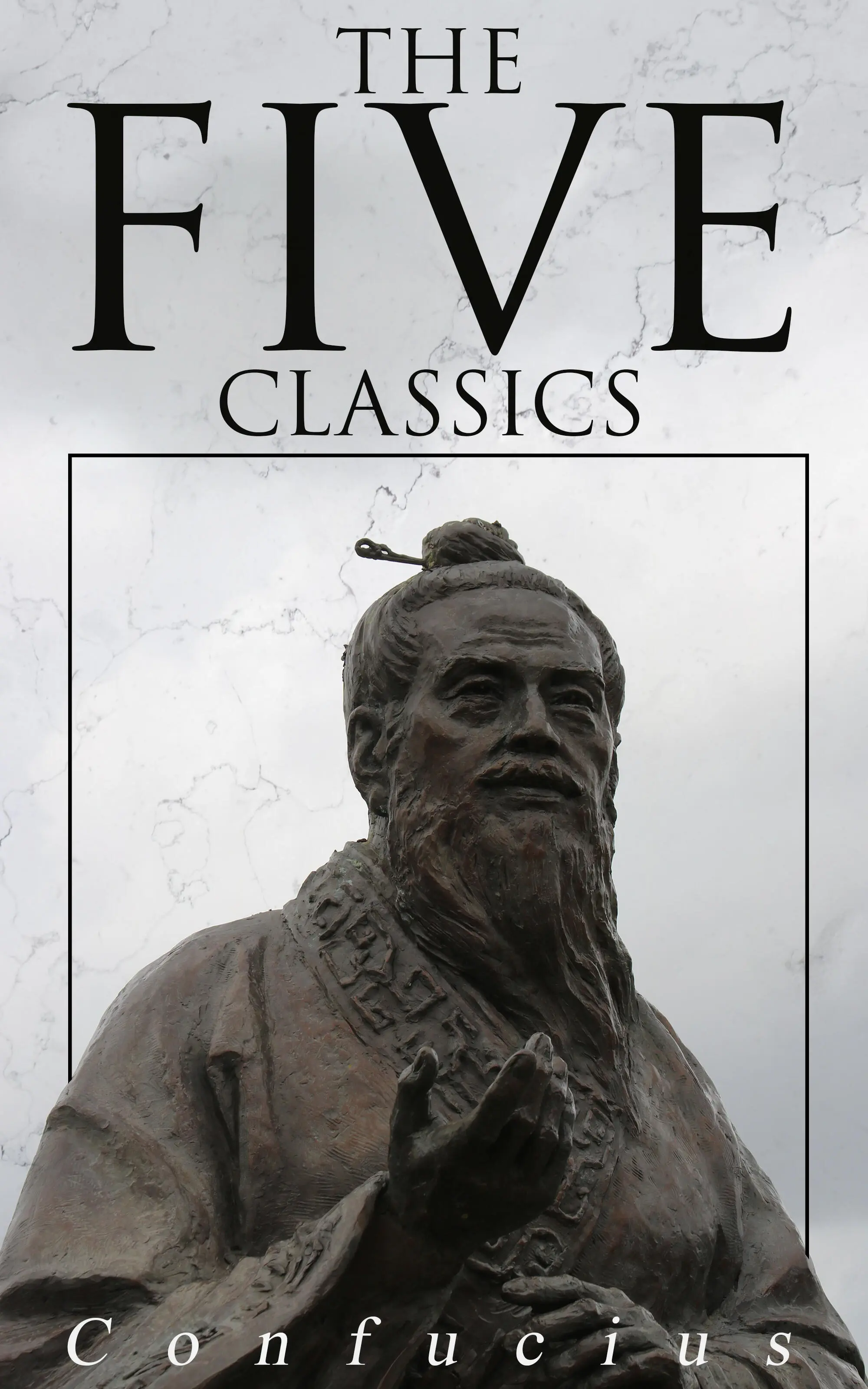
- Название:The Five Classics
- Автор:
- Жанр:
- Год:неизвестен
- ISBN:нет данных
- Рейтинг книги:5 / 5. Голосов: 1
-
Избранное:Добавить в избранное
- Отзывы:
-
Ваша оценка:
The Five Classics: краткое содержание, описание и аннотация
Предлагаем к чтению аннотацию, описание, краткое содержание или предисловие (зависит от того, что написал сам автор книги «The Five Classics»). Если вы не нашли необходимую информацию о книге — напишите в комментариях, мы постараемся отыскать её.
I Ching – The book contains a divination system comparable to Western geomancy or the West African Ifá system. In Western cultures and modern East Asia, it is still widely used for this purpose.
Shu King – A collection of documents and speeches alleged to have been written by rulers and officials of the early Zhou period and before. It is possibly the oldest Chinese narrative, and may date from the 6th century BC. It includes examples of early Chinese prose.
The Shih King – A collection of 305 poems divided into 160 folk songs, 105 festal songs sung at court ceremonies, and 40 hymns and eulogies sung at sacrifices to heroes and ancestral spirits of the royal house.
The Li Ki – Describes ancient rites, social forms and court ceremonies. The version studied today is a re-worked version compiled by scholars in the third century BC rather than the original text, which is said to have been edited by Confucius himself.
Spring and Autumn Annals – A historical record of the State of Lu, Confucius's native state, 722–481 BC.
The Five Classics — читать онлайн ознакомительный отрывок
Ниже представлен текст книги, разбитый по страницам. Система сохранения места последней прочитанной страницы, позволяет с удобством читать онлайн бесплатно книгу «The Five Classics», без необходимости каждый раз заново искать на чём Вы остановились. Поставьте закладку, и сможете в любой момент перейти на страницу, на которой закончили чтение.
Интервал:
Закладка:
Line 1 is strong, and in an odd place. A successful course might be auspiced for its subject; but the correlate in line 4 is also strong; and therefore disappointment and repentance are likely to ensue. In the condition, however, indicated by Khwei, where people have a common virtue, they will help one another. Through the good services of 4, the other will not have to repent. His condition may be emblemed by a traveller's loss of his horses, which return to him of themselves.
Should he meet with bad men, however, let him not shrink from them. Communication with them will be of benefit. His good p. 141 may overcome their evil, and at least it will help to silence their slanderous tongues.
Line 5 is weak, and its subject is the proper correlate of the strong 2. They might meet openly; but for the separation and disunion that mark the time. A casual, as it were a stolen, interview, as in a bye-lane or passage, however will be useful, and may lead on to a better understanding.
Line 3 is weak, where it ought to be strong. Its correlate, however, in 6 is strong, and the relation between them might seem what it ought to be. But the weak 3 is between the strong lines in 2 and 4; and in a time of disunion there ensue the checking and repulsion emblemed in the Text. At the same time the subject of line 6 inflicts on that of 3 the punishments which are mentioned. It is thus bad for 3 at first, but we are told that in the end it will be well with him; and this will be due to the strength of the sixth line. The conclusion grows out of a conviction in the mind of the author that what is right and good is destined to triumph over what is wrong and bad. Disorder shall in the long run give place to order, and disunion to union.
Line 4 has no proper correlate, and might seem to be solitary. But, as we saw on line 1, in this hexagram, correlates of the same class help each other. Hence the subjects of 4 and 1, meeting together, work with good will and success.
The place of 5 is odd, but the line itself is weak, so that there might arise occasion for repentance. But the strong 2 is a proper correlate to the weak 5. Five being the sovereign's place, the subject of 2 is styled the sovereign's relative, of the same surname p. 142 with him, and head of some branch of the descendants of the royal house. It is as easy for 5, so supported, to deal with the disunion of the time, as to bite through a piece of skin.
Line 6 is an even place, and yet the line is strong;--what can its subject effect? He looks at 3, which, as weak, is a proper correlate; but he looks with the evil eye of disunion. The subject of 3 appears no better than a filthy pig, nor more real than an impossible carriage-load of ghosts. He bends his bow against him, but he unbends it, discovering a friend in 3, as x did in 4, and 5 in 2. He acts and with good luck, comparable to the falling rain, which results from the happy union of the yang and yin in nature.
Hexagram XXXIX. 39Kien
Table of Contents

In (the state indicated by) K ien advantage will be found in the south-west, and the contrary in the north-east. It will be advantageous (also) to meet with the great man. (In these circumstances), with firmness and correctness, there will be good fortune.
1. From the first line, divided, we learn that advance (on the part of its subject) will lead to (greater) difficulties, while remaining stationary will afford ground for praise.
2. The second line, divided, shows the minister of the king struggling with difficulty on difficulty, and not with a view to his own advantage.
3. The third line, undivided, shows its subject advancing, (but only) to (greater) difficulties. He remains stationary, and returns (to his former associates).
4. The fourth line, divided, shows its subject advancing, (but only) to (greater) difficulties. He remains stationary, and unites (with the subject of the line above).
5. The fifth line, undivided, shows its subject struggling with the greatest difficulties, while friends are coming to help him.
6. The topmost line, divided, shows its subject going forward, (only to increase) the difficulties, while his remaining stationary will be (productive of) great (merit). There will be good fortune, and it will be advantageous to meet with the great man.
Footnotes
39.Kien is the symbol for incompetency in the feet and legs, involving difficulty in walking; hence it is used in this hexagram to indicate a state of the kingdom which makes the government of it an arduous task. How this task may be successfully performed, now by activity on the part of the ruler, and now by a discreet inactivity:--this is what the figure teaches, or at least gives hints about. For the development of the meaning of the symbolic character from the structure of the lineal figure, see Appendixes I and II.
The Thwan seems to require three things--attention to place, the presence of the great man, and the firm observance of correctness--in order to cope successfully with the difficulties of the situation. The first thing is enigmatically expressed, and the language should be compared with what we find in the Thwan of hexagrams 2 and 40. Referring to Figure 2, in Plate III, we find that, according to Win's arrangement of the trigrams, the southwest is occupied by Khwăn (  ), and the north-east by K ăn (
  ). The former represents the champaign country; the latter, the mountainous region. The former is easily traversed and held; the latter, with difficulty. The attention to place thus becomes transformed into a calculation of circumstances; those that promise success in an enterprise, which should be taken advantage of, and those that threaten difficulty and failure, which should be shunned.
This is the generally accepted view of this difficult passage. The Khang-hsî editors have a view of their own. I have been myself inclined to find less symbolism in it, and to take the southwest as the regions in the south and west of the kingdom, which we know from the Shih were more especially devoted to Wăn and his house, while the strength of the kings of Shang lay in the north and east.
'The idea of "the great man," Mencius's "minister of Heaven,"' is illustrated by the strong line in the fifth place, having for its correlate the weak line in 2. But favourableness of circumstances and place, and the presence of the great man do not dispense from the observance of firm correctness. Throughout these essays of the Yî this is always insisted on.
Line 1 is weak, whereas it ought to be strong as being in an odd place. If its subject advance, he will not be able to cope with the difficulties of the situation, but be overwhelmed by them. Let him wait for a more favourable time.
Line 2 is weak, but in its proper place. Its correlation with the strong 5, and consequent significance, are well set forth.
Line 3 is strong, and in a place of strength; but its correlate in 6 is weak, so that the advance of its subject would be unsupported. He waits therefore for a better time, and cherishes the subjects of the two lines below, who naturally cling to him.
Line 4 is weak, and, though in its proper place, its subject could do little of himself. He is immediately below the king or great man, however, and cultivates his loyal attachment to him, waiting for the time when he shall be required to act.
Line 5 is the king, the man great and strong. He can cope with the difficulties, and the subjects of 2 and the other lines of the lower trigram give their help.
Читать дальшеИнтервал:
Закладка:
Похожие книги на «The Five Classics»
Представляем Вашему вниманию похожие книги на «The Five Classics» списком для выбора. Мы отобрали схожую по названию и смыслу литературу в надежде предоставить читателям больше вариантов отыскать новые, интересные, ещё непрочитанные произведения.






Обсуждение, отзывы о книге «The Five Classics» и просто собственные мнения читателей. Оставьте ваши комментарии, напишите, что Вы думаете о произведении, его смысле или главных героях. Укажите что конкретно понравилось, а что нет, и почему Вы так считаете.