Confucius - The Five Classics
Здесь есть возможность читать онлайн «Confucius - The Five Classics» — ознакомительный отрывок электронной книги совершенно бесплатно, а после прочтения отрывка купить полную версию. В некоторых случаях можно слушать аудио, скачать через торрент в формате fb2 и присутствует краткое содержание. Жанр: unrecognised, на английском языке. Описание произведения, (предисловие) а так же отзывы посетителей доступны на портале библиотеки ЛибКат.
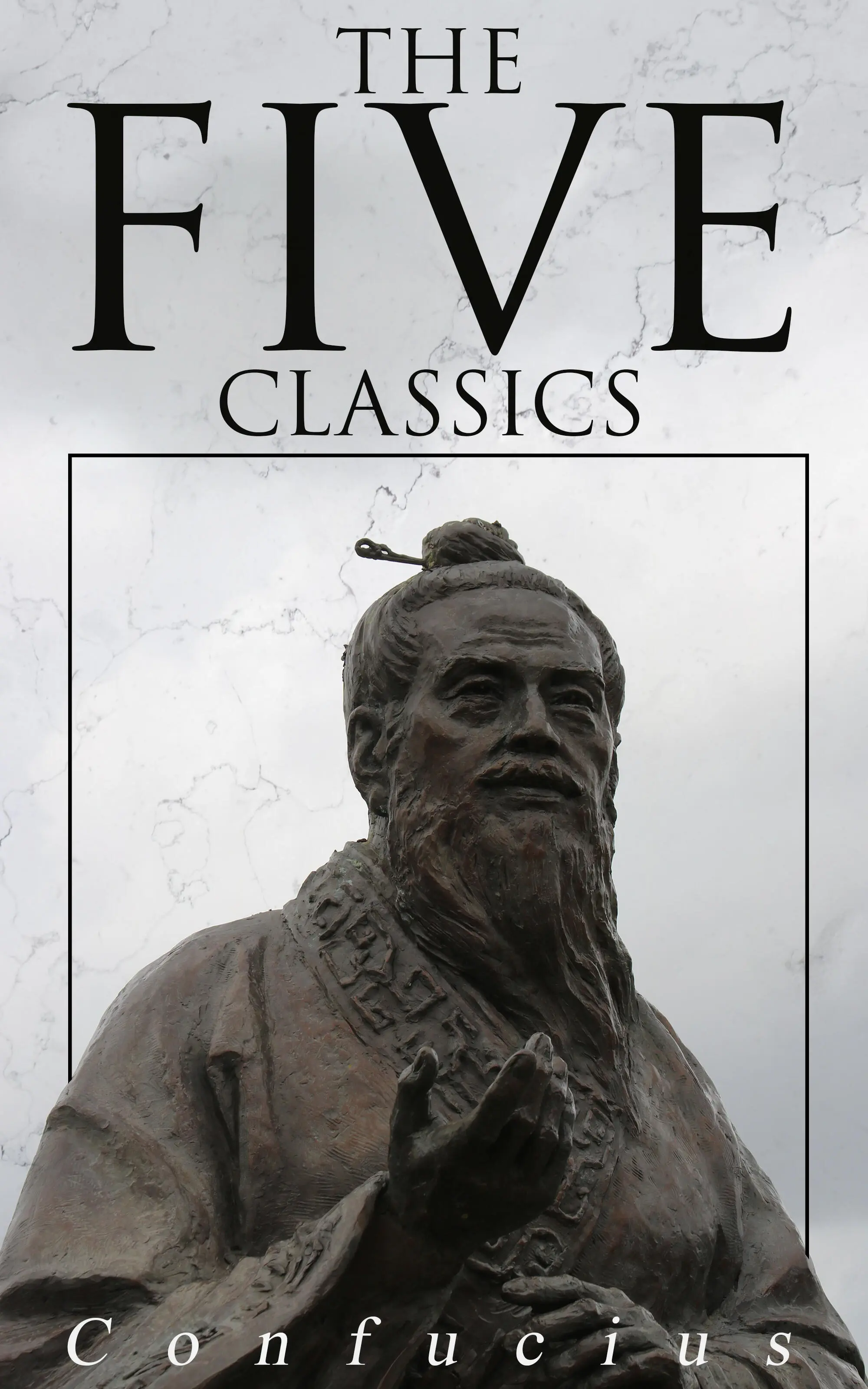
- Название:The Five Classics
- Автор:
- Жанр:
- Год:неизвестен
- ISBN:нет данных
- Рейтинг книги:5 / 5. Голосов: 1
-
Избранное:Добавить в избранное
- Отзывы:
-
Ваша оценка:
The Five Classics: краткое содержание, описание и аннотация
Предлагаем к чтению аннотацию, описание, краткое содержание или предисловие (зависит от того, что написал сам автор книги «The Five Classics»). Если вы не нашли необходимую информацию о книге — напишите в комментариях, мы постараемся отыскать её.
I Ching – The book contains a divination system comparable to Western geomancy or the West African Ifá system. In Western cultures and modern East Asia, it is still widely used for this purpose.
Shu King – A collection of documents and speeches alleged to have been written by rulers and officials of the early Zhou period and before. It is possibly the oldest Chinese narrative, and may date from the 6th century BC. It includes examples of early Chinese prose.
The Shih King – A collection of 305 poems divided into 160 folk songs, 105 festal songs sung at court ceremonies, and 40 hymns and eulogies sung at sacrifices to heroes and ancestral spirits of the royal house.
The Li Ki – Describes ancient rites, social forms and court ceremonies. The version studied today is a re-worked version compiled by scholars in the third century BC rather than the original text, which is said to have been edited by Confucius himself.
Spring and Autumn Annals – A historical record of the State of Lu, Confucius's native state, 722–481 BC.
The Five Classics — читать онлайн ознакомительный отрывок
Ниже представлен текст книги, разбитый по страницам. Система сохранения места последней прочитанной страницы, позволяет с удобством читать онлайн бесплатно книгу «The Five Classics», без необходимости каждый раз заново искать на чём Вы остановились. Поставьте закладку, и сможете в любой момент перейти на страницу, на которой закончили чтение.
Интервал:
Закладка:
1. The first line, divided, shows one wishing to advance, and (at the same time) kept back. Let him be firm and correct, and there will be good fortune. If trust be not reposed in him, let him maintain a large and generous mind, and there will be no error.
2. The second line, divided, shows its subject with the appearance of advancing, and yet of being sorrowful. If he be firm and correct, there will be good fortune. He will receive this great blessing from his grandmother.
3. The third line, divided, shows its subject trusted by all (around him). All occasion for repentance will disappear.
4. The fourth line, undivided, shows its subject with the appearance of advancing, but like a marmot. However firm and correct he may be, the position is one of peril.
5. The fifth line, divided, shows how all occasion for repentance disappears (from its subject). (But) let him not concern himself about whether he shall fail or succeed. To advance will be fortunate, and in every way advantageous.
6. The topmost line, undivided, shows one advancing his horns. But he only uses them to punish the (rebellious people of his own) city. The position is perilous, but there will be good fortune. (Yet) however firm and correct he may be, there will be occasion for regret.
Footnotes
35.The Thwan of this hexagram expresses its subject more fully and plainly than that of any of the previous thirty-four. It is about a feudal prince whose services to the country have made him acceptable to his king. The king's favour has been shown to him by gifts and personal attentions such as form the theme of more than one ode in the Shih; see especially III, iii, 7. The symbolism of the lines dimly indicates the qualities of such a prince. Ȝin means to advance.' Hexagrams 46 and 53 agree with this in being called by names that indicate progress and advance. The advance in Ȝin is like that of the sun, 'the shining light, shining more and more to the perfect day.'
Line 1 is weak, and in the lowest place, and its correlate in 4 is neither central nor in its correct position. This indicates the small and obstructed beginnings of his subject. But by his firm correctness he pursues the way to good fortune; and though the king does not yet believe in him, he the more pursues his noble course.
Line 2 is weak, and its correlate in 5 is also weak. Its subject therefore has still to mourn in obscurity. But his position is central and correct, and he holds on his way, till success comes ere long. The symbolism says he receives it 'from his grandmother;' and readers will be startled by the extraordinary statement, as I was when I first read it. Literally the Text says 'the king's mother,' as P. Regis rendered it,--'Istam magnam felicitatem a matre regis recipit.' He also tries to give the name a historical reference;--to Thâi- K iang, the grandmother of king Wăn; Thâi- Z ăn, his mother; or to Thâi-sze, his wife, and the mother of king Wû and the duke of K âu, all famous in Chinese history, and celebrated in the Shih. But 'king's father' and 'king's mother' are well-known Chinese appellations for 'grandfather' and 'grandmother.' This is the view given on the passage, by Kh ăng-ȝze, K û Hsî, and the Khang-hsî editors, the latter of whom, indeed, account for the use of the name, instead of 'deceased mother,' which we find in hexagram 62, by the regulations observed in the ancestral temple. These authorities, moreover, all agree in saying that the name points us to line 5, the correlate of 2, and 'the lord of the hexagram.' Now the subject of line 5 is the sovereign, who at length acknowledges the worth of the feudal lord, and gives him p. 134 the great blessing. The 'New Digest of Comments on the Yî (1686),' in its paraphrase of the line, has, 'He receives at last this great blessing from the mild and compliant ruler.' I am not sure that 'motherly king' would not be the best and fairest translation of the phrase.
Canon McClatchie has a very astonishing note on the name, which he renders 'Imperial Mother' (p. 164):--'That is, the wife of Imperial Heaven (Juno), who occupies the "throne of the diagram," viz. the fifth stroke, which is soft and therefore feminine. She is the Great Ancestress of the human race. See Imp. Ed. vol. iv, Sect. v, p. 25, Com.' Why such additions to the written word?
Line 3 is weak, and in an odd place; but the subjects of 1 and 2 are possessed by the same desire to advance as the subject of this. A common trust and aim possess them; and hence the not unfavourable auspice.
Line 4 is strong, but it is in an even place, nor is it central. It suggests the idea of a marmot (? or rat), stealthily advancing. Nothing could be more opposed to the ideal of the feudal lord in the hexagram.
In line 5 that lord and his intelligent sovereign meet happily. He holds on his right course, indifferent as to results, but things are so ordered that he is, and will continue to be, crowned with success.
Line 6 is strong, and suggests the idea of its subject to the last continuing his advance, and that not only with firm correctness, but with strong force. The 'horns' are an emblem of threatening strength, and though he uses them only in his own state, and against the rebellious there, that such a prince should have any occasion to use force is matter for regret.
Hexagram XXXVI. 36Ming Î
Table of Contents

Ming Î indicates that (in the circumstances which it denotes) it will be advantageous to realise the difficulty (of the position), and maintain firm correctness.
1. The first line, undivided, shows its subject, (in the condition indicated by) Ming Î, flying, but with drooping wings. When the superior man (is revolving) his going away, he may be for three days without eating. Wherever he goes, the people there may speak (derisively of him).
2. The second line, divided, shows its subject, (in the condition indicated by) Ming Î, wounded in the left thigh. He saves himself by the strength of a (swift) horse; and is fortunate.
3. The third line, undivided, shows its subject, (in the condition indicated by) Ming Î, hunting in the south, and taking the great chief (of the darkness). He should not be eager to make (all) correct (at once).
4. The fourth six, divided, shows its subject (just) entered into the left side of the belly (of the dark land). (But) he is able to carry out the mind appropriate (in the condition indicated by) Ming Î, quitting the gate and courtyard (of the lord of darkness).
5. The fifth six, divided, shows how the count of K î fulfilled the condition indicated by Ming Î. It will be advantageous to be firm and correct.
6. The sixth six, divided, shows the case where there is no light, but (only) obscurity. (Its subject) had at first ascended to (the top of) the sky; his future shall be to go into the earth.
Footnotes
36.In this hexagram we have the representation of a good and intelligent minister or officer going forward in the service of his country, notwithstanding the occupancy of the throne by a weak p. 136 and unsympathising sovereign. Hence comes its name of Ming Î, or 'Intelligence Wounded,' that is, injured and repressed. The treatment of the subject shows how such an officer will conduct himself, and maintain his purpose. The symbolism of the figure is treated of in the same way in the first and second Appendixes. Appendix VI merely says that the advance set forth in 35 is sure to meet with wounding, and hence Ȝin is followed by Ming Î.
Line 1 is strong, and in its right place;--its subject should be going forward. But the general signification of the hexagram supposes him to be wounded. The wound, however, being received at the very commencement of its action, is but slight. And hence conies the emblem of a bird hurt so as to be obliged to droop its wings. The subject then appears directly as 'the superior man.' He sees it to be his course to desist from the struggle for a time, and is so rapt in the thought that he can fast for three days and not think of it. When he does withdraw, opposition follows him; but it is implied that he holds on to his own good purpose.
Читать дальшеИнтервал:
Закладка:
Похожие книги на «The Five Classics»
Представляем Вашему вниманию похожие книги на «The Five Classics» списком для выбора. Мы отобрали схожую по названию и смыслу литературу в надежде предоставить читателям больше вариантов отыскать новые, интересные, ещё непрочитанные произведения.






Обсуждение, отзывы о книге «The Five Classics» и просто собственные мнения читателей. Оставьте ваши комментарии, напишите, что Вы думаете о произведении, его смысле или главных героях. Укажите что конкретно понравилось, а что нет, и почему Вы так считаете.