Confucius - The Five Classics
Здесь есть возможность читать онлайн «Confucius - The Five Classics» — ознакомительный отрывок электронной книги совершенно бесплатно, а после прочтения отрывка купить полную версию. В некоторых случаях можно слушать аудио, скачать через торрент в формате fb2 и присутствует краткое содержание. Жанр: unrecognised, на английском языке. Описание произведения, (предисловие) а так же отзывы посетителей доступны на портале библиотеки ЛибКат.
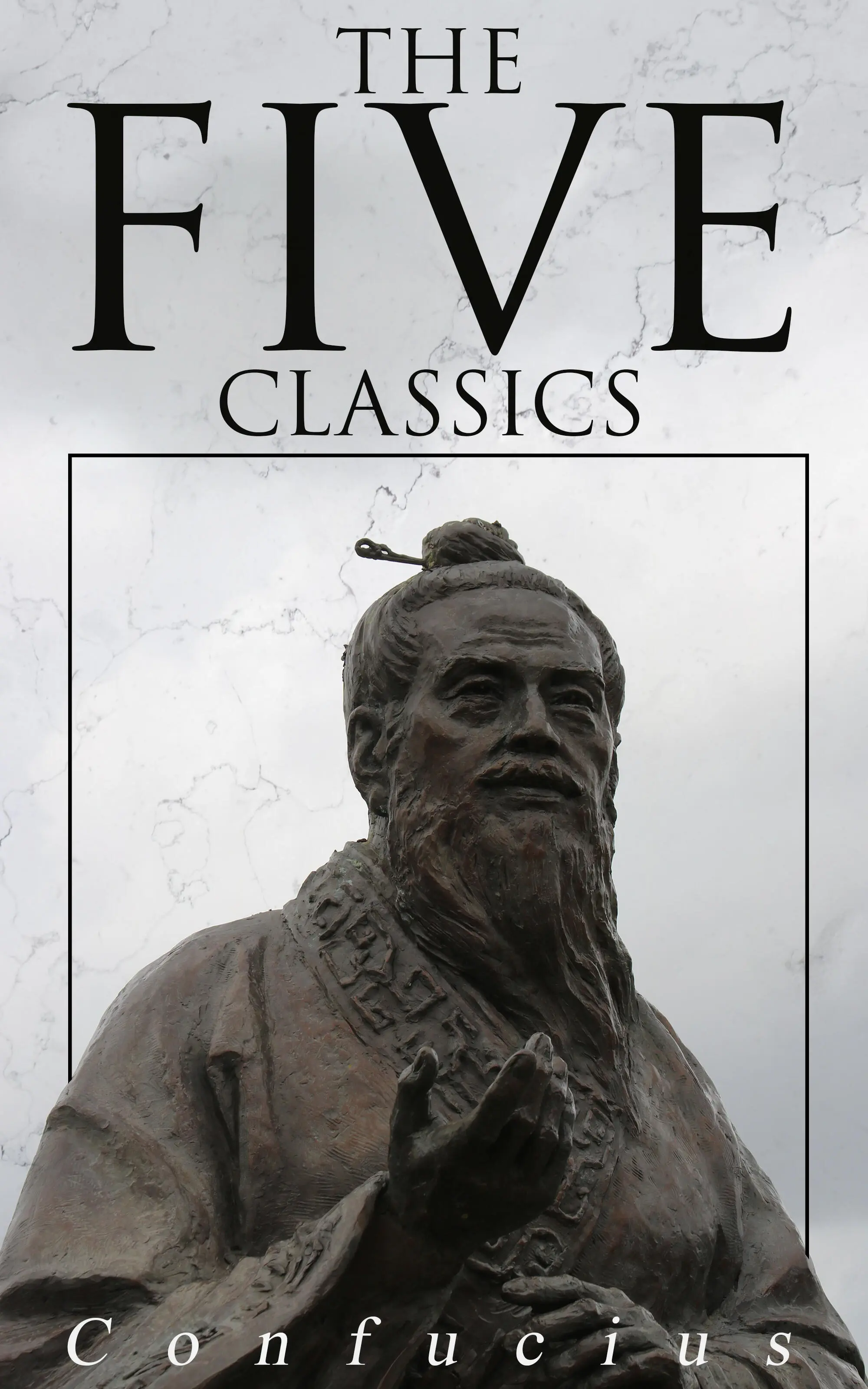
- Название:The Five Classics
- Автор:
- Жанр:
- Год:неизвестен
- ISBN:нет данных
- Рейтинг книги:5 / 5. Голосов: 1
-
Избранное:Добавить в избранное
- Отзывы:
-
Ваша оценка:
The Five Classics: краткое содержание, описание и аннотация
Предлагаем к чтению аннотацию, описание, краткое содержание или предисловие (зависит от того, что написал сам автор книги «The Five Classics»). Если вы не нашли необходимую информацию о книге — напишите в комментариях, мы постараемся отыскать её.
I Ching – The book contains a divination system comparable to Western geomancy or the West African Ifá system. In Western cultures and modern East Asia, it is still widely used for this purpose.
Shu King – A collection of documents and speeches alleged to have been written by rulers and officials of the early Zhou period and before. It is possibly the oldest Chinese narrative, and may date from the 6th century BC. It includes examples of early Chinese prose.
The Shih King – A collection of 305 poems divided into 160 folk songs, 105 festal songs sung at court ceremonies, and 40 hymns and eulogies sung at sacrifices to heroes and ancestral spirits of the royal house.
The Li Ki – Describes ancient rites, social forms and court ceremonies. The version studied today is a re-worked version compiled by scholars in the third century BC rather than the original text, which is said to have been edited by Confucius himself.
Spring and Autumn Annals – A historical record of the State of Lu, Confucius's native state, 722–481 BC.
The Five Classics — читать онлайн ознакомительный отрывок
Ниже представлен текст книги, разбитый по страницам. Система сохранения места последней прочитанной страницы, позволяет с удобством читать онлайн бесплатно книгу «The Five Classics», без необходимости каждый раз заново искать на чём Вы остановились. Поставьте закладку, и сможете в любой момент перейти на страницу, на которой закончили чтение.
Интервал:
Закладка:
The Chinese character called hsien is  , the graphic symbol for 'all, together, jointly.' Kan, the symbol for 'influencing,' has hsien in it as its phonetic constituent (though the changes in pronunciation make it hard for an English reader to appreciate this), with the addition of hsin, the symbol for the heart.' Thus
  kan, 'to affect or influence,' = +
  ; and it may have been that while the name or word was used with the significance of 'influencing,' the was purposely dropt from it, to indicate the most important element in the thing,--the absence of all purpose or motive. I venture to think that this would have been a device worthy of a diviner.
With regard to the idea of husband and wife being in the teaching of the hexagram, it is derived from the more recent symbolism of the eight trigrams ascribed to king Wăn, and exhibited on p. 33 and plate III. The more ancient usage of them is given in the paragraph on the Great Symbolism of Appendix II. The figure consists of Kăn  'the youngest son,' and over it Tui (
  ), 'the youngest daughter.' These are in 'happy union.' p. 125 No influence, it is said, is so powerful and constant as that between husband and wife; and where these are young, it is especially active. Hence it is that Hsien is made up of Kăn and Tui. All this is to me very doubtful. I can dimly apprehend why the whole line (
  ) was assumed as the symbol of strength and authority, and the broken line as that of weakness and submission. Beyond this I cannot follow Fû-hsî in his formation of the trigrams; and still less can I assent to the more recent symbolism of them ascribed to king Wăn.
Coming now to the figure, and its lines, the subject is that of mutual influence; and the author teaches that that influence, correct in itself, and for correct ends, is sure to be effective. He gives an instance,--the case of a man marrying a young lady, the regulations for which have been laid down in China from the earliest times with great strictness and particularity. Such influence will be effective and fortunate.
Line 1 is weak, and at the bottom of the hexagram. Though 4 be a proper correlate, yet the influence indicated by it must be ineffective. However much a man's great toes may be moved, that will not enable him to walk.
The calves cannot move of themselves. They follow the moving of the feet. The moving of them indicates too much anxiety to move. Line 2, moreover, is weak. But it is also the central line, and if its subject abide quiet, till he is acted on from above, there will be good fortune.
Neither can the thighs move of themselves. The attempt to p. 126 move them is inauspicious. Its subject, however, the line being strong, and in an odd place, will wish to move, and follows the subject of 4, which is understood to be the seat of the mind. He exercises his influence therefore with a mind and purpose, which is not good.
Line 4 is strong, but in an even place. It is the seat of the mind. Its subject therefore is warned to be firm and correct in order to a good issue. If he be wavering and uncertain, his influence will not extend beyond the circle of his friends.
The symbolism of line 5 refers to a part of the body behind the heart, and is supposed therefore to indicate an influence, ineffective indeed, but free from selfish motive, and not needing to be repented of.
Line 6 is weak, and in an even place. It is the topmost line also of the trigram of satisfaction. Its influence by means of speech will only be that of loquacity and flattery, the evil of which needs not to be pointed out.
Hexagram XXXII. 32Hăng
Table of Contents

Hăng indicates successful progress and no error (in what it denotes). But the advantage will come from being firm and correct; and movement in any direction whatever will be advantageous.
1. The first line, divided, shows its subject deeply (desirous) of long continuance. Even with firm correctness there will be evil; there will be no advantage in any way.
2. The second line, undivided, shows all occasion for repentance disappearing.
3. The third line, undivided, shows one who does not continuously maintain his virtue. There are those who will impute this to him as a disgrace. However firm he may be, there will be ground for regret.
4. The fourth line, undivided, shows a field where there is no game.
5. The fifth line, divided, shows its subject continuously maintaining the virtue indicated by it. In a wife this will be fortunate; in a husband, evil.
6. The topmost line, divided, shows its subject exciting himself to long continuance. There will be evil.
Footnotes
32.The subject of this hexagram may be given as perseverance in well doing, or in continuously acting out the law of one's p. 127 being. The sixth Appendix makes it a sequel of the previous figure. As that treats, it is said, of the relation between husband and wife, so this treats of the continuous observance of their respective duties. Hsien, we saw, is made up of Kăn, the symbol of the youngest son, and Tui, the symbol of the youngest daughter, attraction and influence between the sexes being strongest in youth. Hăng consists of Sun, 'the oldest daughter,' and K ăn, the oldest son. The couple are more staid. The wife occupies the lower place; and the relation between them is marked by her submission. This is sound doctrine, especially from a Chinese point of view; but I doubt whether such application of his teaching was in the mind of king Wăn. Given two parties, an inferior and superior in correlation. If both be continuously observant of what is correct, the inferior being also submissive, and the superior firm, good fortune and progress may be predicated of their course.
Line 1 has a proper correlate in 4; but between them are two strong lines; and it is itself weak. These two conditions are against its subject receiving much help from the subject of 4. He should be quiet, and not forward for action.
Line 2 is strong, but in the place of a weak line. Its position, however, being central, and its subject holding fast to the due mean, the unfavourable condition of an even place is more than counteracted.
Line 3 is strong, and in its proper place; but being beyond the centre of the trigram, its subject is too strong, and coming under p. 128 the attraction of his correlate in 6, he is supposed to be ready to abandon his place and virtue. He may try to be firm and correct, but circumstances are adverse to him.
Line 4 is strong in the place of a weak line, and suggests the symbolism of the duke of K âu.
Читать дальшеИнтервал:
Закладка:
Похожие книги на «The Five Classics»
Представляем Вашему вниманию похожие книги на «The Five Classics» списком для выбора. Мы отобрали схожую по названию и смыслу литературу в надежде предоставить читателям больше вариантов отыскать новые, интересные, ещё непрочитанные произведения.






Обсуждение, отзывы о книге «The Five Classics» и просто собственные мнения читателей. Оставьте ваши комментарии, напишите, что Вы думаете о произведении, его смысле или главных героях. Укажите что конкретно понравилось, а что нет, и почему Вы так считаете.