Confucius - The Five Classics
Здесь есть возможность читать онлайн «Confucius - The Five Classics» — ознакомительный отрывок электронной книги совершенно бесплатно, а после прочтения отрывка купить полную версию. В некоторых случаях можно слушать аудио, скачать через торрент в формате fb2 и присутствует краткое содержание. Жанр: unrecognised, на английском языке. Описание произведения, (предисловие) а так же отзывы посетителей доступны на портале библиотеки ЛибКат.
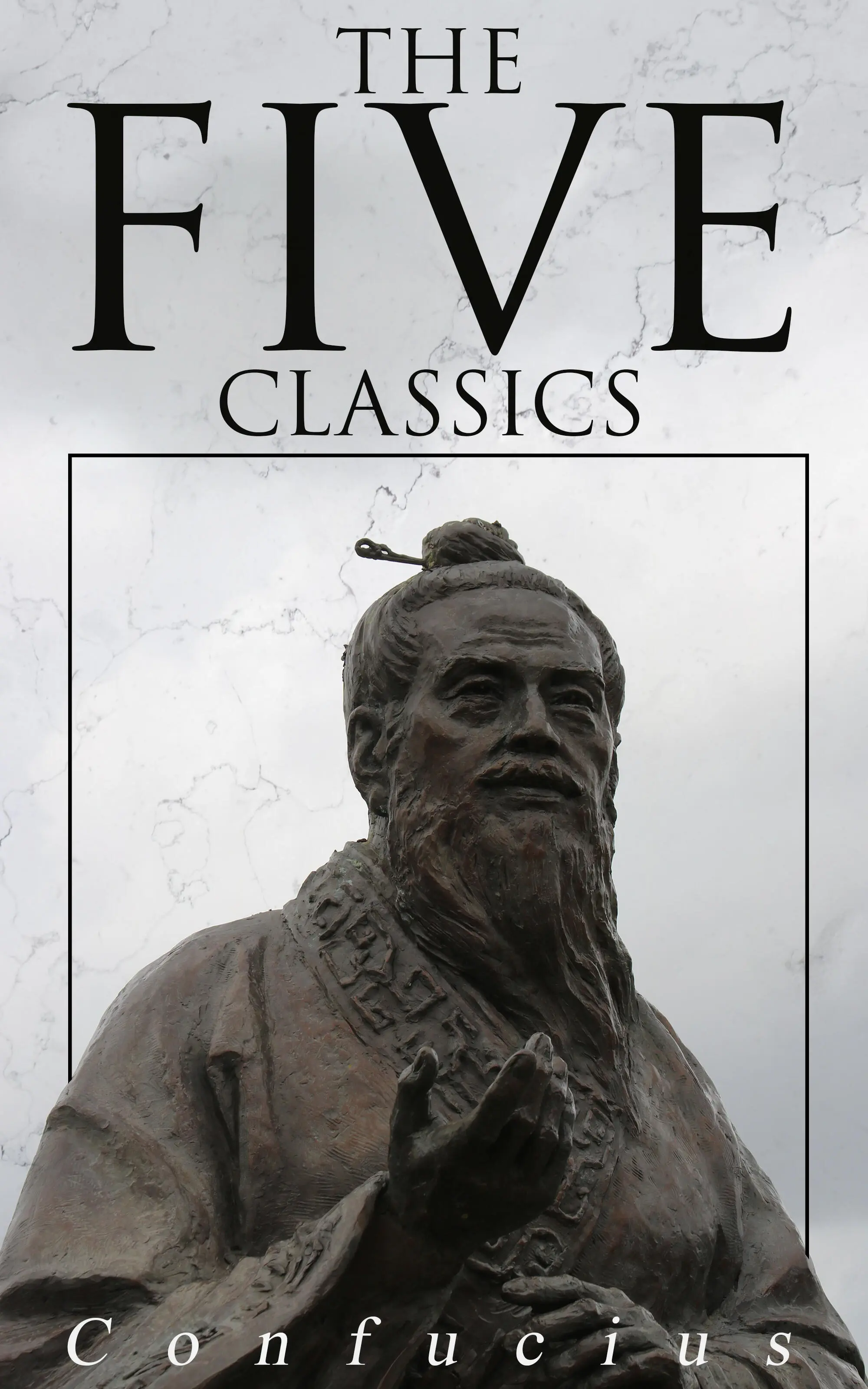
- Название:The Five Classics
- Автор:
- Жанр:
- Год:неизвестен
- ISBN:нет данных
- Рейтинг книги:5 / 5. Голосов: 1
-
Избранное:Добавить в избранное
- Отзывы:
-
Ваша оценка:
The Five Classics: краткое содержание, описание и аннотация
Предлагаем к чтению аннотацию, описание, краткое содержание или предисловие (зависит от того, что написал сам автор книги «The Five Classics»). Если вы не нашли необходимую информацию о книге — напишите в комментариях, мы постараемся отыскать её.
I Ching – The book contains a divination system comparable to Western geomancy or the West African Ifá system. In Western cultures and modern East Asia, it is still widely used for this purpose.
Shu King – A collection of documents and speeches alleged to have been written by rulers and officials of the early Zhou period and before. It is possibly the oldest Chinese narrative, and may date from the 6th century BC. It includes examples of early Chinese prose.
The Shih King – A collection of 305 poems divided into 160 folk songs, 105 festal songs sung at court ceremonies, and 40 hymns and eulogies sung at sacrifices to heroes and ancestral spirits of the royal house.
The Li Ki – Describes ancient rites, social forms and court ceremonies. The version studied today is a re-worked version compiled by scholars in the third century BC rather than the original text, which is said to have been edited by Confucius himself.
Spring and Autumn Annals – A historical record of the State of Lu, Confucius's native state, 722–481 BC.
The Five Classics — читать онлайн ознакомительный отрывок
Ниже представлен текст книги, разбитый по страницам. Система сохранения места последней прочитанной страницы, позволяет с удобством читать онлайн бесплатно книгу «The Five Classics», без необходимости каждый раз заново искать на чём Вы остановились. Поставьте закладку, и сможете в любой момент перейти на страницу, на которой закончили чтение.
Интервал:
Закладка:
The first line is strong; at the commencement of the inner trigram denoting movement, the action of its subject will very much characterise all the action set forth, and will itself be fortunate.
Line 2 is weak, central, and in its correct place. The quality may be predicated of it in its highest degree. There is an entire freedom in its subject from selfish or mercenary motive. He is good simply for goodness' sake. And things are so constituted that his action will be successful.
But calamity may also sometimes befal the best, and where there is this freedom from insincerity; and line 3 being weak, and in the place of an even line, lays its subject open to this misfortune. 'The people of the neighbourhood' are of course entirely innocent.
Line 4 is the lowest in the trigram of strength, and 1 is not a p. 112 proper correlate, nor is the fourth the place for a strong line. Hence the paragraph must be understood as a caution.
Line 5 is strong, in the central place of honour, and has its proper correlate in 2. Hence its subject must possess the quality of the hexagram in perfection. And yet he shall he sick or in distress. But he need not be anxious. Without his efforts a way of escape for him will be opened.
Line 6 is at the top of the hexagram, and comes into the field when the action has run its course. He should be still, and not initiate any fresh movement.
Hexagram XXVI. 26Tâ Khû
Table of Contents

Under the conditions of Tâ Kh û it will be advantageous to be firm and correct. (If its subject do not seek to) enjoy his revenues in his own family (without taking service at court), there will be good fortune. It will be advantageous for him to cross the great stream.
1. The first line, undivided, shows its subject in a position of peril. It will be advantageous for him to stop his advance.
2. The second line, undivided, shows a carriage with the strap under it removed.
3. The third line, undivided, shows its subject urging his way with good horses. It will be advantageous for him to realise the difficulty (of his course), and to be firm and correct, exercising himself daily in his charioteering and methods of defence; then there will be advantage in whatever direction he may advance.
4. The fourth six, divided, shows the young bull, (and yet) having the piece of wood over his horns. There will be great good fortune.
5. The fifth six, divided, shows the teeth of a castrated hog. There will be good fortune.
6. The sixth line, undivided, shows its subject (as) in command of the firmament of heaven. There will be progress.
Footnotes
26. Kh û has two meanings. It is the symbol of restraint, and of accumulation. What is repressed and restrained accumulates its strength and increases its volume. Both these meanings are found in the treatise on the Thwan; the exposition of the Great Symbolism has for its subject the accumulation of virtue. The different lines are occupied with the repression or restraint of movement. The first three lines receive that repression, the upper three exercise it. The accumulation to which all tends is that of virtue; and hence the name of Tâ Kh û, 'the Great Accumulation.'
What the Thwan teaches, is that he who goes about to accumulate his virtue must be firm and correct, and may then, engaging in the public service, enjoy the king's grace, and undertake the most difficult enterprises.
Line 1 is subject to the repression of 4, which will be increased if he try to advance. It is better for him to halt.
Line 2 is liable to the repression of 5, and stops its advance of itself, its subject having the wisdom to do so through its position in the central place. The strap below, when attached to the axle, made the carriage stop; he himself acts that part.
Line 3 is the last of Kh ien, and responds to the sixth line, the last of Kăn, above. But as they are both strong, the latter does not exert its repressive force. They advance rapidly together; but the position is perilous for 3. By firmness and caution, however, its subject will escape the peril, and the issue will be good.
The young bull in line 4 has not yet got horns. The attaching to their rudiments the piece of wood to prevent him from goring is an instance of extraordinary precaution; and precaution is always good.
A boar is a powerful and dangerous animal. Let him be castrated, and though his tusks remain, he cares little to use them. Here line 5 represents the ruler in the hexagram, whose work is to repress the advance of evil. A conflict with the subject of the strong second line in its advance would be perilous; but 5, taking early precaution, reduces it to the condition of the castrated pig. Not only is there no evil, but there is good fortune.
The work of repression is over, and the strong subject of line 6 has now the amplest scope to carry out the idea of the hexagram in the accumulation of virtue.
Hexagram XXVII. 27Î
Table of Contents

Î indicates that with firm correctness there will be good fortune (in what is denoted by it). We must look at what we are seeking to nourish, and by the exercise of our thoughts seek for the proper aliment.
1. The first line, undivided, (seems to be thus addressed), 'You leave your efficacious tortoise, and look at me till your lower jaw hangs down.' There will be evil.
2. The second line, divided, shows one looking downwards for nourishment, which is contrary to what is proper; or seeking it from the height (above), advance towards which will lead to evil.
3. The third line, divided, shows one acting contrary to the method of nourishing. However firm he may be, there will be evil. For ten years let him not take any action, (for) it will not be in any way advantageous.
4. The fourth line, divided, shows one looking downwards for (the power to) nourish. There will be good fortune. Looking with a tiger's downward unwavering glare, and with his desire that impels him to spring after spring, he will fall into no error.
5. The fifth line, divided, shows one acting contrary to what is regular and proper; but if he abide in firmness, there will be good fortune. He should not, (however, try to) cross the great stream.
6. The sixth line, undivided, shows him from whom comes the nourishing. His position is perilous, but there will be good fortune. It will be advantageous to cross the great stream.
Footnotes
27.Î is the symbol of the upper jaw, and gives name to the hexagram; but the whole figure suggests the appearance of the mouth. There are the two undivided lines at the bottom and top, and the four divided lines between them. The first line is the first in the trigram K ăn, denoting movement; and the sixth is the third in Kăn, denoting what is solid. The former is the lower jaw, part of the mobile chin; and the other the more fixed upper jaw. The open lines are the cavity of the mouth. As the name of the hexagram, Î denotes nourishing,--one's body or mind, one's self or others. The nourishment in both the matter and method will differ according to the object of it; and every one must determine what to employ and do in every case by exercising his own thoughts, only one thing being premised,--that in both respects the nourishing must be correct, and in harmony with what is right. The auspice of the whole hexagram is good.
The first line is strong, and in its proper place; its subject might suffice for the nourishing of himself, like a tortoise, which is supposed to live on air, without more solid nourishment. But he is drawn out of himself by desire for the weak 4, his proper correlate, at whom he looks till his jaw hangs down, or, as we say, his mouth waters. Hence the auspice is bad. The symbolism takes the form of an expostulation addressed, we must suppose, by the fourth line to the first.
Читать дальшеИнтервал:
Закладка:
Похожие книги на «The Five Classics»
Представляем Вашему вниманию похожие книги на «The Five Classics» списком для выбора. Мы отобрали схожую по названию и смыслу литературу в надежде предоставить читателям больше вариантов отыскать новые, интересные, ещё непрочитанные произведения.






Обсуждение, отзывы о книге «The Five Classics» и просто собственные мнения читателей. Оставьте ваши комментарии, напишите, что Вы думаете о произведении, его смысле или главных героях. Укажите что конкретно понравилось, а что нет, и почему Вы так считаете.