Confucius - The Five Classics
Здесь есть возможность читать онлайн «Confucius - The Five Classics» — ознакомительный отрывок электронной книги совершенно бесплатно, а после прочтения отрывка купить полную версию. В некоторых случаях можно слушать аудио, скачать через торрент в формате fb2 и присутствует краткое содержание. Жанр: unrecognised, на английском языке. Описание произведения, (предисловие) а так же отзывы посетителей доступны на портале библиотеки ЛибКат.
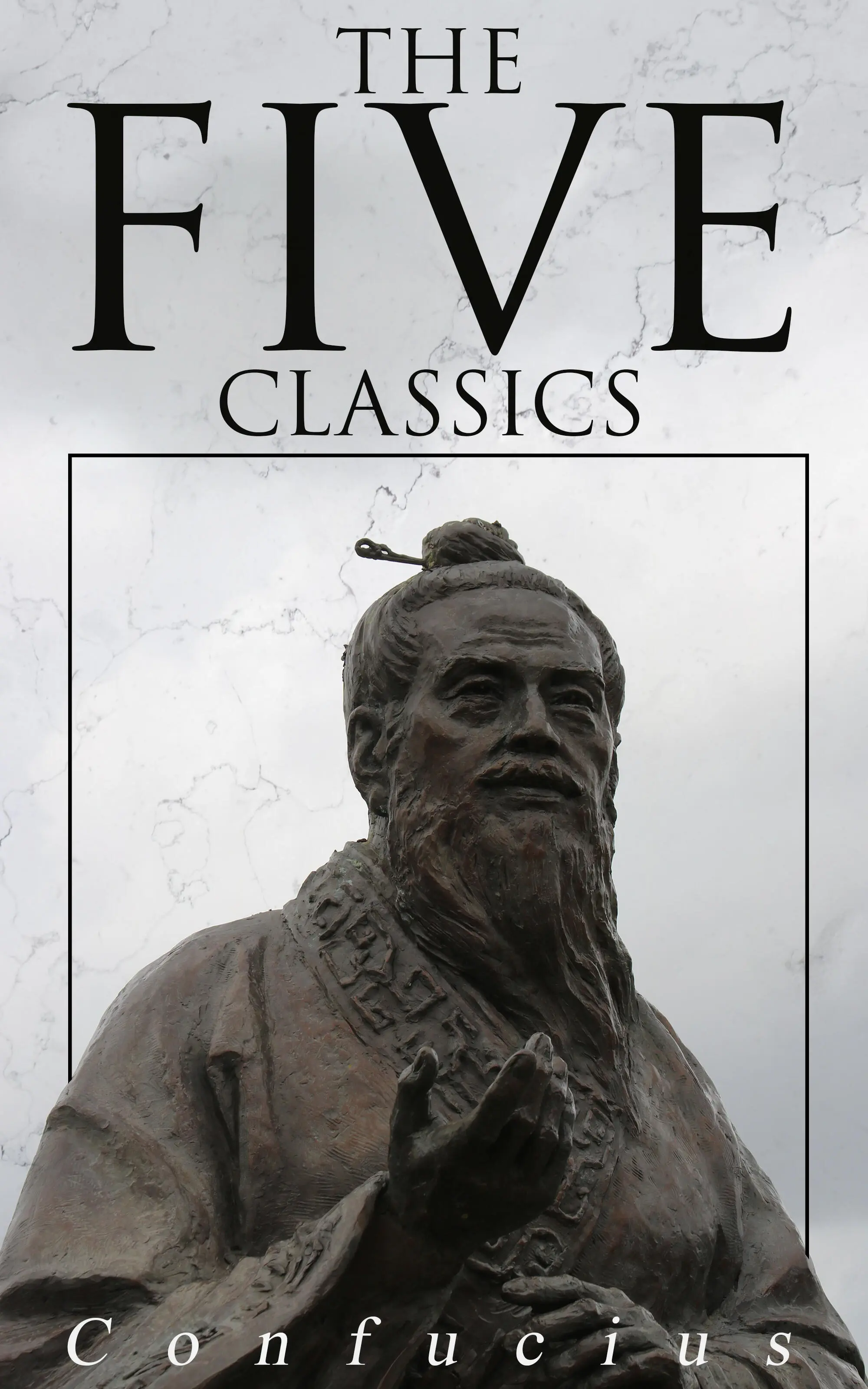
- Название:The Five Classics
- Автор:
- Жанр:
- Год:неизвестен
- ISBN:нет данных
- Рейтинг книги:5 / 5. Голосов: 1
-
Избранное:Добавить в избранное
- Отзывы:
-
Ваша оценка:
The Five Classics: краткое содержание, описание и аннотация
Предлагаем к чтению аннотацию, описание, краткое содержание или предисловие (зависит от того, что написал сам автор книги «The Five Classics»). Если вы не нашли необходимую информацию о книге — напишите в комментариях, мы постараемся отыскать её.
I Ching – The book contains a divination system comparable to Western geomancy or the West African Ifá system. In Western cultures and modern East Asia, it is still widely used for this purpose.
Shu King – A collection of documents and speeches alleged to have been written by rulers and officials of the early Zhou period and before. It is possibly the oldest Chinese narrative, and may date from the 6th century BC. It includes examples of early Chinese prose.
The Shih King – A collection of 305 poems divided into 160 folk songs, 105 festal songs sung at court ceremonies, and 40 hymns and eulogies sung at sacrifices to heroes and ancestral spirits of the royal house.
The Li Ki – Describes ancient rites, social forms and court ceremonies. The version studied today is a re-worked version compiled by scholars in the third century BC rather than the original text, which is said to have been edited by Confucius himself.
Spring and Autumn Annals – A historical record of the State of Lu, Confucius's native state, 722–481 BC.
The Five Classics — читать онлайн ознакомительный отрывок
Ниже представлен текст книги, разбитый по страницам. Система сохранения места последней прочитанной страницы, позволяет с удобством читать онлайн бесплатно книгу «The Five Classics», без необходимости каждый раз заново искать на чём Вы остановились. Поставьте закладку, и сможете в любой момент перейти на страницу, на которой закончили чтение.
Интервал:
Закладка:
The weak 2, insufficient for itself, seeks nourishment first from p. 116 the strong line below, which is not proper, and then from the strong 6, not its proper correlate, and too far removed. In either case the thing is evil.
Line 3 is weak, in an odd place; and as it occupies the last place in the trigram of movement, all that quality culminates in its subject. Hence he considers himself sufficient for himself, without any help from without, and the issue is bad.
With line 4 we pass into the upper trigram. It is next to the ruler's place in 5 moreover, and bent on nourishing and training all below. Its proper correlate is the strong 1; and though weak in himself, its subject looks with intense desire to the subject of that for help; and there is no error.
The subject of line 5 is not equal to the requirements of his position; but with a firm reliance on the strong 6, there will be good fortune. Let him not, however, engage in the most difficult undertakings.
The topmost line is strong, and 5 relies on its subject; but being penetrated with the idea of the hexagram, he feels himself in the position of master or tutor to all under heaven. The task is hard and the responsibility great; but realising these things, he will prove himself equal to them.
Hexagram XXVIII. 28Tâ Kwo
Table of Contents

Tâ Kwo suggests to us a beam that is weak. There will be advantage in moving (under its conditions) in any direction whatever; there will be success.
1. The first line, divided, shows one placing mats of the white mâo grass under things set on the ground. There will be no error.
2. The second line, undivided, shows a decayed willow producing shoots, or an old husband in possession of his young wife. There will be advantage in every way.
3. The third line, undivided, shows a beam that is weak. There will be evil.
4. The fourth line, undivided, shows a beam curving upwards. There will be good fortune. If (the subject of it) looks for other (help but that of line one), there will be cause for regret.
5. The fifth line, undivided, shows a decayed willow producing flowers, or an old wife in possession of her young husband. There will be occasion neither for blame nor for praise.
6. The topmost line, divided, shows its subject with extraordinary (boldness) wading through a stream, till the water hides the crown of his head. There will be evil, but no ground for blame.
Footnotes
28.Very extraordinary times require very extraordinary gifts in the conduct of affairs in them. This is the text on which king Wăn and his son discourse after their fashion in this hexagram. What goes, in their view, to constitute anything extraordinary is its greatness and difficulty. There need not be about it what is not right.
Looking at the figure we see two weak lines at the top and bottom, and four strong lines between them, giving us the idea of a great beam unable to sustain its own weight. But the second and fifth lines are both strong and in the centre; and from this and the attributes of the component trigrams a good auspice is obtained.
Line 1 being weak, and at the bottom of the figure, and of the trigram Sun, which denotes flexibility and humility, its subject is distinguished by his carefulness, as in the matter mentioned; and there is a good auspice.
Line 2 has no proper correlate above. Hence he inclines to the weak 1 below him; and we have the symbolism of the line. An p. 118 old husband with a young wife will yet have children; the action of the subject of 2 will be successful.
Line 3 is strong, and in an odd place. Its subject is confident in his own strength, but his correlate in 6 is weak. Alone, he is unequal to the extraordinary strain on him, and has for his symbol the weak beam.
Line 4 is near 5, the ruler's place. On its subject devolves the duty of meeting the extraordinary exigency of the time; but he is strong; and, the line being in an even place, his strength is tempered. He will be equal to his task. Should he look out for the help of the subject of 1, that would affect him with another element of weakness; and his action would give cause for regret.
Line 5 is strong and central. Its subject should be equal to achieve extraordinary merit. But he has no proper correlate below, and as 2 inclined to 1, so does this to 6. But here the willow only produces flowers, not shoots;--its decay will soon reappear. An old wife will have no children. If the subject of the line is not to be condemned as that of 3, his action does not deserve praise.
The subject of 6 pursues his daring course, with a view to satisfy the extraordinary exigency of the time, and benefit all under the sky. He is unequal to the task, and sinks beneath it; but his motive modifies the judgment on his conduct.
Hexagram XXIX. 29Khan
Table of Contents

Khan, here repeated, shows the possession of sincerity, through which the mind is. penetrating. Action (in accordance with this) will be of high value.
1. The first line, divided, shows its subject in the double defile, and (yet) entering a cavern within it. There will be evil.
2. The second line, undivided, shows its subject in all the peril of the defile. He will, however, get a little (of the deliverance) that he seeks.
3. The third line, divided, shows its subject, whether he comes or goes ( =descends or ascends), confronted by a defile. All is peril to him and unrest. (His endeavours) will lead him into the cavern of the pit. There should be no action (in such a case).
4. The fourth line, divided, shows its subject (at a feast), with (simply) a bottle of spirits, and a subsidiary basket of rice, while (the cups and bowls) are (only) of earthenware. He introduces his important lessons (as his ruler's) intelligence admits. There will in the end be no error.
5. The fifth line, undivided, shows the water of the defile not yet full, (so that it might flow away); but order will (soon) be brought about. There will be no error.
6. The topmost line, divided, shows its subject bound with cords of three strands or two strands, and placed in the thicket of thorns. But in three years he does not learn the course for him to pursue. There will be evil.
Footnotes
29.The trigram Khan, which is doubled to form this hexagram, is the lineal symbol of water. Its meaning, as a character, is 'a pit,' 'a perilous cavity, or defile;' and here and elsewhere in the Yî it leads the reader to think of a dangerous defile, with water flowing through it. It becomes symbolic of danger, and what the authors of the Text had in mind was to show how danger should be encountered, its effect on the mind, and how to get out of it.
The trigram exhibits a strong central line, between two divided lines. The central represented to king Wăn the sincere honesty and goodness of the subject of the hexagram, whose mind was sharpened and made penetrating by contact with danger, and who p. 120 acted in a manner worthy of his character. It is implied, though the Thwan does not say it, that he would get out of the danger,
Line 1 is weak, at the bottom of the figure, and has no correlate above, no helper, that is, beyond itself. All these things render the case of its subject hopeless. He will by his efforts only involve himself more deeply in danger.
Line 2 is strong, and in the centre. Its subject is unable, indeed, to escape altogether from the danger, but he does not involve himself more deeply in it like the subject of 1, and obtains some ease.
Читать дальшеИнтервал:
Закладка:
Похожие книги на «The Five Classics»
Представляем Вашему вниманию похожие книги на «The Five Classics» списком для выбора. Мы отобрали схожую по названию и смыслу литературу в надежде предоставить читателям больше вариантов отыскать новые, интересные, ещё непрочитанные произведения.





Обсуждение, отзывы о книге «The Five Classics» и просто собственные мнения читателей. Оставьте ваши комментарии, напишите, что Вы думаете о произведении, его смысле или главных героях. Укажите что конкретно понравилось, а что нет, и почему Вы так считаете.