Confucius - The Five Classics
Здесь есть возможность читать онлайн «Confucius - The Five Classics» — ознакомительный отрывок электронной книги совершенно бесплатно, а после прочтения отрывка купить полную версию. В некоторых случаях можно слушать аудио, скачать через торрент в формате fb2 и присутствует краткое содержание. Жанр: unrecognised, на английском языке. Описание произведения, (предисловие) а так же отзывы посетителей доступны на портале библиотеки ЛибКат.
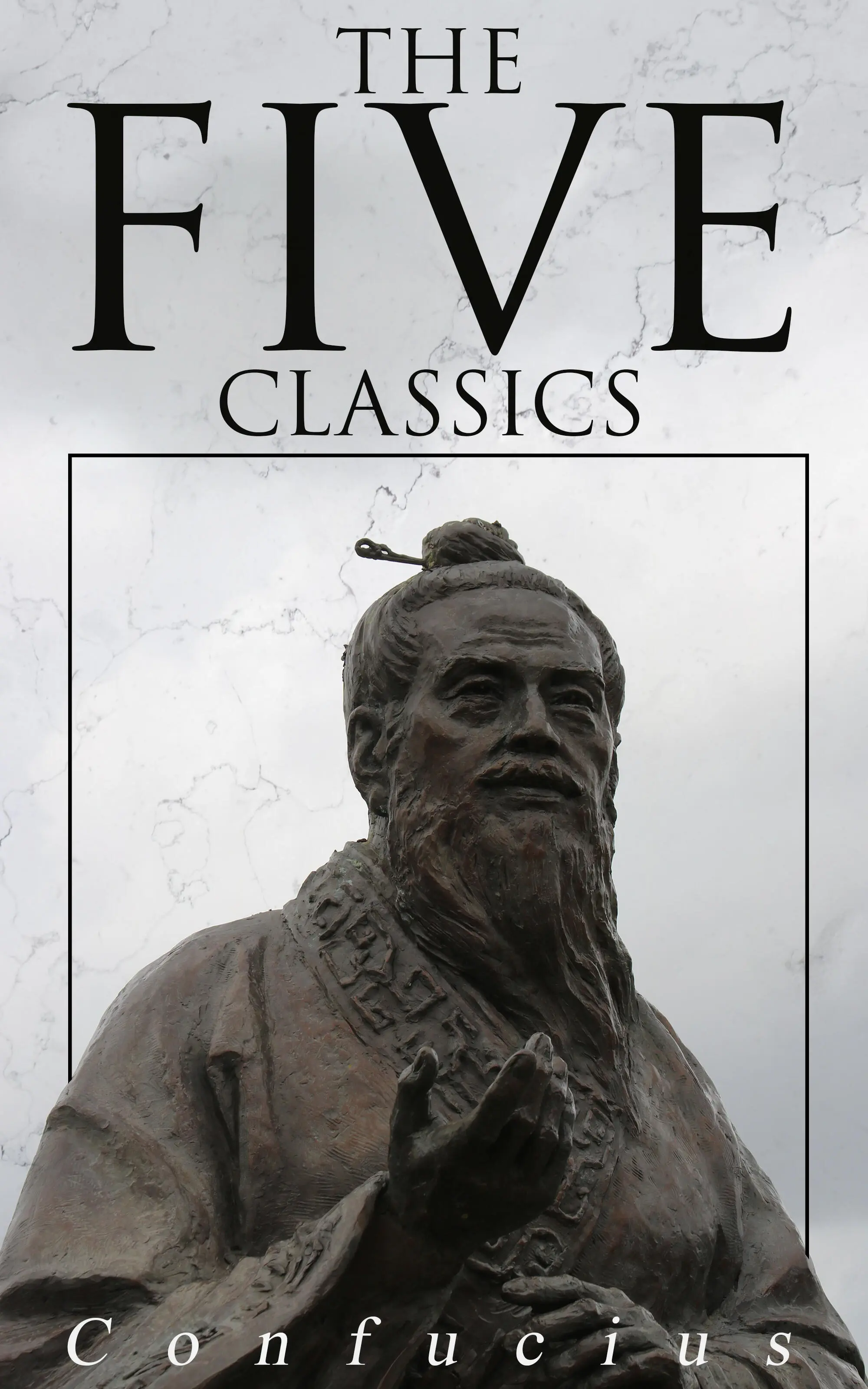
- Название:The Five Classics
- Автор:
- Жанр:
- Год:неизвестен
- ISBN:нет данных
- Рейтинг книги:5 / 5. Голосов: 1
-
Избранное:Добавить в избранное
- Отзывы:
-
Ваша оценка:
The Five Classics: краткое содержание, описание и аннотация
Предлагаем к чтению аннотацию, описание, краткое содержание или предисловие (зависит от того, что написал сам автор книги «The Five Classics»). Если вы не нашли необходимую информацию о книге — напишите в комментариях, мы постараемся отыскать её.
I Ching – The book contains a divination system comparable to Western geomancy or the West African Ifá system. In Western cultures and modern East Asia, it is still widely used for this purpose.
Shu King – A collection of documents and speeches alleged to have been written by rulers and officials of the early Zhou period and before. It is possibly the oldest Chinese narrative, and may date from the 6th century BC. It includes examples of early Chinese prose.
The Shih King – A collection of 305 poems divided into 160 folk songs, 105 festal songs sung at court ceremonies, and 40 hymns and eulogies sung at sacrifices to heroes and ancestral spirits of the royal house.
The Li Ki – Describes ancient rites, social forms and court ceremonies. The version studied today is a re-worked version compiled by scholars in the third century BC rather than the original text, which is said to have been edited by Confucius himself.
Spring and Autumn Annals – A historical record of the State of Lu, Confucius's native state, 722–481 BC.
The Five Classics — читать онлайн ознакомительный отрывок
Ниже представлен текст книги, разбитый по страницам. Система сохранения места последней прочитанной страницы, позволяет с удобством читать онлайн бесплатно книгу «The Five Classics», без необходимости каждый раз заново искать на чём Вы остановились. Поставьте закладку, и сможете в любой момент перейти на страницу, на которой закончили чтение.
Интервал:
Закладка:
From line 4 the danger is imminent. The couch has been overthrown. The person of the occupant is at the mercy of the destroyers.
With line 5 the symbolism changes. The subject of 5 is 'lord of all the other weak lines,' and their subjects are at his disposal. He and they are represented as fishes, following one another as if strung together. All fishes come under the category of yin. Then the symbolism changes again. The subject of 5, representing and controlling all the yin lines, is loyal to the subject of the yang sixth line. He is the rightful sovereign in his palace, and 5 leads all the others there to enjoy the sovereign's favours.
We have still different symbolism under line 6. Its strong subject, notwithstanding the attempts against him, survives, and acquires fresh vigour. The people again cherish their sovereign, and the plotters have wrought to their own overthrow.
Hexagram XXIV. 24Fû
Table of Contents

Fû indicates that there will be free course and progress (in what it denotes). (The subject of it) finds no one to distress him in his exits and entrances; friends come to him, and no error is committed . He will return and repeat his (proper) course. In seven days comes his return. There will be advantage in whatever direction movement is made.
1. The first line, undivided, shows its subject returning (from an error) of no great extent, which would not proceed to anything requiring repentance. There will be great good fortune.
2. The second line, divided, shows the admirable return (of its subject). There will be good fortune.
3. The third line, divided, shows one who has made repeated returns. The position is perilous, but there will be no error.
4. The fourth line, divided, shows its subject moving right in the centre (among those represented by the other divided lines), and yet returning alone (to his proper path).
5. The fifth line, divided, shows the noble return of its subject. There will be no ground for repentance.
6. The topmost line, divided, shows its subject all astray on the subject of returning. There will be evil. There will be calamities and errors. If with his views he put the hosts in motion, the end will be a great defeat, whose issues will extend to the ruler of the state. Even in ten years he will not be able to repair the disaster.
Footnotes
24.Fû symbolises the idea of returning, coming back or over again. The last hexagram showed us inferior prevailing over superior men, all that is good in nature and society yielding before what is bad. But change is the law of nature and society. When decay has reached its climax, recovery will begin to take place. In Po we had one strong topmost line, and five weak lines below p. 109 it; here we have one strong line, and five weak lines above it. To illustrate the subject from what we see in nature,--Po is the hexagram of the ninth month, in which the triumph of cold and decay in the year is nearly complete. It is complete in the tenth month, whose hexagram is Khwăn  ; then follows our hexagram Fû, belonging to the eleventh month, in which was the winter solstice when the sun turned back in his course, and moved with a constant regular progress towards the summer solstice. In harmony with these changes of nature are the changes in the political and social state of a nation. There is nothing in the Yî to suggest the hope of a perfect society or kingdom that cannot be moved.
The strong bottom line is the first of K ăn, the trigram of movement, and the upper trigram is Khwăn, denoting docility and capacity. The strong returning line will meet with no distressing obstacle, and the weak lines will change before it into strong, and be as friends. The bright quality will be developed brighter and brighter from day to day, and month to month.
The sentence, 'In seven days comes his return,' occasions some perplexity. If the reader will refer to hexagrams 44, 33, 12, 20, 23, and 2, he will see that during the months denoted by those figures, the 5th, 6th, 7th, 8th, 9th, and 10th, the yin lines have gradually been prevailing over the yang, until in Khwăn (2) they have extruded them entirely from the lineal figure. Then comes our Fû, as a seventh figure, in which the yang line begins to reassert itself, and from which it goes on to extrude the yin lines in their turn. Explained therefore of the months of the year, we have to take a day for a month. And something analogous--we cannot say exactly what--must have place in society and the state.
The concluding auspice or oracle to him who finds this Fû by divination is what we might expect.
The subject of line 1 is of course the undivided line, meaning here, says Kh ăng-ȝze, 'the way of the superior man.' There must have been some deviation from that, or 'returning' could not be spoken of.
Line 2 is in its proper place, and central; but it is weak. This is more than compensated for, however, by its adherence to line 1, the fifth line not being a proper correlate. Hence the return of its subject is called excellent or admirable.
Line 3 is weak, and in the uneven place of a strong line. It is the top line, moreover, of the trigram whose attribute is movement. Hence the symbolism; but any evil issue may be prevented by a realisation of danger and by caution.
Line 4 has its proper correlate in i; different from all the other weak lines; and its course is different accordingly.
Line 5 is in the central place of honour, and the middle line of Khwăn, denoting docility. Hence its auspice.
Line 6 is weak; and being at the top of the hexagram, when its action of returning is all concluded, action on the part of its subject will lead to evils such as are mentioned. 'Ten years' seems to be a round number, signifying a long time, as in hexagram 3. 2.
Hexagram XXV. 25Wû Wang
Table of Contents

Wû Wang indicates great progress and success, while there will be advantage in being firm and correct. If (its subject and his action) be not correct, he will fall into errors, and it will not be advantageous for him to move in any direction.
1. The first line, undivided, shows its subject free from all insincerity. His advance will be accompanied with good fortune.
2. The second line, divided, shows one who reaps without having ploughed (that he might reap), and gathers the produce of his third year's fields without having cultivated them the first year for that end. To such a one there will be advantage in whatever direction he may move.
3. The third line, divided, shows calamity happening to one who is free from insincerity;--as in the case of an ox that has been tied up. A passer by finds it (and carries it off), while the people in the neighbourhood have the calamity (of being accused and. apprehended).
4. The fourth line, undivided, shows (a case) in which, if its subject can remain firm and correct, there will be no error.
5. The fifth line, undivided, shows one who is free from insincerity, and yet has fallen ill. Let him not use medicine, and he will have occasion for joy (in his recovery).
6. The topmost line, undivided, shows its subject free from insincerity, yet sure to fall into error, if he take action. (His action) will not be advantageous in any way.
Footnotes
25.Wang is the symbol of being reckless, and often of being insincere; Wû Wang is descriptive of a state of entire freedom from such a condition; its subject is one who is entirely simple and sincere. The quality is characteristic of the action of Heaven, and of the highest style of humanity. In this hexagram we have an essay on this noble attribute. An absolute rectitude is essential to it. The nearer one comes to the ideal of the quality, the more powerful will be his influence, the greater his success. But let him see to it that he never swerve from being correct.
Читать дальшеИнтервал:
Закладка:
Похожие книги на «The Five Classics»
Представляем Вашему вниманию похожие книги на «The Five Classics» списком для выбора. Мы отобрали схожую по названию и смыслу литературу в надежде предоставить читателям больше вариантов отыскать новые, интересные, ещё непрочитанные произведения.






Обсуждение, отзывы о книге «The Five Classics» и просто собственные мнения читателей. Оставьте ваши комментарии, напишите, что Вы думаете о произведении, его смысле или главных героях. Укажите что конкретно понравилось, а что нет, и почему Вы так считаете.