Confucius - The Five Classics
Здесь есть возможность читать онлайн «Confucius - The Five Classics» — ознакомительный отрывок электронной книги совершенно бесплатно, а после прочтения отрывка купить полную версию. В некоторых случаях можно слушать аудио, скачать через торрент в формате fb2 и присутствует краткое содержание. Жанр: unrecognised, на английском языке. Описание произведения, (предисловие) а так же отзывы посетителей доступны на портале библиотеки ЛибКат.
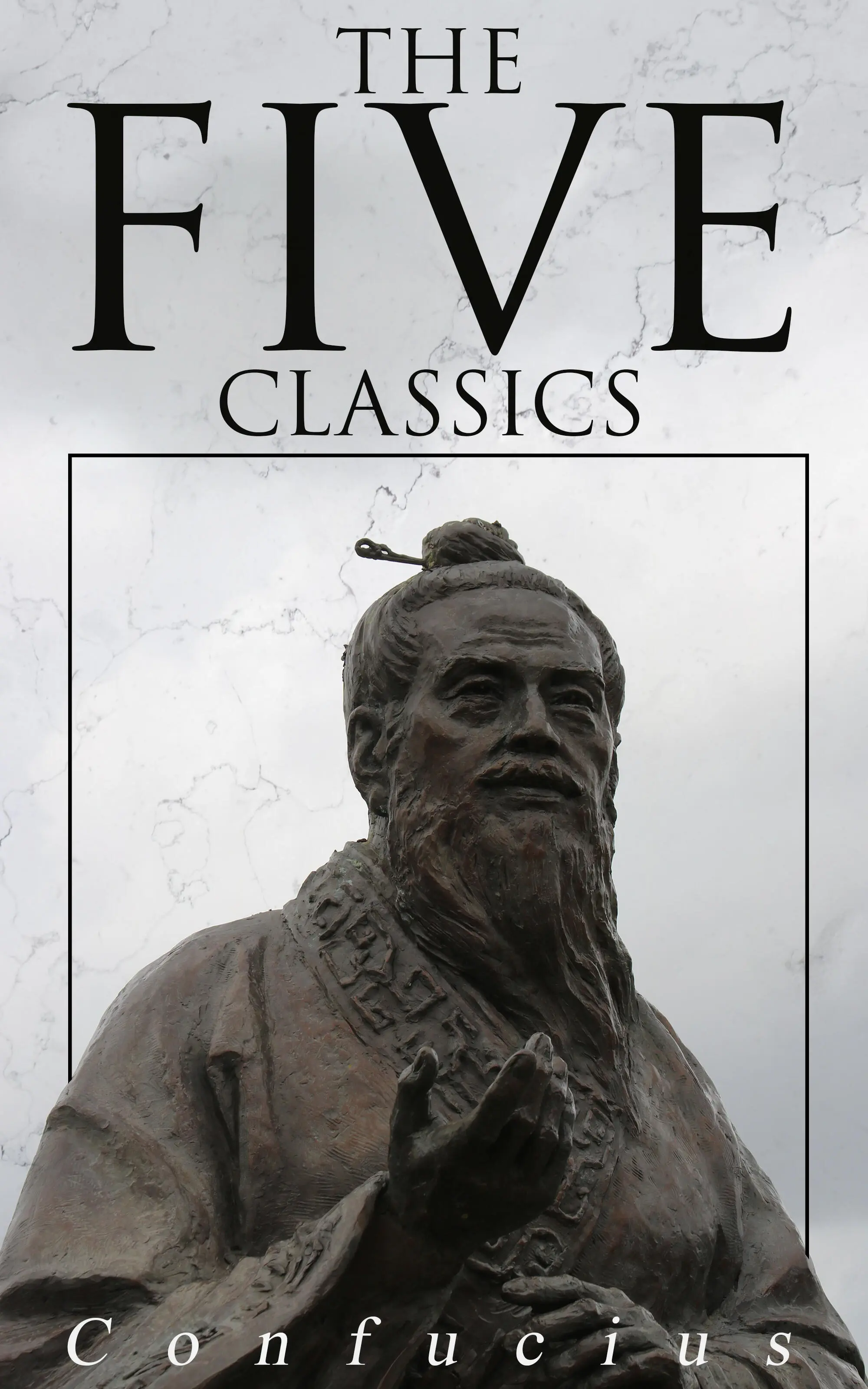
- Название:The Five Classics
- Автор:
- Жанр:
- Год:неизвестен
- ISBN:нет данных
- Рейтинг книги:5 / 5. Голосов: 1
-
Избранное:Добавить в избранное
- Отзывы:
-
Ваша оценка:
The Five Classics: краткое содержание, описание и аннотация
Предлагаем к чтению аннотацию, описание, краткое содержание или предисловие (зависит от того, что написал сам автор книги «The Five Classics»). Если вы не нашли необходимую информацию о книге — напишите в комментариях, мы постараемся отыскать её.
I Ching – The book contains a divination system comparable to Western geomancy or the West African Ifá system. In Western cultures and modern East Asia, it is still widely used for this purpose.
Shu King – A collection of documents and speeches alleged to have been written by rulers and officials of the early Zhou period and before. It is possibly the oldest Chinese narrative, and may date from the 6th century BC. It includes examples of early Chinese prose.
The Shih King – A collection of 305 poems divided into 160 folk songs, 105 festal songs sung at court ceremonies, and 40 hymns and eulogies sung at sacrifices to heroes and ancestral spirits of the royal house.
The Li Ki – Describes ancient rites, social forms and court ceremonies. The version studied today is a re-worked version compiled by scholars in the third century BC rather than the original text, which is said to have been edited by Confucius himself.
Spring and Autumn Annals – A historical record of the State of Lu, Confucius's native state, 722–481 BC.
The Five Classics — читать онлайн ознакомительный отрывок
Ниже представлен текст книги, разбитый по страницам. Система сохранения места последней прочитанной страницы, позволяет с удобством читать онлайн бесплатно книгу «The Five Classics», без необходимости каждый раз заново искать на чём Вы остановились. Поставьте закладку, и сможете в любой момент перейти на страницу, на которой закончили чтение.
Интервал:
Закладка:
Line 1 is a strong line in its proper place. The danger is that its subject may be more strong than prudent, hence the caution in requiring firm correctness.
Line 2, as strong, should be in an odd place; but this is more than counterbalanced by the central position, and its correlate in line 5.
Line 3 is weak, and neither central, nor in its correct position. Hence its action will not be advantageous; but being at the top of the trigram Tui, which means being pleased, its subject is represented as 'well pleased to advance.' Anxious reflection will save him from error.
Line 4, though weak, is in its proper place, and has for its correlate the strong 1. Hence its advance is 'in the highest style.'
Line 5 is the position of the ruler. It is weak, but being central, and having for its correlate the strong and central 2, we have in it a symbol of authority distrustful of itself, and employing fit agents;--characteristic of the wise ruler.
Line 6 is the last of the trigram Khwăn, the height therefore of docility. Line 2 is not its correlate, but it belongs to the Yin to seek for the Yang; and it is so emphatically in this case. Hence the characteristic and issue as assigned.
Hexagram XX. 20Kwân
Table of Contents

Kwân shows (how he whom it represents should be like) the worshipper who has washed his hands, but not (yet) presented his offerings;--with sincerity and an appearance of dignity (commanding reverent regard).
1. The first line, divided, shows the looking of a lad;--not blamable in men of inferior rank, but matter for regret in superior men.
2. The second line, divided, shows one peeping out from a door. It would be advantageous if it were (merely) the firm correctness of a female.
3. The third line, divided, shows one looking at (the course of) his own life, to advance or recede (accordingly).
4. The fourth line, divided, shows one contemplating the glory of the kingdom. It will be advantageous for him, being such as he is, (to seek) to be a guest of the king.
5. The fifth line, undivided, shows its subject contemplating his own life(-course). A superior man, he will (thus) fall into no error.
6. The sixth line, undivided, shows its subject contemplating his character to see if it be indeed that of a superior man. He will not fall into error.
Footnotes
20.The Chinese character Kwân, from which this hexagram is named, is used in it in two senses. In the Thwan, the first paragraph of the treatise on the Thwan, and the paragraph on the Great Symbolism, it denotes showing, manifesting; in all other places it denotes contemplating, looking at. The subject of the hexagram is the sovereign and his subjects, how he manifests himself to them, and how they contemplate him. The two upper, undivided, lines belong to the sovereign; the four weak lines below them are his subjects,--ministers and others who look up at him. Kwân is the hexagram of the eighth month.
In the Thwan king Wăn symbolises the sovereign by a worshipper when he is most solemn in his religious service, at the commencement of it, full of sincerity and with a dignified carriage.
Line 1 is weak, and in the lowest place, improper also for it;--p. 101the symbol of a thoughtless lad, who cannot see far, and takes only superficial views.
Line 2 is also weak, but in its proper place, showing a woman, living retired, and only able to peep as from her door at the subject of the fifth line. But ignorance and retirement are proper in a woman.
Line 3, at the top of the lower trigram Khwăn, and weak, must belong to a subject of the utmost docility, and will wish to act only according to the exigency of time and circumstances.
Line 4, in the place proper to its weakness, is yet in immediate proximity to 5, representing the sovereign. Its subject is moved accordingly, and stirred to ambition.
Line 5 is strong, and in the place of the ruler. He is a superior man, but this does not relieve him from the duty of self-contemplation or examination.
There is a slight difference in the 6th paragraph from the 5th, which can hardly be expressed in a translation. By making a change in the punctuation, however, the different significance may be brought out. Line 6 is strong, and should be considered out of the work of the hexagram, but its subject is still possessed by the spirit of its idea, and is led to self-examination.
Hexagram XXI. 21Shih Ho
Table of Contents

Shih Ho indicates successful progress (in the condition of things which it supposes). It will be advantageous to use legal constraints.
1. The first line, undivided, shows one with his feet in the stocks and deprived of his toes. There will be no error.
2. The second line, divided, shows one biting through the soft flesh, and (going on to) bite off the nose. There will be no error.
3. The third line, divided, shows one gnawing dried flesh, and meeting with what is disagreeable. There will be occasion for some small regret, but no (great) error.
4. The fourth line, undivided, shows one gnawing the flesh dried on the bone, and getting the pledges of money and arrows. It will be advantageous to him to realise the difficulty of his task and be firm,--in which case there will be good fortune.
5. The fifth line, divided, shows one gnawing at dried flesh, and finding the yellow gold. Let him be firm and correct, realising the peril (of his position). There will be no error.
6. The sixth line, undivided, shows one wearing the cangue, and deprived of his cars. There will be evil.
Footnotes
21.Shih Ho means literally 'Union by gnawing.' We see in the figure two strong lines in the first and last places, while all the others, with the exception of the fourth, are divided. This suggests the idea of the jaws and the mouth between them kept open by something in it. Let that be gnawed through and the mouth will close and the jaws come together. So in the body politic. Remove the obstacles to union, and high and low will come together with a good understanding. And how are those obstacles to be removed? By force, emblemed by the gnawing; that is, by legal constraints. And these are sure to be successful. The auspice of the figure is favourable. There will be success.
Lines 1 and 6 are much out of the game or action described in the figure. Hence they are held to represent parties receiving punishment, while the other lines represent parties inflicting it. The punishment in line 1 is that of the stocks, administered for a small offence, and before crime has made much way. But if the 'depriving' of the toes is not merely keeping them in restraint, but cutting them off, as the Chinese character suggests, the punishment appears to a western reader too severe.
Line 2 is weak, appropriately therefore in an even place, and it is central besides. The action therefore of its subject should p. 103 be effective; and this is shown by the 'biting through the soft flesh,' an easy thing. Immediately below, however, is a strong offender represented by the strong line, and before he will submit it is necessary to 'bite off his nose;' for punishment is the rule it must be continued and increased till the end is secured.
Line 3 is weak, and in an even place. The action of its subject will be ineffective; and is emblemed by the hard task of gnawing through dried flesh, and encountering, besides, what is distasteful and injurious in it. But again comes in the consideration that here punishment is the rule, and the auspice is not all bad.
Читать дальшеИнтервал:
Закладка:
Похожие книги на «The Five Classics»
Представляем Вашему вниманию похожие книги на «The Five Classics» списком для выбора. Мы отобрали схожую по названию и смыслу литературу в надежде предоставить читателям больше вариантов отыскать новые, интересные, ещё непрочитанные произведения.






Обсуждение, отзывы о книге «The Five Classics» и просто собственные мнения читателей. Оставьте ваши комментарии, напишите, что Вы думаете о произведении, его смысле или главных героях. Укажите что конкретно понравилось, а что нет, и почему Вы так считаете.