Confucius - The Five Classics
Здесь есть возможность читать онлайн «Confucius - The Five Classics» — ознакомительный отрывок электронной книги совершенно бесплатно, а после прочтения отрывка купить полную версию. В некоторых случаях можно слушать аудио, скачать через торрент в формате fb2 и присутствует краткое содержание. Жанр: unrecognised, на английском языке. Описание произведения, (предисловие) а так же отзывы посетителей доступны на портале библиотеки ЛибКат.
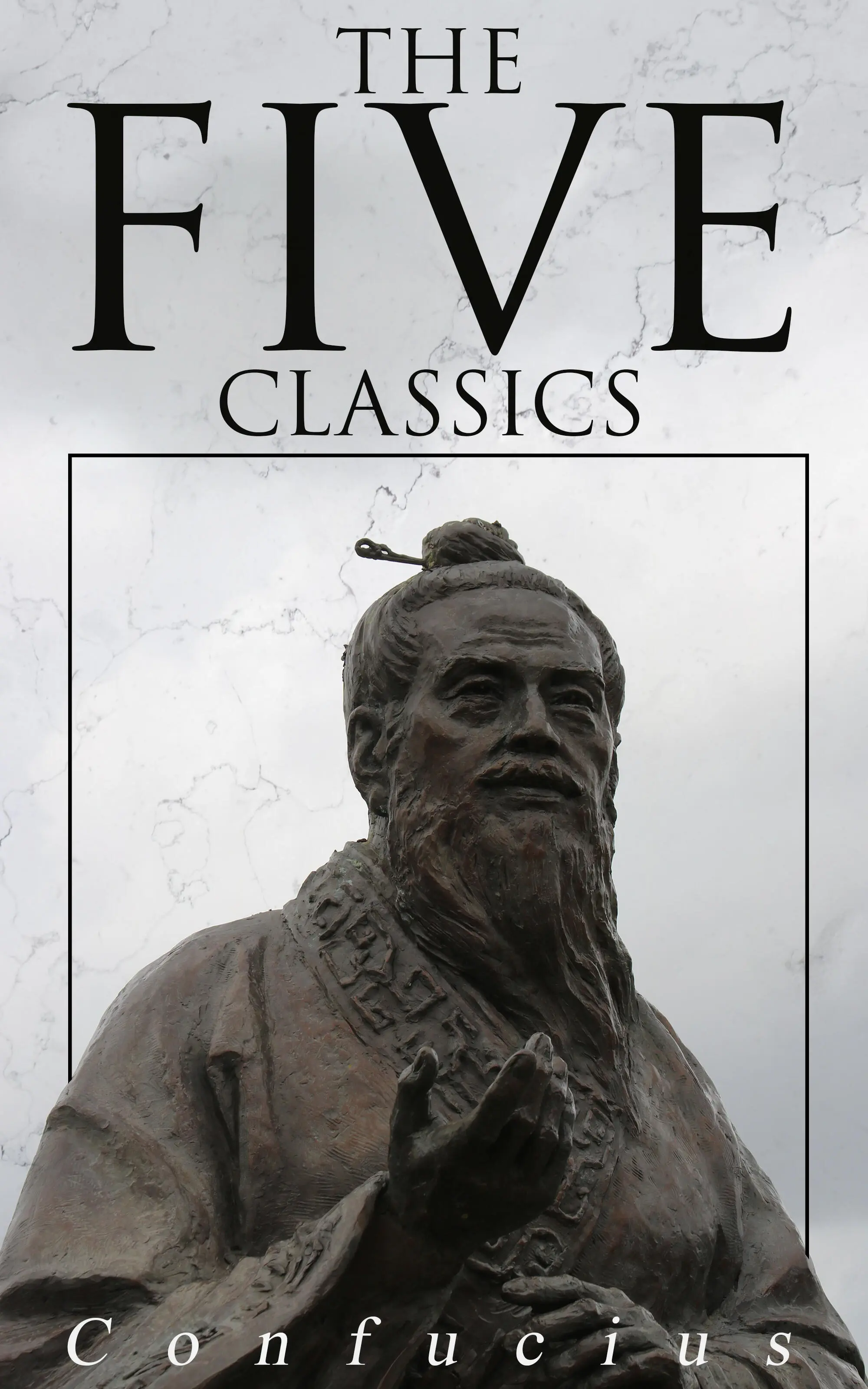
- Название:The Five Classics
- Автор:
- Жанр:
- Год:неизвестен
- ISBN:нет данных
- Рейтинг книги:5 / 5. Голосов: 1
-
Избранное:Добавить в избранное
- Отзывы:
-
Ваша оценка:
The Five Classics: краткое содержание, описание и аннотация
Предлагаем к чтению аннотацию, описание, краткое содержание или предисловие (зависит от того, что написал сам автор книги «The Five Classics»). Если вы не нашли необходимую информацию о книге — напишите в комментариях, мы постараемся отыскать её.
I Ching – The book contains a divination system comparable to Western geomancy or the West African Ifá system. In Western cultures and modern East Asia, it is still widely used for this purpose.
Shu King – A collection of documents and speeches alleged to have been written by rulers and officials of the early Zhou period and before. It is possibly the oldest Chinese narrative, and may date from the 6th century BC. It includes examples of early Chinese prose.
The Shih King – A collection of 305 poems divided into 160 folk songs, 105 festal songs sung at court ceremonies, and 40 hymns and eulogies sung at sacrifices to heroes and ancestral spirits of the royal house.
The Li Ki – Describes ancient rites, social forms and court ceremonies. The version studied today is a re-worked version compiled by scholars in the third century BC rather than the original text, which is said to have been edited by Confucius himself.
Spring and Autumn Annals – A historical record of the State of Lu, Confucius's native state, 722–481 BC.
The Five Classics — читать онлайн ознакомительный отрывок
Ниже представлен текст книги, разбитый по страницам. Система сохранения места последней прочитанной страницы, позволяет с удобством читать онлайн бесплатно книгу «The Five Classics», без необходимости каждый раз заново искать на чём Вы остановились. Поставьте закладку, и сможете в любой момент перейти на страницу, на которой закончили чтение.
Интервал:
Закладка:
The strong line in the fifth, (its correct), place, brings the distress and obstruction to a close. Yet its subject--the ruler in the hexagram-is warned to continue to be cautious in two lines of rhyme:--
'And let him say, "I die! I die I"
So to a bushy clump his fortune he shall tie.'
There is an end of the condition of distress. It was necessary, that condition should give place to its opposite; and the strong line in the topmost place fitly represents the consequent joy.
Hexagram XIII. 13Thung Zăn
Table of Contents

Thung Z ăn (or 'Union of men') appears here (as we find it) in the (remote districts of the) country, indicating progress and success. It will be advantageous to cross the great stream. It will be advantageous to maintain the firm correctness of the superior man.
1. The first line, undivided, (shows the representative of) the union of men just issuing from his gate. There will be no error.
2. The second line, divided, (shows the representative of) the union of men in relation with his kindred. There will be occasion for regret.
3. The third line, undivided, (shows its subject) with his arms hidden in the thick grass, and at the top of a high mound. (But) for three years he makes no demonstration.
4. The fourth line, undivided, (shows its subject) mounted on the city wall; but he does not proceed to make the attack (he contemplates). There will be good fortune.
5. In the fifth line, undivided, (the representative of) the union of men first wails and cries out, and then laughs. His great host conquers, and he (and the subject of the second line) meet together.
6. The topmost line, undivided, (shows the representative of) the union of men in the suburbs. There will be no occasion for repentance.
Footnotes
13.Thung Z ăn describes a condition of nature and of the state opposite to that of Phî. There was distress and obstruction; here is union. But the union must be based entirely on public considerations, without taint of selfishness.
The strong line in the fifth, its correct, place, occupies the most important position, and has for its correlate the weak second line, also in its correct place. The one divided line is naturally sought after by all the strong lines. The upper trigram is that of heaven, which is above; the lower is that of fire, whose tendency is to mount upwards. All these things are in harmony with the idea of union. But the union must be free from all selfish motives, and this is indicated by its being in the remote districts of the country, where people are unsophisticated, and free from the depraving effects incident to large societies. A union from such motives will cope with the greatest difficulties; and yet a word of caution is added.
Line 1 emblems the first attempts at union. It is strong, but in the lowest place; and it has no proper correlate above. There is, however, no intermixture of selfishness in it.
Lines 2 and 5 are proper correlates, which fact suggests in this hexagram the idea of their union being limited and partial, and such as may afford ground for blame.
Line 3 is strong, and in an odd place; but it has not a proper correlate in 6. This makes its subject more anxious to unite with 2; but 2 is devoted to its proper correlate in 5, of whose strength 3 is afraid, and takes the measures described. His abstaining so long, however, from any active attempt, will save him from misfortune.
Line 4 is strong, but in an even place, which weakens its subject, He also would fain make an attempt on 2; but he is afraid, and does not carry his purpose into effect.
Line 5 is strong, in an odd, and the central place; and would fain unite with 2, which indeed is the proper correlate of its subject. But 3 and 4 are powerful foes that oppose the union, Their opposition makes him weep; but he collects his forces, defeats them, and effects his purpose.
The union reaches to all within the suburbs, and is riot yet universal; but still there is no cause for repentance.
Hexagram XIV. 14Tâ Yû
Table of Contents

Tâ Yû indicates that, (under the circumstances which it implies), there will be great progress and success.
1. In the first line, undivided, there is no approach to what is injurious, and there is no error. Let there be a realisation of the difficulty (and danger of the position), and there will be no error (to the end).
2. In the second line, undivided, we have a large waggon with its load. In whatever direction advance is made, there will be no error.
3. The third line, undivided, shows us a feudal prince presenting his offerings to the Son of Heaven. A small man would be unequal (to such a duty).
4. The fourth line, undivided, shows its subject keeping his great resources under restraint. There will be no error.
5. The fifth line, divided, shows the sincerity of its subject reciprocated by that of all the others (represented in the hexagram). Let him display a proper majesty, and there will be good fortune.
6. The topmost line, undivided, shows its subject with help accorded to him from Heaven. There will be good fortune, advantage in every respect.
Footnotes
14.Tâ Yû means 'Great Havings;' denoting in a kingdom a state of prosperity and abundance, and in a, family or individual, a p. 89 state of opulence. The danger threatening such a condition arises from the pride which it is likely to engender. But everything here is against that issue. Apart from the symbolism of the trigrams, we have the place of honour occupied by a weak line, so that its subject will be humble; and all the other lines, strong as they are, will act in obedient sympathy. There will be great progress and success.
Line 2, though strong, is at the lowest part of the figure, and has no correlate above. No external influences have as yet acted injuriously on its subject. Let him do as directed, and no hurtful influence will ever affect him.
The strong line 2 has its proper correlate in line 5, the ruler of the figure, and will use its strength in subordination to his humility. Hence the symbolism.
Line 3 is strong, and in the right (an odd) place. The topmost line of the lower trigram is the proper place for a feudal lord. The subject of this will humbly serve the condescending ruler in line 5. A small man, having the place without the virtue, would give himself airs.
Line 4 is strong, but the strength is tempered by the position, which is that of a weak line. Hence he will do no injury to the mild ruler, to whom he is so near.
Line 5 symbolises the ruler. Mild sincerity is good in him, and affects his ministers and others. But a ruler must not be without an awe-inspiring majesty.
Even the topmost line takes its character from 5. The strength of its subject is still tempered, and Heaven gives its approval.
Hexagram XV. 15Khien
Table of Contents

Kh ien indicates progress and success. The superior man, (being humble as it implies), will have a (good) issue (to his undertakings).
1. The first line, divided, shows us the superior man who adds humility to humility. (Even) the great stream may be crossed with this, and there will be good fortune.
2. The second line, divided, shows us humility that has made itself recognised. With firm correctness there will be good fortune.
Читать дальшеИнтервал:
Закладка:
Похожие книги на «The Five Classics»
Представляем Вашему вниманию похожие книги на «The Five Classics» списком для выбора. Мы отобрали схожую по названию и смыслу литературу в надежде предоставить читателям больше вариантов отыскать новые, интересные, ещё непрочитанные произведения.






Обсуждение, отзывы о книге «The Five Classics» и просто собственные мнения читателей. Оставьте ваши комментарии, напишите, что Вы думаете о произведении, его смысле или главных героях. Укажите что конкретно понравилось, а что нет, и почему Вы так считаете.