Confucius - The Five Classics
Здесь есть возможность читать онлайн «Confucius - The Five Classics» — ознакомительный отрывок электронной книги совершенно бесплатно, а после прочтения отрывка купить полную версию. В некоторых случаях можно слушать аудио, скачать через торрент в формате fb2 и присутствует краткое содержание. Жанр: unrecognised, на английском языке. Описание произведения, (предисловие) а так же отзывы посетителей доступны на портале библиотеки ЛибКат.
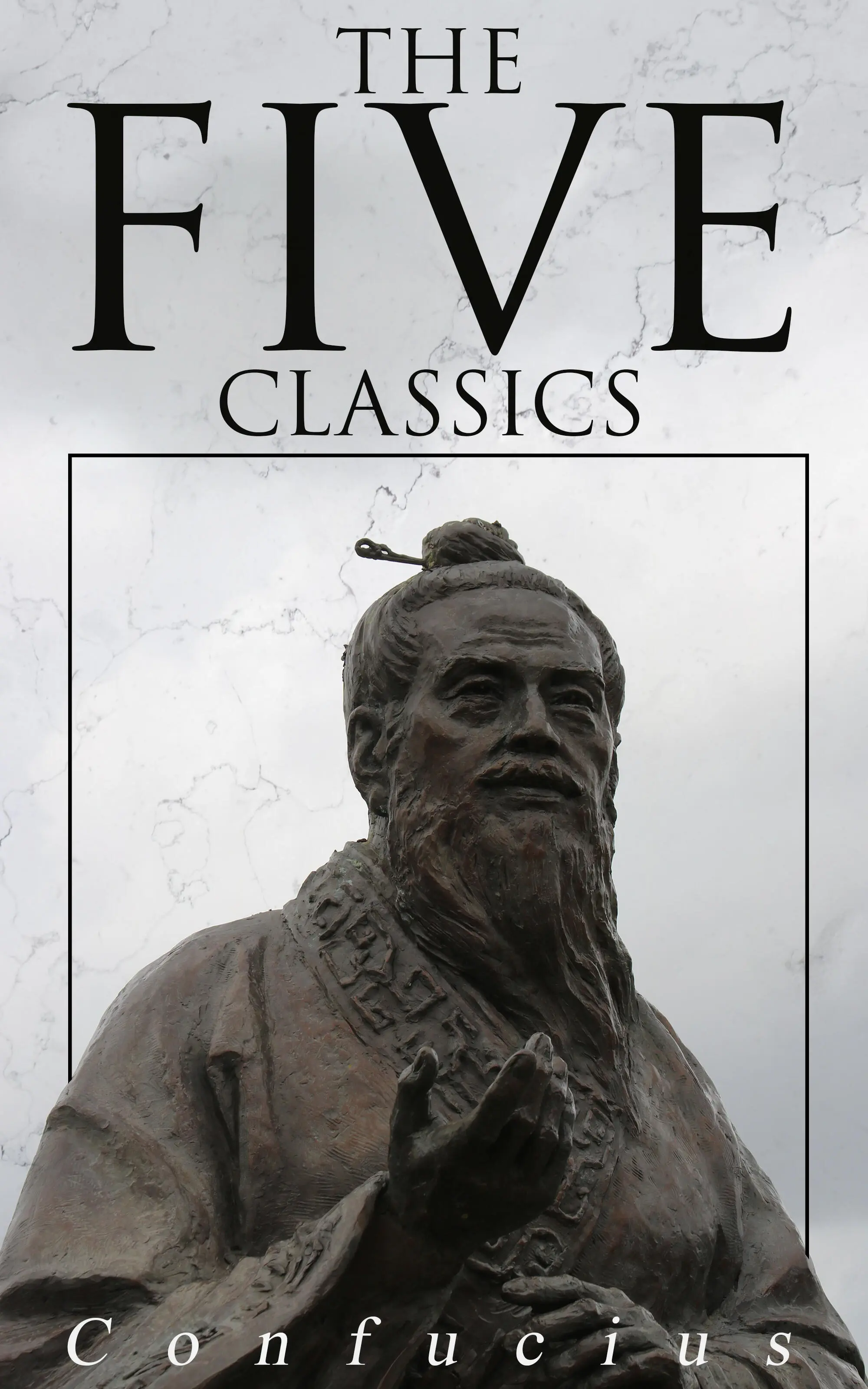
- Название:The Five Classics
- Автор:
- Жанр:
- Год:неизвестен
- ISBN:нет данных
- Рейтинг книги:5 / 5. Голосов: 1
-
Избранное:Добавить в избранное
- Отзывы:
-
Ваша оценка:
The Five Classics: краткое содержание, описание и аннотация
Предлагаем к чтению аннотацию, описание, краткое содержание или предисловие (зависит от того, что написал сам автор книги «The Five Classics»). Если вы не нашли необходимую информацию о книге — напишите в комментариях, мы постараемся отыскать её.
I Ching – The book contains a divination system comparable to Western geomancy or the West African Ifá system. In Western cultures and modern East Asia, it is still widely used for this purpose.
Shu King – A collection of documents and speeches alleged to have been written by rulers and officials of the early Zhou period and before. It is possibly the oldest Chinese narrative, and may date from the 6th century BC. It includes examples of early Chinese prose.
The Shih King – A collection of 305 poems divided into 160 folk songs, 105 festal songs sung at court ceremonies, and 40 hymns and eulogies sung at sacrifices to heroes and ancestral spirits of the royal house.
The Li Ki – Describes ancient rites, social forms and court ceremonies. The version studied today is a re-worked version compiled by scholars in the third century BC rather than the original text, which is said to have been edited by Confucius himself.
Spring and Autumn Annals – A historical record of the State of Lu, Confucius's native state, 722–481 BC.
The Five Classics — читать онлайн ознакомительный отрывок
Ниже представлен текст книги, разбитый по страницам. Система сохранения места последней прочитанной страницы, позволяет с удобством читать онлайн бесплатно книгу «The Five Classics», без необходимости каждый раз заново искать на чём Вы остановились. Поставьте закладку, и сможете в любой момент перейти на страницу, на которой закончили чтение.
Интервал:
Закладка:
3. The third line, undivided, shows the superior man of (acknowledged) merit. He will maintain his success to the end, and have good fortune.
4. The fourth line, divided, shows one, whose action would be in every way advantageous, stirring up (the more) his humility.
5. The fifth line, divided, shows one who, without being rich, is able to employ his neighbours. He may advantageously use the force of arms. All his movements will be advantageous.
6. The sixth line, divided, shows us humility that has made itself recognised. The subject of it will with advantage put his hosts in motion; but (he will only) punish his own towns and state.
Footnotes
15.An essay on humility rightly follows that on abundant possessions. The third line, which is a whole line amid five others divided, occupying the topmost place in the lower trigram, is held by the Khang-hsî editors and many others to be 'the lord of the hexagram,' the representative of humility, strong, but abasing itself. There is nothing here in the text to make us enter farther on the symbolism of the figure. Humility is the way to permanent success.
A weak line, at the lowest place of the figure, is the fitting symbol of the superior man adding humility to humility.
Line 2 is weak, central, and in its proper place, representing a humility that has 'crowed;' that is, has proclaimed itself.
Line 3 is strong, and occupies an odd (its proper) place. It is 'the lord of the hexagram,' to whom all represented by the lines above and below turn.
Line 4 is weak and in its proper position. Its subject is sure to p. 91 be successful and prosperous, but being so near the fifth line, he should still use the greatest precaution.
All men love and honour humility, in itself and without the adjuncts which usually command obedience and respect. Hence his neighbours follow the ruler in the fifth line, though he may not be very rich or powerful. His humility need not keep him from asserting the right, even by force of arms.
The subject of the sixth line, which is weak, is outside the game, so to speak, that has been played out. He will use force, but only within his own sphere and to assert what is right. He will not be aggressive.
Hexagram XVI. 16Yü
Table of Contents

Yü indicates that, (in the state which it implies), feudal princes may be set up, and the hosts put in motion, with advantage.
1. The first line, divided, shows its subject proclaiming his pleasure and satisfaction. There will be evil.
2. The second line, divided, shows one who is firm as a rock. (He sees a thing) without waiting till it has come to pass; with his firm correctness there will be good fortune.
3. The third line, divided, shows one looking up (for favours), while he indulges the feeling of pleasure and satisfaction. If he would understand!--If he be late in doing so, there will indeed be occasion for repentance.
4. The fourth line, undivided, shows him from whom the harmony and satisfaction come. Great is the success which he obtains. Let him not allow suspicions to enter his mind, and thus friends will gather around him.
5. The fifth six, divided, shows one with a chronic complaint, but who lives on without dying.
6. The topmost six, divided, shows its subject with darkened mind devoted to the pleasure and satisfaction (of the time); but if he change his course even when (it may be considered as) completed, there will be no error.
Footnotes
16.The Yü hexagram denoted to king Win a condition of harmony and happy contentment throughout the kingdom, when the people rejoiced in and readily obeyed their sovereign. At such a time his appointments and any military undertakings would be hailed and supported. The fourth line, undivided, is the lord of the figure, and being close to the fifth or place of dignity, is to be looked on as the minister or chief officer of the ruler. The ruler gives to him his confidence; and all represented by the other lines yield their obedience.
Line 1 is weak, and has for its correlate the strong 4. Its subject may well enjoy the happiness of the time. But he cannot contain himself, and proclaims, or boasts of, his satisfaction;--which is evil.
Line 2, though weak, is in its correct position, the centre, moreover, of the lower trigram. Quietly and firmly its subject is able to abide in his place, and exercise a far-seeing discrimination. All is indicative of good fortune.
Line 3 is weak, and in an odd place. Immediately below line 4, its subject keeps looking up to the lord of the figure, and depends on him, thinking of doing nothing, but how to enjoy himself. The consequence will be as described, unless he speedily change.
The strong subject of line 4 is the agent to whom the happy condition is owing; and it is only necessary to caution him to maintain his confidence in himself and his purpose, and his adherents and success will continue.
Line 5 is in the ruler's place; but it is weak, and he is in danger of being carried away by the lust of pleasure. Moreover, proximity to the powerful minister represented by 4 is a source of danger. p. 93 Hence he is represented as suffering from a chronic complaint, but nevertheless he does not die. See Appendix II on the line.
Line 6, at the very top or end of the hexagram, is weak, and its subject is all but lost. Still even for him there is a chance of safety, if he will but change.
Hexagram XVII. 17Sui
Table of Contents

Sui indicates that (under its conditions) there will be great progress and success. But it will be advantageous to be firm and correct. There will (then) be no error.
1. The first line, undivided, shows us one changing the object of his pursuit; but if he be firm and correct, there will he good fortune. Going beyond (his own) gate to find associates, he will achieve merit.
2. The second line, divided, shows us one who cleaves to the little boy, and lets go the man of age and experience.
3. The third line, divided, shows us one who cleaves to the man of age and experience, and lets go. the little boy. Such following will get what it seeks; but it will be advantageous to adhere to what is firm and correct.
4. The fourth line, undivided, shows us one followed and obtaining (adherents). Though he be firm and correct, there will be evil. If he be sincere (however) in his course, and make that evident, into what error will he fall?
5. The fifth line, undivided, shows us (the ruler) sincere in (fostering all) that is excellent. There will be good fortune.
6. The topmost line, divided, shows us (that sincerity) firmly held and clung to, yea, and bound fast. (We see) the king with it presenting his offerings on the western mountain.
Footnotes
17.Sui symbolises the idea of following. It is said to follow Yü, the symbol of harmony and satisfaction. Where there are these conditions men are sure to follow; nor will they follow those in whom they have no complacency. The hexagram includes the cases where one follows others, and where others follow him; and the auspice of great progress and success is due to this flexibility and applicability of it. But in both cases the following must be guided by a reference to what is proper and correct. See the notes on the Thwan and the Great Symbolism.
Line 1 is strong, and lord of the lower trigram. The weak lines ought to follow it; but here it is below them, in the lowest place of the figure. This gives rise to the representation of one changing his pursuit. Still through the native vigour indicated by the line being strong, and in its correct place, its subject will be fortunate. Going beyond his gate to find associates indicates his public spirit, and superiority to selfish considerations.
Читать дальшеИнтервал:
Закладка:
Похожие книги на «The Five Classics»
Представляем Вашему вниманию похожие книги на «The Five Classics» списком для выбора. Мы отобрали схожую по названию и смыслу литературу в надежде предоставить читателям больше вариантов отыскать новые, интересные, ещё непрочитанные произведения.






Обсуждение, отзывы о книге «The Five Classics» и просто собственные мнения читателей. Оставьте ваши комментарии, напишите, что Вы думаете о произведении, его смысле или главных героях. Укажите что конкретно понравилось, а что нет, и почему Вы так считаете.