Confucius - The Five Classics
Здесь есть возможность читать онлайн «Confucius - The Five Classics» — ознакомительный отрывок электронной книги совершенно бесплатно, а после прочтения отрывка купить полную версию. В некоторых случаях можно слушать аудио, скачать через торрент в формате fb2 и присутствует краткое содержание. Жанр: unrecognised, на английском языке. Описание произведения, (предисловие) а так же отзывы посетителей доступны на портале библиотеки ЛибКат.
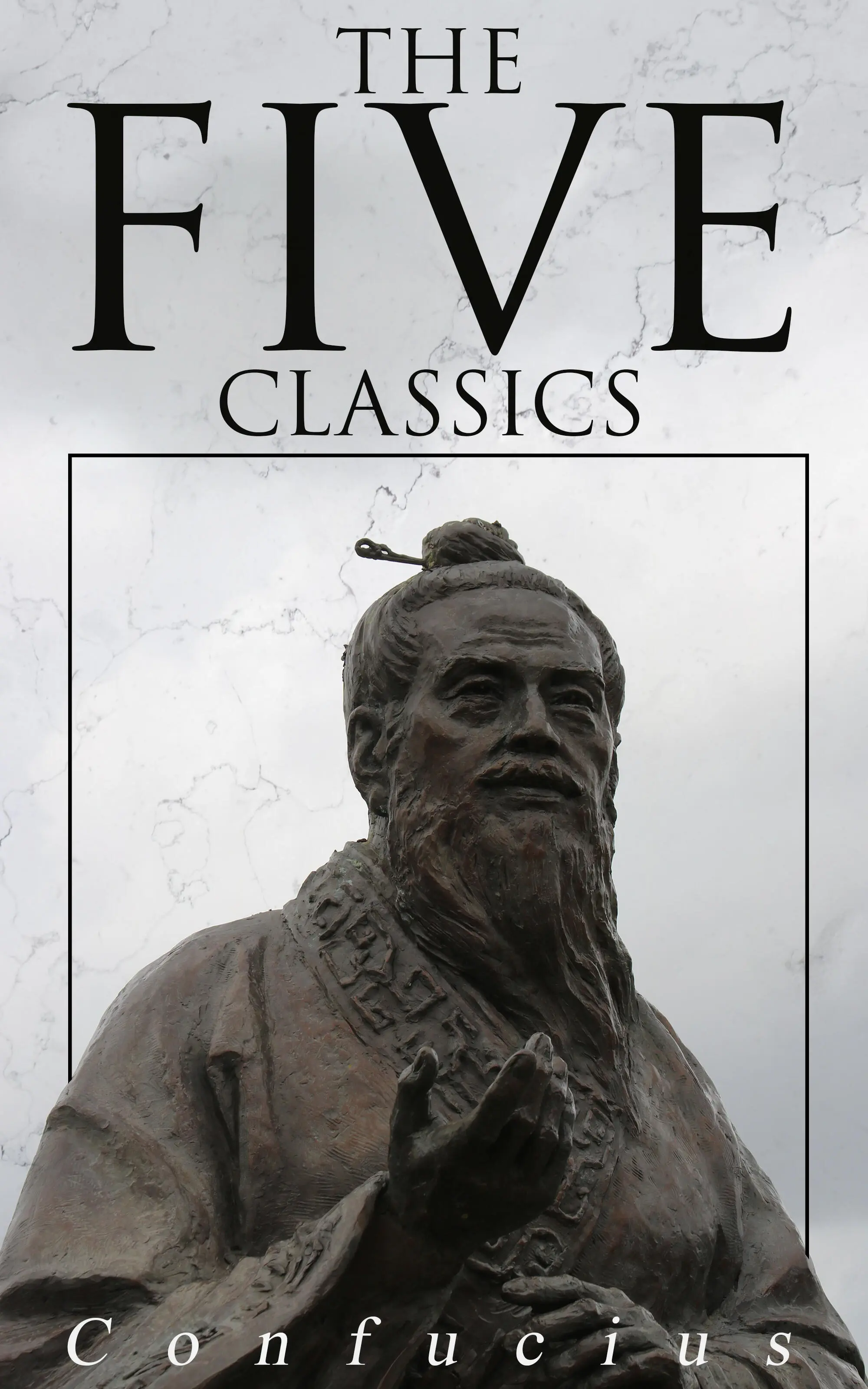
- Название:The Five Classics
- Автор:
- Жанр:
- Год:неизвестен
- ISBN:нет данных
- Рейтинг книги:5 / 5. Голосов: 1
-
Избранное:Добавить в избранное
- Отзывы:
-
Ваша оценка:
The Five Classics: краткое содержание, описание и аннотация
Предлагаем к чтению аннотацию, описание, краткое содержание или предисловие (зависит от того, что написал сам автор книги «The Five Classics»). Если вы не нашли необходимую информацию о книге — напишите в комментариях, мы постараемся отыскать её.
I Ching – The book contains a divination system comparable to Western geomancy or the West African Ifá system. In Western cultures and modern East Asia, it is still widely used for this purpose.
Shu King – A collection of documents and speeches alleged to have been written by rulers and officials of the early Zhou period and before. It is possibly the oldest Chinese narrative, and may date from the 6th century BC. It includes examples of early Chinese prose.
The Shih King – A collection of 305 poems divided into 160 folk songs, 105 festal songs sung at court ceremonies, and 40 hymns and eulogies sung at sacrifices to heroes and ancestral spirits of the royal house.
The Li Ki – Describes ancient rites, social forms and court ceremonies. The version studied today is a re-worked version compiled by scholars in the third century BC rather than the original text, which is said to have been edited by Confucius himself.
Spring and Autumn Annals – A historical record of the State of Lu, Confucius's native state, 722–481 BC.
The Five Classics — читать онлайн ознакомительный отрывок
Ниже представлен текст книги, разбитый по страницам. Система сохранения места последней прочитанной страницы, позволяет с удобством читать онлайн бесплатно книгу «The Five Classics», без необходимости каждый раз заново искать на чём Вы остановились. Поставьте закладку, и сможете в любой момент перейти на страницу, на которой закончили чтение.
Интервал:
Закладка:
4. The fourth line, divided, shows its subject fluttering (down);--not relying on his own rich resources, but calling in his neighbours. (They all come) not as having received warning, but in the sincerity (of their hearts).
5. The fifth six, divided, reminds us of (king) Tî-yî's (rule about the) marriage of his younger sister. By such a course there is happiness and there will be great good fortune.
6. The sixth six, divided, shows us the city wall returned into the moat. It is not the time to use the army. (The subject of the line) may, indeed, announce his orders to the people of his own city; but however correct and firm he may be, he will have cause for regret.
Footnotes
11.The language of the Thwan has reference to the form of Thâi, with the three strong lines of Kh ien below, and the three weak lines of Khwăn above. The former are 'the great,' active and vigorous; the latter are 'the small,' inactive and submissive. But where have the former 'come' from, and whither are the latter gone?' In many editions of the Yî beneath the hexagram of Thâi here, there appears that of Kwei Mei, the 54th in order (  ), which becomes Thâi, if the third and fourth lines exchange places. But in the notes on the Thwan, in the first Appendix, on hexagram 6, I have spoken of the doctrine of 'changing figures,' and intimated my disbelief of it. The different hexagrams arose necessarily by the continued manipulation of the undivided and divided lines, and placing them each over itself and over the other. When king Wăn wrote these Thwan, he was taking the 64 hexagrams, as they were ready to his hand, and not forming one from another by any process of divination. The 'gone' and 'come' are merely equivalent to 'below' and 'above,' in the lower trigram or in the upper.
A course in which the motive forces are represented by the three strong, and the opposing by the three weak lines, must be progressive and successful. Thâi is called the hexagram of the first month of the year, the first month of the natural spring, when for six months, through the fostering sun and genial skies, the processes of growth will be going on.
The symbolism of paragraph 1 is suggested by the three strong lines of Kh ien all together, and all possessed by the same instinct to advance. The movement of the first will be supported by that of the others, and be fortunate.
The second line is strong, but in an even place. This is supposed to temper the strength of its subject; which is expressed by the first of his characteristics. But the even place is the central; and it is responded to by a proper correlate in the fifth line above. Hence come all the symbolism of the paragraph and the auspice of good fortune implied in it.
Beneath the symbolism in paragraph 3 there lies the persuasion of the constant change that is taking place in nature and in human affairs. As night succeeds to day, and winter to summer, so calamity may be expected to follow prosperity, and decay the flourishing of a state. The third is the last of the lines of Kh ien, by whose strength and activity the happy state of Thâi has been produced. Another aspect of things may be looked for; but by firmness and correctness the good estate of the present may be long continued.
According to the treatise on the Thwan, the subjects of the fourth and other upper lines are not 'the small returning' as opponents of the strong lines below, as is generally supposed; but as the correlates of those lines, of one heart and mind with them to maintain the state of Thâi, and giving them, humbly but readily, all the help in their power.
Tî-yî, the last sovereign but one of the Yin dynasty, reigned from B. C. 1191 to 1155; but what was the history of him and his sister here referred to we do not know. P. Regis assumes that he gave his sister in marriage to the lord of K âu, known in subsequent p. 84 time as king Wăn, and that she was the famous Thaî-sze;--contrary to all the evidence I have been able to find on the subject. According to Kh ăng-ȝze, Tî-yî was the first to enact a law that daughters of the royal house, in marrying princes of the states, should be in subjection to them, as if they were not superior to them in rank. Here line 5, while occupying the place of dignity and authority in the hexagram, is yet a weak line in the place of a strong and its subject, accordingly, humbly condescends to his one, strong and proper correlate in line 2.
The course denoted by Thâi has been run; and will be followed by one of a different and unhappy character. The earth dug from the moat had been built up to form a protecting wall; but it is now again fallen into the ditch. War will only aggravate the evil; and however the ruler may address good proclamations to himself and the people of his capital, the coming evil cannot be altogether averted.
Hexagram XII. 12Phî
Table of Contents

In Phî there is the want of good understanding between the (different classes of) men, and its indication is unfavourable to the firm and correct course of the superior man. We see in it the great gone and the little come.
1. The first line, divided, suggests the idea of grass pulled up, and bringing with it other stalks with whose roots it is connected. With firm correctness (on the part of its subject), there will be good fortune and progress.
2. The second line, divided, shows its subject patient and obedient. To the small man (comporting himself so) there will be good fortune. If the great man (comport himself) as the distress and obstruction require, he will have success.
The third line, divided, shows its subject ashamed of the purpose folded (in his breast).
4. The fourth line, undivided, shows its subject acting in accordance with the ordination (of Heaven), and committing no error. His companions will come and share in his happiness.
5. In the fifth line, undivided, we see him who brings the distress and obstruction to a close,--the great man and fortunate. (But let him say), 'We may perish! We may perish!' (so shall the state of things become firm, as if) bound to a clump of bushy mulberry trees.
6. The sixth line, undivided, shows the overthrow (and removal of) the condition of distress and obstruction. Before this there was that condition. Hereafter there will be joy.
Footnotes
12.The form of Phî, it will be seen, is exactly the opposite of that of Thâi. Much of what has been said on the interpretation of that will apply to this, or at least assist the student in making out the meaning of its symbolism. Phî is the hexagram of the seventh month. Genial influences have done their work, the processes of growth are at an end. Henceforth increasing decay must be looked for.
Naturally we should expect the advance of the subject of the first of the three weak lines to lead to evil; but if he set himself to be firm and correct, he will bring about a different issue.
Patience and obedience are proper for the small man in all circumstances. If the great man in difficulty yet cherish these attributes, he will soon have a happy issue out of the distress.
The third line is weak. Its place is odd, and therefore for it incorrect. Its subject would vent his evil purpose, but has not strength to do so. He is left therefore to the shame which he ought to feel without a word of warning. Does the ming of the fourth line mean 'the ordination of Heaven,' as K û Hsî thinks; or the orders of the ruler, as Khăng-ȝze says? Whichever interpretation be taken (and some critics unite the two), the action of the subject of the line, whose strength is tempered by the even position, will be good and correct, and issue in success and happiness.
Читать дальшеИнтервал:
Закладка:
Похожие книги на «The Five Classics»
Представляем Вашему вниманию похожие книги на «The Five Classics» списком для выбора. Мы отобрали схожую по названию и смыслу литературу в надежде предоставить читателям больше вариантов отыскать новые, интересные, ещё непрочитанные произведения.






Обсуждение, отзывы о книге «The Five Classics» и просто собственные мнения читателей. Оставьте ваши комментарии, напишите, что Вы думаете о произведении, его смысле или главных героях. Укажите что конкретно понравилось, а что нет, и почему Вы так считаете.