Confucius - The Five Classics
Здесь есть возможность читать онлайн «Confucius - The Five Classics» — ознакомительный отрывок электронной книги совершенно бесплатно, а после прочтения отрывка купить полную версию. В некоторых случаях можно слушать аудио, скачать через торрент в формате fb2 и присутствует краткое содержание. Жанр: unrecognised, на английском языке. Описание произведения, (предисловие) а так же отзывы посетителей доступны на портале библиотеки ЛибКат.
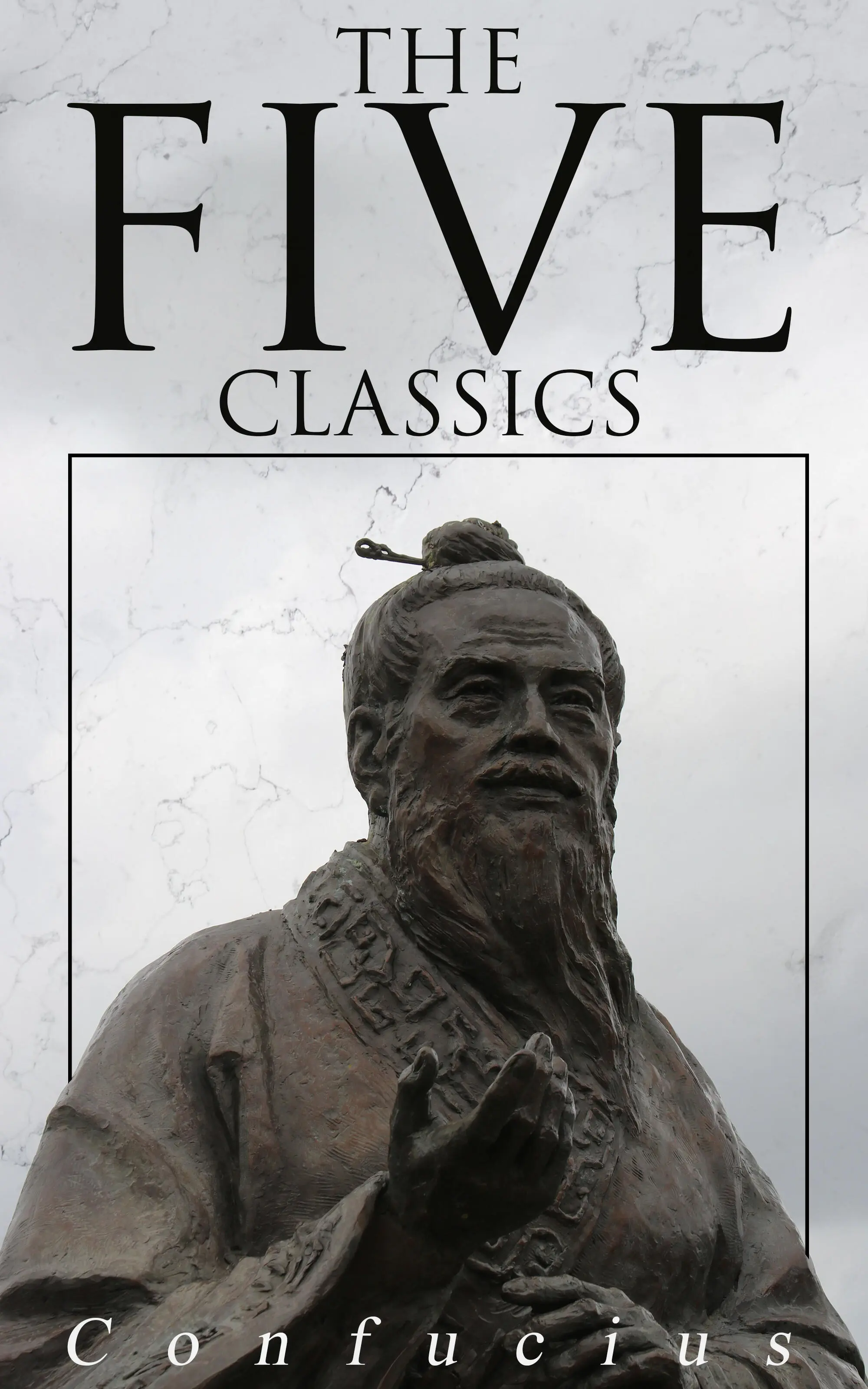
- Название:The Five Classics
- Автор:
- Жанр:
- Год:неизвестен
- ISBN:нет данных
- Рейтинг книги:5 / 5. Голосов: 1
-
Избранное:Добавить в избранное
- Отзывы:
-
Ваша оценка:
The Five Classics: краткое содержание, описание и аннотация
Предлагаем к чтению аннотацию, описание, краткое содержание или предисловие (зависит от того, что написал сам автор книги «The Five Classics»). Если вы не нашли необходимую информацию о книге — напишите в комментариях, мы постараемся отыскать её.
I Ching – The book contains a divination system comparable to Western geomancy or the West African Ifá system. In Western cultures and modern East Asia, it is still widely used for this purpose.
Shu King – A collection of documents and speeches alleged to have been written by rulers and officials of the early Zhou period and before. It is possibly the oldest Chinese narrative, and may date from the 6th century BC. It includes examples of early Chinese prose.
The Shih King – A collection of 305 poems divided into 160 folk songs, 105 festal songs sung at court ceremonies, and 40 hymns and eulogies sung at sacrifices to heroes and ancestral spirits of the royal house.
The Li Ki – Describes ancient rites, social forms and court ceremonies. The version studied today is a re-worked version compiled by scholars in the third century BC rather than the original text, which is said to have been edited by Confucius himself.
Spring and Autumn Annals – A historical record of the State of Lu, Confucius's native state, 722–481 BC.
The Five Classics — читать онлайн ознакомительный отрывок
Ниже представлен текст книги, разбитый по страницам. Система сохранения места последней прочитанной страницы, позволяет с удобством читать онлайн бесплатно книгу «The Five Classics», без необходимости каждый раз заново искать на чём Вы остановились. Поставьте закладку, и сможете в любой момент перейти на страницу, на которой закончили чтение.
Интервал:
Закладка:
Line 4 is weak and not central; and therefore 'to retreat' is p. 74 natural for its subject. But its place is even, and proper for a divided line; and the retreat will be right in the circumstances.
In line 5 we seem to have an intimation of the important truth that only defensive war, or war waged by the rightful authority to put down rebellion and lawlessness, is right. 'The birds in the fields' symbolise parties attacking for plunder. The fifth line symbolises the chief authority,--the king, who is weak, or humble, and in the centre, and cedes the use of all his power to the general symbolised by line 2. The subject of 2 is 'the oldest son.' Those of three and four are supposed to be 'the younger brother and son,' that is, the younger men, who would cause evil if admitted to share the command.
The lesson on the topmost line is true and important, but the critics seem unable to deduce it from the nature of the line, as divided and in the sixth place.
Hexagram VIII. 8Pî
Table of Contents

Pî indicates that (under the conditions which it supposes) there is good fortune. But let (the principal party intended in it) re-examine himself, (as if) by divination, whether his virtue be great, unintermitting, and firm. If it be so, there will be no error. Those who have not rest will then come to him; and with those who are (too) late in coming it will be ill.
1. The first line, divided, shows its subject seeking by his sincerity to win the attachment of his object. There will be no error. Let (the breast) be full of sincerity as an earthenware vessel is of its contents, and it will in the end bring other advantages.
2. In the second line, divided, we see the movement towards union and attachment proceeding from the inward (mind). With firm correctness there will be good fortune.
In the third line, divided, we see its subject seeking for union with such as ought not to be associated with.
4. In the fourth line, divided, we see its subject seeking for union with the one beyond himself. With firm correctness there will be good fortune.
5. The fifth line, undivided, affords the most illustrious instance of seeking union and attachment. (We seem to see in it) the king urging his pursuit of the game (only) in three directions, and allowing the escape of all the animals before him, while the people of his towns do not warn one another (to prevent it). There will be good fortune.
6. In the topmost line, divided, we see one seeking union and attachment without having taken the first step (to such an end). There will be evil.
Footnotes
8.The idea of union between the different members and classes of a state, and how it can be secured, is the subject of the hexagram Pî. The whole line occupying the fifth place, or that of authority, in the hexagram, represents the ruler to whom the subjects of all the other lines offer a ready submission. According to the general rules for the symbolism of the lines, the second line is the correlate of the fifth; but all the other lines are here made subject to that fifth;--which is also a law of the Yî, according to the 'Daily Lecture.' To me it has the suspicious look of being made for the occasion. The harmony of union, therefore, is to be secured by the sovereign authority of one; but he is warned to see to it that his virtue be what will beseem his place, and subjects are warned not to delay to submit to him.
Where does the 'sincerity' predicated of the subject of line 1 come from? The 'earthenware vessel' is supposed to indicate its plain, unadorned character; but there is nothing in the position and nature of the line, beyond the general idea in the figure, to Suggest the attribute.
Line 2 is the proper correlate of 5. Its position in the centre of the inner or lower trigram agrees with the movement of its subject as proceeding from the inward mind.
Line 3 is weak, not in the centre, nor in its correct place. The lines above and below it are both weak. All these things are supposed to account for what is said on it.
'The one beyond himself' in line 4 is the ruler or king, who is p. 76 the subject of 5, and with whom union ought to be sought. The divided line, moreover, is in a place proper to it. If its subject be firm and correct, there will be good fortune.
The subject of line 5 is the king, who must be the centre of union. The ancient kings had their great hunting expeditions in the different seasons; and that of each season had its peculiar rules. But what is stated here was common to all. When the beating was completed, and the shooting was ready to commence, one side of the enclosure into which the game had been driven was left open and unguarded;--a proof of the royal benevolence, which did not want to make an end of all the game. So well known and understood is this benevolence of the model king of the hexagram, that all his people try to give it effect. Thus the union contemplated is shown to be characterised by mutual confidence and appreciation in virtue and benevolence.
A weak line being in the 6th place, which is appropriate to it, its subject is supposed to be trying to promote union among and with the subjects of the lines below. It is too late. The time is past. Hence it is symbolised as 'without a head,' that is, as not having taken the first step, from which its action should begin, and go on to the end.
Hexagram IX. 9Hsiâo Khû
Table of Contents

Hsiâo Kh û indicates that (under its conditions) there will be progress and success. (We see) dense clouds, but no rain coming from our borders in the west.
1. The first line, undivided, shows its subject returning and pursuing his own course. What mistake should he fall into? There will be good fortune.
2. The second line, undivided, shows its subject, by the attraction (of the former line), returning (to the proper course). There will be good fortune.
3. The third line, undivided, suggests the idea of a carriage, the strap beneath which has been removed, or of a husband and wife looking on each other with averted eyes.
4. The fourth line, divided, shows its subject possessed of sincerity. The danger of bloodshed is thereby averted, and his (ground for) apprehension dismissed. There will be no mistake.
5. The fifth line, undivided, shows its subject possessed of sincerity, and drawing others to unite with him. Rich in resources, he employs his neighbours (in the same cause with himself).
6. The topmost line, undivided, shows how the rain has fallen, and the (onward progress) is stayed;--(so) must we value the full accumulation of the virtue (represented by the upper trigram). But a wife (exercising restraint), however firm and correct she may be, is in a position of peril, (and like) the moon approaching to the full. If the superior man prosecute his measures (in such circumstances), there will be evil.
Footnotes
9.The name Hsiâo Kh û is interpreted as meaning 'small restraint.' The idea of 'restraint' having once been determined on as that to be conveyed by the figure, it is easily made out that the restraint must be small, for its representative is the divided line in the fourth place; and the check given by that to all the undivided lines cannot be great. Even if we suppose, as many critics do, that all the virtue of that upper trigram Sun is concentrated in its first line, the attribute ascribed to Sun is that of docile flexibility, which cannot long be successful against the strength emblemed by the lower trigram Kh ien. The restraint therefore is small, and in the end there will be 'progress and success.'
Читать дальшеИнтервал:
Закладка:
Похожие книги на «The Five Classics»
Представляем Вашему вниманию похожие книги на «The Five Classics» списком для выбора. Мы отобрали схожую по названию и смыслу литературу в надежде предоставить читателям больше вариантов отыскать новые, интересные, ещё непрочитанные произведения.






Обсуждение, отзывы о книге «The Five Classics» и просто собственные мнения читателей. Оставьте ваши комментарии, напишите, что Вы думаете о произведении, его смысле или главных героях. Укажите что конкретно понравилось, а что нет, и почему Вы так считаете.