Confucius - The Five Classics
Здесь есть возможность читать онлайн «Confucius - The Five Classics» — ознакомительный отрывок электронной книги совершенно бесплатно, а после прочтения отрывка купить полную версию. В некоторых случаях можно слушать аудио, скачать через торрент в формате fb2 и присутствует краткое содержание. Жанр: unrecognised, на английском языке. Описание произведения, (предисловие) а так же отзывы посетителей доступны на портале библиотеки ЛибКат.
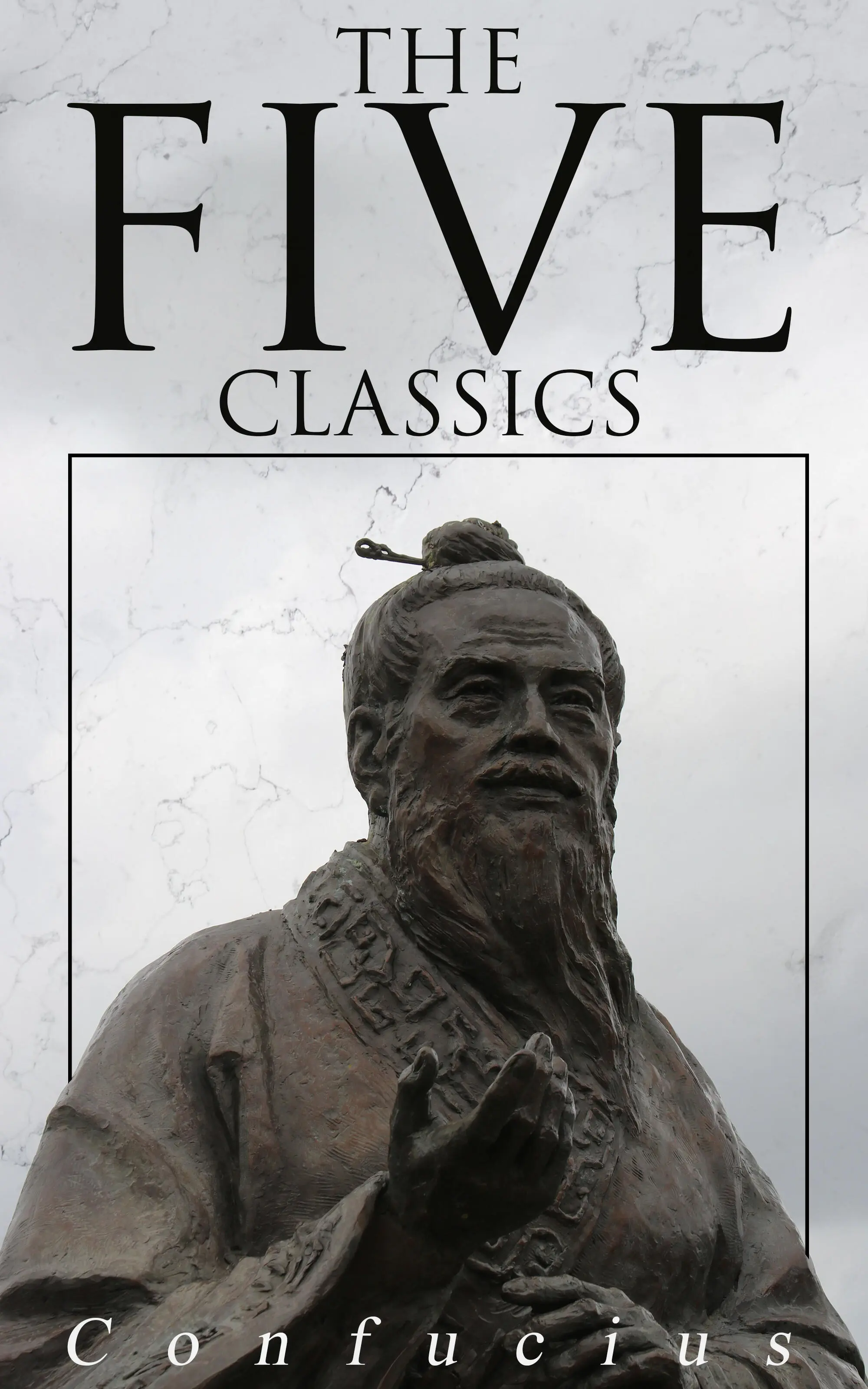
- Название:The Five Classics
- Автор:
- Жанр:
- Год:неизвестен
- ISBN:нет данных
- Рейтинг книги:5 / 5. Голосов: 1
-
Избранное:Добавить в избранное
- Отзывы:
-
Ваша оценка:
The Five Classics: краткое содержание, описание и аннотация
Предлагаем к чтению аннотацию, описание, краткое содержание или предисловие (зависит от того, что написал сам автор книги «The Five Classics»). Если вы не нашли необходимую информацию о книге — напишите в комментариях, мы постараемся отыскать её.
I Ching – The book contains a divination system comparable to Western geomancy or the West African Ifá system. In Western cultures and modern East Asia, it is still widely used for this purpose.
Shu King – A collection of documents and speeches alleged to have been written by rulers and officials of the early Zhou period and before. It is possibly the oldest Chinese narrative, and may date from the 6th century BC. It includes examples of early Chinese prose.
The Shih King – A collection of 305 poems divided into 160 folk songs, 105 festal songs sung at court ceremonies, and 40 hymns and eulogies sung at sacrifices to heroes and ancestral spirits of the royal house.
The Li Ki – Describes ancient rites, social forms and court ceremonies. The version studied today is a re-worked version compiled by scholars in the third century BC rather than the original text, which is said to have been edited by Confucius himself.
Spring and Autumn Annals – A historical record of the State of Lu, Confucius's native state, 722–481 BC.
The Five Classics — читать онлайн ознакомительный отрывок
Ниже представлен текст книги, разбитый по страницам. Система сохранения места последней прочитанной страницы, позволяет с удобством читать онлайн бесплатно книгу «The Five Classics», без необходимости каждый раз заново искать на чём Вы остановились. Поставьте закладку, и сможете в любой момент перейти на страницу, на которой закончили чтение.
Интервал:
Закладка:
3. The third line, divided, shows its subject keeping in the old place assigned for his support, and firmly correct. Perilous as the position is, there will be good fortune in the end. Should he perchance engage in the king's business, he will not (claim the merit of) achievement.
4. The fourth line, undivided, shows its subject unequal to the contention. He returns to (the study of Heaven's) ordinances, changes (his wish to contend), and rests in being firm and correct. There will be good fortune.
S. The fifth line, undivided, shows its subject contending;--and with great good fortune.
6. The topmost line, undivided, shows how its subject may have the leathern belt conferred on him (by the sovereign), and thrice it shall be taken from him in a morning.
Footnotes
6.We have strength in the upper trigram, as if to regulate and control the lower, and peril in that lower as if looking out for an opportunity to assail the upper; or, as it may be represented, we have one's self in a state of peril matched against strength from without. All this is supposed to give the idea of contention or strife. But the undivided line in the centre of Khân is emblematic of sincerity, and gives a character to the whole figure. An individual, so represented, will be very wary, and have good fortune; but strife is bad, and if persevered in even by such a one, the effect will be evil. The fifth line, undivided, in an odd place, and central, serves as a representative of 'the great man,' whose agency is sure to be good; but the topmost line being also strong, and with its two companions, riding as it were, on the trigram of peril, its action is likely to be too rash for a great enterprise. See the treatise on the Thwan, in loc.
The subject of line 1 is weak and at the bottom of the figure. He may suffer a little in the nascent strife, but will let it drop; and the effect will be good.
Line 2 represents one who is strong, and has the rule of the lower trigram;--he has the mind for strife, and might be expected to engage in it. But his strength is weakened by, being in an even place, and he is no match for his correlate in line 5, and therefore retreats. A town or city with only three hundred families is said p. 71 to be very small. That the subject of the line should retire to so insignificant a place is further proof of his humility.
Line 3 is weak and in an odd place. Its subject therefore is not equal to strive, but withdraws from the arena. Even if forced into it, he will keep himself in the background;--and be safe. 'He keeps in the old place assigned for his support' is, literally, 'He eats his old virtue;' meaning that he lives in and on the appanage assigned to him for his services.
Line 4 is strong, and not in the centre; so that we are to conceive of its subject as having a mind to strive. But immediately above it is line 5, the symbol of the ruler, and with him it is hopeless to strive; immediately below is 3, weak, and out of its proper place, incapable of maintaining a contention. Its proper correlate is the lowest line, weak, and out of its proper place, from whom little help can come. Hence its subject takes the course indicated, which leads to good fortune.
Line 5 has every circumstance in favour of its subject.
Line 6 is strong and able to contend successfully; but is there to be no end of striving? Persistence in it is sure to end in defeat and disgrace. The contender here might receive a reward from the king for his success; but if he received it thrice in a morning, thrice it would be taken from him again. As to the nature of the reward here given, see on the Lî K î, X, ii, 32.
P. Regis explains several of the expressions in the Text, both in the Thwan and the Hsiang, from the history of king Wăn and his son king Wû. Possibly his own circumstances may have suggested to Wăn some of the Thwan; and his course in avoiding a direct collision with the tyrant Shâu, and Wû's subsequent exploits may have been in the mind of the duke of K âu. Some of the sentiments, however, cannot be historically explained. They are general protests against all contention and strife.
Hexagram VII. 7Sze
Table of Contents

Sze indicates how, in the case which it supposes, with firmness and correctness, and (a leader of) age and experience, there will be good fortune and no error.
1. The first line, divided, shows the host going forth according to the rules (for such a movement). If these be not good, there will be evil.
2. The second line, undivided, shows (the leader) in the midst of the host. There will be good fortune and no error. The king has thrice conveyed to him the orders (of his favour).
3. The third line, divided, shows how the host may, possibly, have many inefficient leaders. There will be evil.
4. The fourth line, divided, shows the host in retreat. There is no error.
5. The fifth line, divided, shows birds in the fields, which it will be advantageous to seize (and destroy). In that case there will be no error. If the oldest son leads the host, and younger men (idly occupy offices assigned to them), however firm and correct he may be, there will be evil.
6. The topmost line, divided, shows the great ruler delivering his charges, (appointing some) to be rulers of states, and others to undertake the headship of clans; but small men should not be employed (in such positions).
Footnotes
7.The conduct of military expeditions in a feudal kingdom, and we may say, generally, is denoted by the hexagram Sze. Referring to Appendixes I and II for an explanation of the way in which the combination of lines in it is made out to suggest the idea of an army, and that idea being assumed, it is easy to see how the undivided line in the second place should be interpreted of the general, who is responded to by the divided line in the fifth and royal place. Thus entire trust is reposed in him. He is strong p. 73 and correct, and his enterprises will be successful. He is denominated k ang z ăn, 'an old, experienced man.'
'The rules,' it is said, 'are twofold;--first, that the war be for a righteous end; and second, that the manner of conducting it, especially at the outset, be right.' But how this and the warning in the conclusion should both follow from the divided line being in the first place, has not been sufficiently explained.
How line 2 comes to be the symbol of the general in command of the army has been shown above on the Thwan. The orders of the king thrice conveyed to him are to be understood of his appointment to the command, and not of any rewards conferred on him as a tribute to his merit. Nor is stress to be laid on the 'thrice.' 'It does not mean that the appointment came to him three times; but that it was to him exclusively, and with the entire confidence of the king.'
The symbolism of line 3 is very perplexing. P. Regis translates it:--'Milites videntur deponere sarcinas in curribus. Male.' Canon McClatchie has:--'Third-six represents soldiers as it were lying dead in their baggage carts, and is unlucky.' To the same effect was my own translation of the paragraph, nearly thirty years ago. But the third line, divided, cannot be forced to have such an indication. The meaning I have now given is more legitimate, taken character by character, and more in harmony with the scope of the hexagram, The subject of line 2 is the one proper leader of the host. But line 3 is divided and weak, and occupies the place of a strong line, as if its subject had perversely jumped over two, and perched himself above it to take the command. This interpretation also suits better in the 5th paragraph.
Читать дальшеИнтервал:
Закладка:
Похожие книги на «The Five Classics»
Представляем Вашему вниманию похожие книги на «The Five Classics» списком для выбора. Мы отобрали схожую по названию и смыслу литературу в надежде предоставить читателям больше вариантов отыскать новые, интересные, ещё непрочитанные произведения.






Обсуждение, отзывы о книге «The Five Classics» и просто собственные мнения читателей. Оставьте ваши комментарии, напишите, что Вы думаете о произведении, его смысле или главных героях. Укажите что конкретно понравилось, а что нет, и почему Вы так считаете.