Confucius - The Five Classics
Здесь есть возможность читать онлайн «Confucius - The Five Classics» — ознакомительный отрывок электронной книги совершенно бесплатно, а после прочтения отрывка купить полную версию. В некоторых случаях можно слушать аудио, скачать через торрент в формате fb2 и присутствует краткое содержание. Жанр: unrecognised, на английском языке. Описание произведения, (предисловие) а так же отзывы посетителей доступны на портале библиотеки ЛибКат.
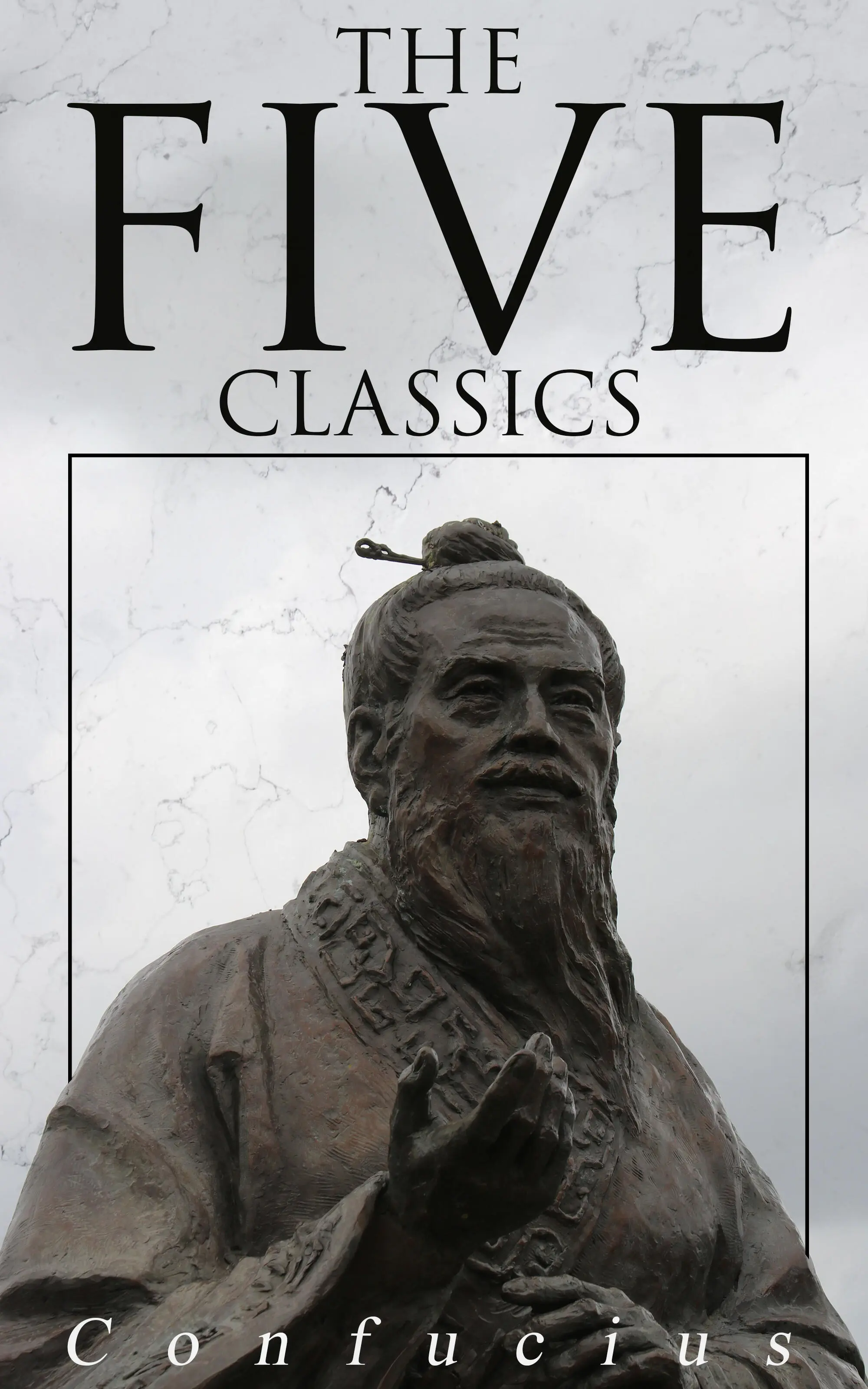
- Название:The Five Classics
- Автор:
- Жанр:
- Год:неизвестен
- ISBN:нет данных
- Рейтинг книги:5 / 5. Голосов: 1
-
Избранное:Добавить в избранное
- Отзывы:
-
Ваша оценка:
The Five Classics: краткое содержание, описание и аннотация
Предлагаем к чтению аннотацию, описание, краткое содержание или предисловие (зависит от того, что написал сам автор книги «The Five Classics»). Если вы не нашли необходимую информацию о книге — напишите в комментариях, мы постараемся отыскать её.
I Ching – The book contains a divination system comparable to Western geomancy or the West African Ifá system. In Western cultures and modern East Asia, it is still widely used for this purpose.
Shu King – A collection of documents and speeches alleged to have been written by rulers and officials of the early Zhou period and before. It is possibly the oldest Chinese narrative, and may date from the 6th century BC. It includes examples of early Chinese prose.
The Shih King – A collection of 305 poems divided into 160 folk songs, 105 festal songs sung at court ceremonies, and 40 hymns and eulogies sung at sacrifices to heroes and ancestral spirits of the royal house.
The Li Ki – Describes ancient rites, social forms and court ceremonies. The version studied today is a re-worked version compiled by scholars in the third century BC rather than the original text, which is said to have been edited by Confucius himself.
Spring and Autumn Annals – A historical record of the State of Lu, Confucius's native state, 722–481 BC.
The Five Classics — читать онлайн ознакомительный отрывок
Ниже представлен текст книги, разбитый по страницам. Система сохранения места последней прочитанной страницы, позволяет с удобством читать онлайн бесплатно книгу «The Five Classics», без необходимости каждый раз заново искать на чём Вы остановились. Поставьте закладку, и сможете в любой момент перейти на страницу, на которой закончили чтение.
Интервал:
Закладка:
The symbolism of the lines is various. Paragraph 2 presents to us the earth itself, according to the Chinese conception of it, as a great cube. To keep his excellence under restraint, as in paragraph 3, is the part of a minister or officer, seeking not his own glory, but that of his ruler. Paragraph 4 shows its subject exercising a still greater restraint on himself than in paragraph 3. There is an interpretation of the symbolism of paragraph 5 in a narrative of the Ȝo K wan, under the 12th year of duke Kh âo, B.C. 530. 'Yellow' is one of the five 'correct' colours, and the colour of the earth. 'The lower garment' is a symbol of humility. The fifth line is the seat of honour. If its occupant possess the qualities indicated, he will be greatly fortunate.
See the note on the sixth line of hexagram 1. What is there said to be 'beyond the proper limits' takes place here 'in the wild.' The humble subject of the divided line is transformed into a p. 62 dragon, and fights with the true dragon, the subject of the undivided line. They fight and bleed, and their blood is of the colour proper to heaven or the sky, and the colour proper to the earth. Paragraph 7 supposes that the hexagram Khwăn should become changed into Kh ien--the result of which would be good.
Hexagram III. 3Kun
Table of Contents

K un (indicates that in the case which it presupposes) there will be great progress and success, and the advantage will come from being correct and firm. (But) any movement in advance should not be (lightly) undertaken. There will be advantage in appointing feudal princes.
1. The first line, undivided, shows the difficulty (its subject has) in advancing. It will be advantageous for him to abide correct and firm; advantageous (also) to be made a feudal ruler.
2. The second line, divided, shows (its subject) distressed and obliged to return; (even) the horses of her chariot (also) seem to be retreating. (But) not by a spoiler (is she assailed), but by one who seeks her to be his wife. The young lady maintains her firm correctness, and declines a union. After ten years she will be united, and have children.
3. The third line, divided, shows one following the deer without (the guidance of) the forester, and only finding himself in the midst of the forest. The superior man, acquainted with the secret risks, thinks it better to give up the chase. If he went forward, he would regret it.
4. The fourth line, divided, shows (its subject as a lady), the horses of whose chariot appear in retreat. She seeks, however, (the help of) him who seeks her to be his wife. Advance will be fortunate; all will turn out advantageously.
5. The fifth line, undivided, shows the difficulties in the way of (its subject's) dispensing the rich favours that might be expected from him. With firmness and correctness there will be good fortune in small things; (even) with them in great things there will be evil.
6. The topmost line, divided, shows (its subject) with the horses of his chariot obliged to retreat, and weeping tears of blood in streams.
Footnotes
3.The character called Kun is pictorial, and was intended to show us how a plant struggles with difficulty out of the earth, rising gradually above the surface. This difficulty, marking the first stages in the growth of a plant, is used to symbolise the struggles that mark the rise of a state out of a condition of disorder, consequent on a great revolution. The same thing is denoted by the combination of the trigrams that form the figure;--as will be seen in the notes on it under Appendix II.
I have introduced within parentheses, in the translation, the words 'in the case which the hexagram presupposes.' It is necessary to introduce them. King Wăn and his son wrote, as they did in every hexagram, with reference to a particular state of affairs which they had in mind. This was the unspoken text which controlled and directed all their writing; and the student must try to get hold of this, if he would make his way with comfort and success through the Yî. Wăn saw the social and political world around him in great disorder, hard to be remedied. But he had faith in himself and the destinies of his House. Let there be prudence and caution, with unswerving adherence to the right; let the government of the different states be entrusted to good and able men:--then all would be well.
The first line is undivided, showing the strength of its subject. He will be capable of action, and his place in the trigram of mobility will the more dispose him to it. But above him is the p. 64 trigram of peril; and the lowest line of that, to which especially he must look for response and co-operation, is divided and weak. Hence arise the ideas of difficulty in advancing, the necessity of caution, and the advantage of his being clothed with authority.
To the subject of the second line, divided, advance is still more difficult. He is weak in himself; he is pressed by the subject of the strong line below him. But happily that subject, though strong, is correct; and above in the fifth line, in the place of authority, is the strong one, union with whom and the service of whom should be the objects pursued. All these circumstances suggested to the duke of K âu the idea of a young lady, sought in marriage by a strong wooer, when marriage was unsuitable, rejecting him, and finally, after ten years, marrying a more suitable, the only suitable, match for her.
The third line is divided, not central, and the number of its place is appropriate to the occupancy of a strong line. All these things should affect the symbolism of the line. But the outcome of the whole hexagram being good, the superior man sees the immediate danger and avoids it.
The subject of the fourth line, the first of the upper trigram, has recourse to the strong suitor of line 1, the first of the lower trigram; and with his help is able to cope with the difficulties of the position, and go forward.
The subject of the fifth line is in the place of authority, and should show himself a ruler, dispensing benefits on a great scale. But he is in the very centre of the trigram denoting perilousness, and line 2, which responds to 5, is weak. Hence arises the symbolism, and great things should not be attempted.
The sixth line is weak; the third responding to it is also weak it is at the extremity of peril; the game is up. What can remain for its subject in such a case but terror and abject weeping?
Hexagram IV. 4Măng
Table of Contents

Măng (indicates that in the case which it presupposes) there will be progress and success. I do not (go and) seek the youthful and inexperienced, but he comes and seeks me. When he shows (the sincerity that marks) the first recourse to divination, I instruct him. If he apply a second and third time, that is troublesome; and I do not instruct the troublesome. There will be advantage in being firm and correct.
1. The first line, divided, (has respect to) the dispelling of ignorance. It will be advantageous to use punishment (for that purpose), and to remove the shackles (from the mind). But going on in that way (of punishment) will give occasion for regret.
2. The second line, undivided, (shows its subject) exercising forbearance with the ignorant, in which there will be good fortune; and admitting (even the goodness of women, which will also be fortunate. (He may be described also as) a son able to (sustain the burden of) his family.
Читать дальшеИнтервал:
Закладка:
Похожие книги на «The Five Classics»
Представляем Вашему вниманию похожие книги на «The Five Classics» списком для выбора. Мы отобрали схожую по названию и смыслу литературу в надежде предоставить читателям больше вариантов отыскать новые, интересные, ещё непрочитанные произведения.






Обсуждение, отзывы о книге «The Five Classics» и просто собственные мнения читателей. Оставьте ваши комментарии, напишите, что Вы думаете о произведении, его смысле или главных героях. Укажите что конкретно понравилось, а что нет, и почему Вы так считаете.