Confucius - The Five Classics
Здесь есть возможность читать онлайн «Confucius - The Five Classics» — ознакомительный отрывок электронной книги совершенно бесплатно, а после прочтения отрывка купить полную версию. В некоторых случаях можно слушать аудио, скачать через торрент в формате fb2 и присутствует краткое содержание. Жанр: unrecognised, на английском языке. Описание произведения, (предисловие) а так же отзывы посетителей доступны на портале библиотеки ЛибКат.
- Название:The Five Classics
- Автор:
- Жанр:
- Год:неизвестен
- ISBN:нет данных
- Рейтинг книги:5 / 5. Голосов: 1
-
Избранное:Добавить в избранное
- Отзывы:
-
Ваша оценка:
The Five Classics: краткое содержание, описание и аннотация
Предлагаем к чтению аннотацию, описание, краткое содержание или предисловие (зависит от того, что написал сам автор книги «The Five Classics»). Если вы не нашли необходимую информацию о книге — напишите в комментариях, мы постараемся отыскать её.
I Ching – The book contains a divination system comparable to Western geomancy or the West African Ifá system. In Western cultures and modern East Asia, it is still widely used for this purpose.
Shu King – A collection of documents and speeches alleged to have been written by rulers and officials of the early Zhou period and before. It is possibly the oldest Chinese narrative, and may date from the 6th century BC. It includes examples of early Chinese prose.
The Shih King – A collection of 305 poems divided into 160 folk songs, 105 festal songs sung at court ceremonies, and 40 hymns and eulogies sung at sacrifices to heroes and ancestral spirits of the royal house.
The Li Ki – Describes ancient rites, social forms and court ceremonies. The version studied today is a re-worked version compiled by scholars in the third century BC rather than the original text, which is said to have been edited by Confucius himself.
Spring and Autumn Annals – A historical record of the State of Lu, Confucius's native state, 722–481 BC.
The Five Classics — читать онлайн ознакомительный отрывок
Ниже представлен текст книги, разбитый по страницам. Система сохранения места последней прочитанной страницы, позволяет с удобством читать онлайн бесплатно книгу «The Five Classics», без необходимости каждый раз заново искать на чём Вы остановились. Поставьте закладку, и сможете в любой момент перейти на страницу, на которой закончили чтение.
Интервал:
Закладка:
16.See the account of Pythagoras and his philosophy in Lewes' History of Philosophy, pp. 18-38 (1871).
17.See Section i, 24, 32, 35; Section ii, 28, 29, 30, 35.
18.As a specimen of what the ablest Sung scholars teach, I may give the remarks (from the I Collected Comments') of K û K ăn (of the same century as K û Hsî, rather earlier) on the 4th paragraph of Appendix V:--In the Yî there is the Great Extreme. When we speak of the yin and yang, we mean the air (or ether) collected in the Great Void. When we speak of the Hard and Soft, we mean that ether collected, and formed into substance. Benevolence and righteousness have their origin in the great void, are seen in the ether substantiated, and move under the influence of conscious intelligence. Looking at the one origin of all things we speak of their nature; looking at the endowments given to them, we speak of the ordinations appointed (for them). Looking at them as (divided into) heaven, earth, and men, we speak of their principle. The three are one and the same. The sages wishing that (their figures) should be in conformity with the principles underlying the natures (of men and things) and the ordinances appointed (for them), called them (now) yin and yang, (now) the hard and the soft, (now) benevolence and righteousness, in order thereby to exhibit the ways of heaven, earth, and men; it is a view of them as related together. The trigrams of the Yî contain the three Powers; and when they are doubled into hexagrams, there the three Powers unite and are one. But there are the changes and movements of their (several) ways, and therefore there are separate places for the yin and yang, and reciprocal uses of the hard and the soft.'
19.Dissertation on the Theology of the Chinese, pp. 111, 112.
20.Theology of the Chinese, p. 122.
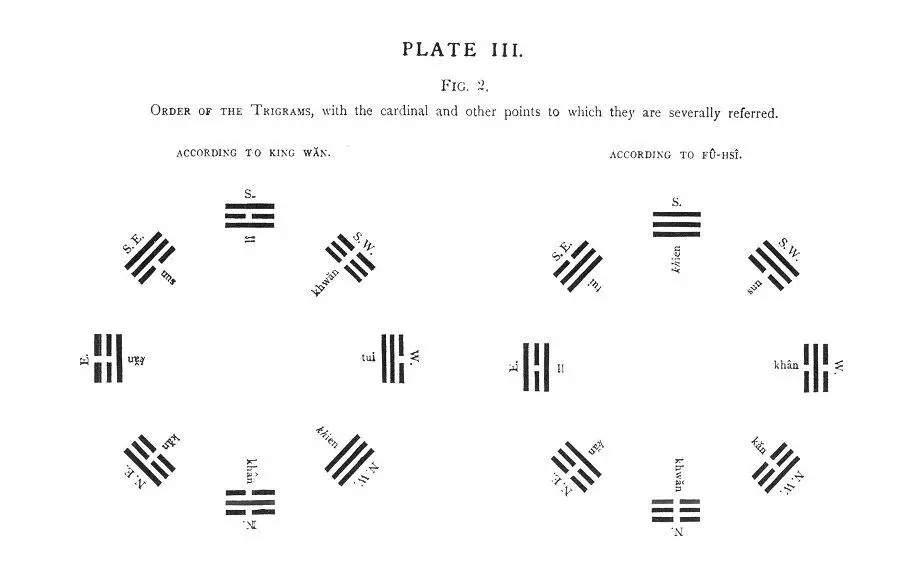
21.Translation of the Yî King, p. 312.
22.Section i, 23, 32, 51, 58, 62, 64, 67, 68, 69, 73, 76, 81; Section ii, 11, 15, 33, 34, 41, 45.
23. K ung-yung xxxi, 4.
24.Section i, 34. This is the only paragraph where kwei-shăn occurs.
25.Section ii, 5.
26.This view seems to be in accordance with that of Wû Kh ăng (of the Yüan dynasty), as given in the 'Collected Comments' of the Khang-hsî edition. The editors express their approval of it in preference to the interpretation of K û Hsî, who understood the whole to refer to the formation of the lineal figures, the 'application' being 'the manipulation of the stalks to find the proper line.'
27.But the Chinese term Shăng  , often rendered 'produced,' must not be pressed, so as to determine the method of production, or the way in which one thing comes from another.
28.The significance of the mythological paragraph is altogether lost in Canon McClatchie's version:--' Kh ien is Heaven, and hence he is called Father; Khwăn is Earth, and hence she is called Mother; K ăn is the first male, and hence he is called the eldest son,' &c. &c.
29.The reader will understand the difference in the two arrangements better by a reference to the circular representations of them on Plate III.
30.E. g. 1, 23, 24:--'Observant etiam philosophi (lib. 15 Sinicae philosophiae Sing-11) principem. Wăn-wang antiquum octo symbolorum, unde aliae figurae omnes pendent, ordinem invertisse; quo ipsa imperii suis temporibus subversio graphice exprimi poterat, mutatis e naturali loco, quem genesis dederat, iis quatuor figuris, quae rerum naturalium pugnis ac dissociationibus, quas posterior labentis anni pars afferre solet, velut in antecessum, repraesentandis idoneae videbantur; v. g. si symbolum  Lî, ignis, supponatur loco symboli
  Khân, aquae, utriusque elementi inordinatio principi visa est non minus apta ad significandas ruinas et clades reipublicae male ordinatae, quam naturales ab hieme aut imminente aut saeviente rerum generatarum corruptiones.' See also pp. 67, 68.
PLATES I, II, III, EXHIBITING THE HEXAGRAMS AND TRIGRAMS
Table of Contents
PLATE I.
The HEXAGRAMS, in the order in which they appear in the Yî, and were arranged by Kin Wăn.
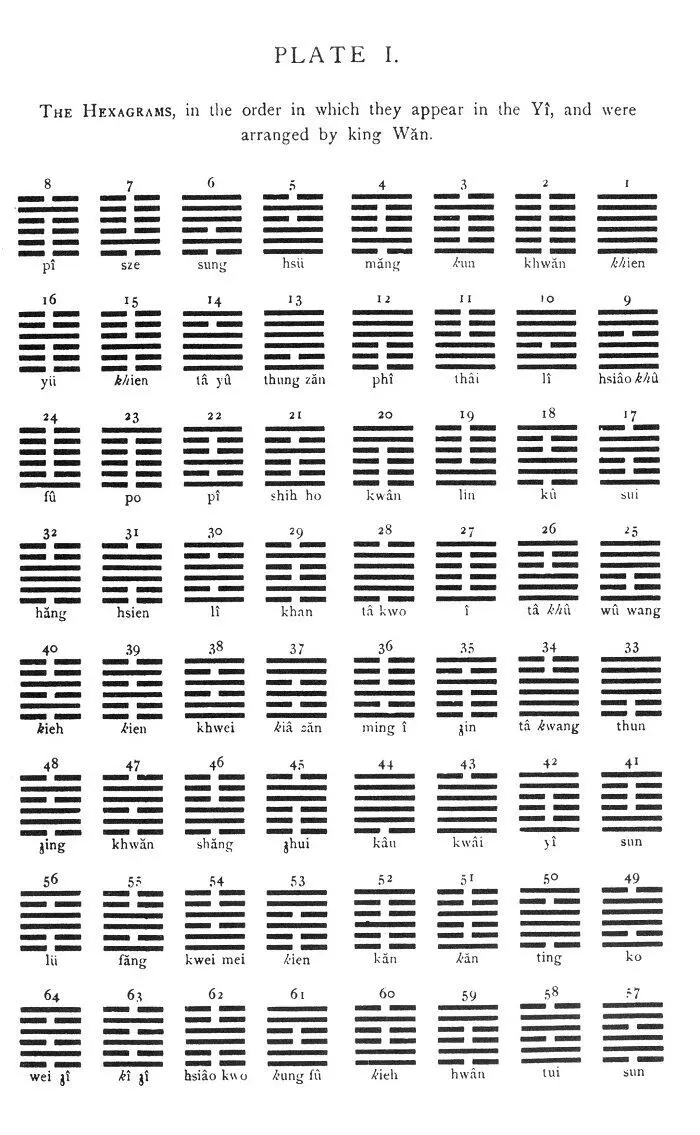
PLATE II.
Fig. 1.
The HEXAGRAMS, exhibited circularly and in a square, according to the natural process of development from the whole and divided lines, and the order ascribed to Fû-hsî.
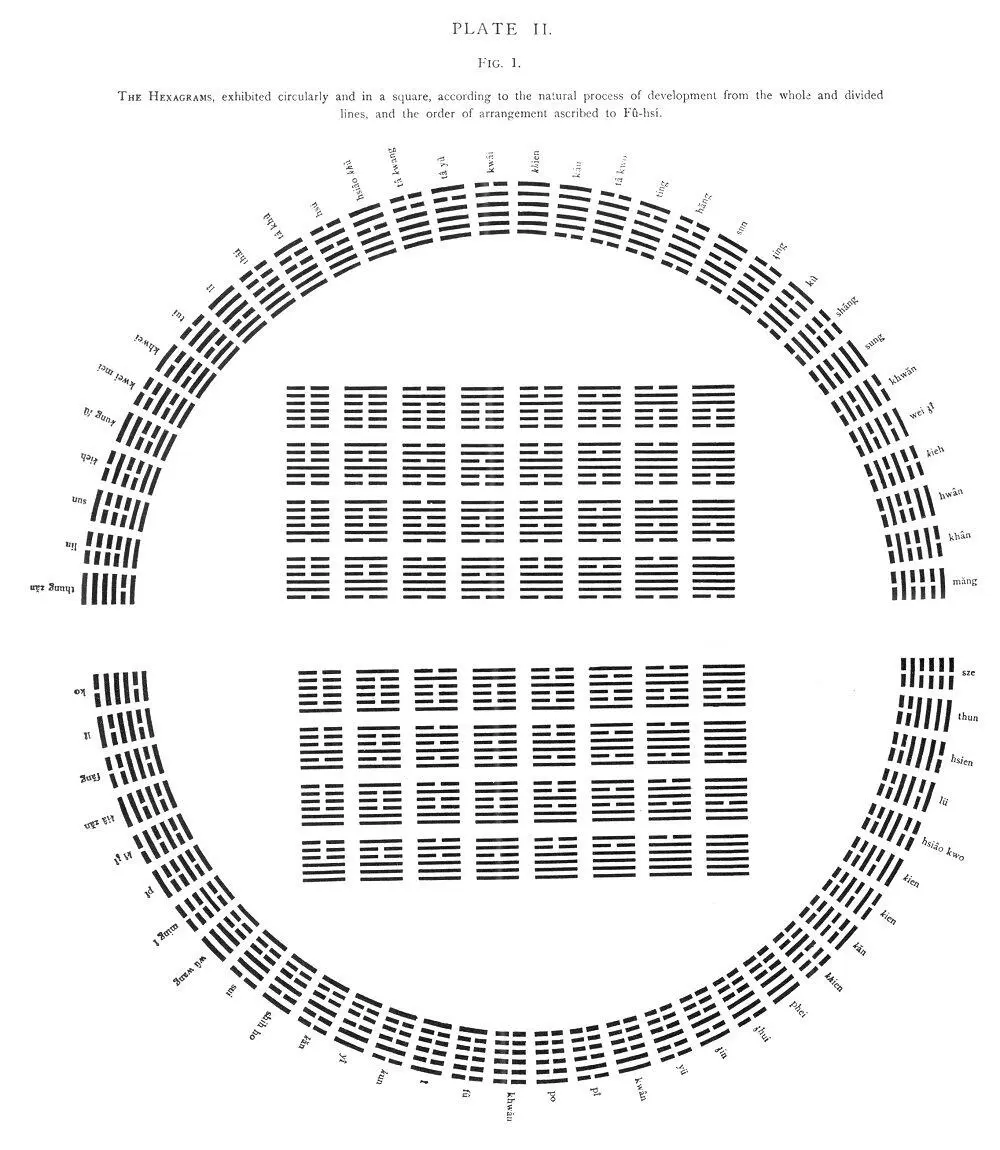
PLATE II.
Fig 2.
The Trigrams distinguished as Yin and Yang.

PLATE III.
Fig 1.
Illustrating the tenth paragraph of Appendix V.
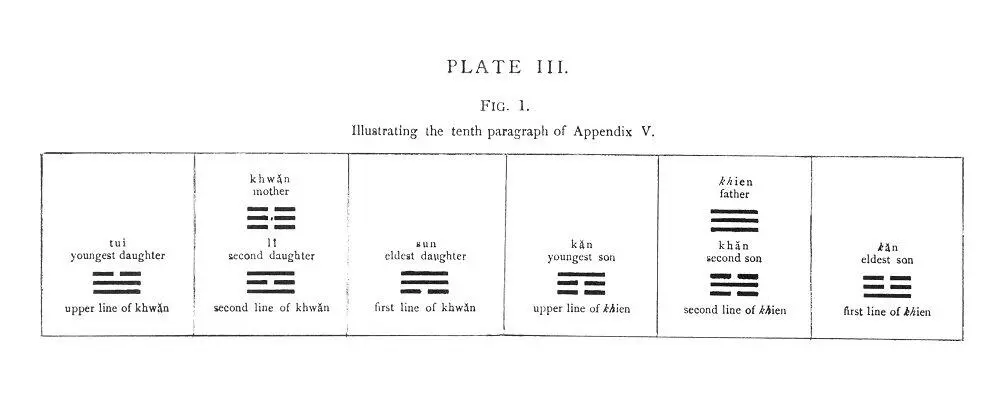
PLATE III.
Fig 2.
ORDER OF THE TRIGRAMS, with the cardinal and other points to which they are severally referred.
THE TEXT
Table of Contents
SECTION I
Table of Contents
Hexagram I. 1Khien
Table of Contents

Explanation of the entire figure by king Wăn
Kh ien (represents) what is great and originating, penetrating, advantageous, correct and firm.
Explanation of the separate lines by the duke of K âu.
1. In the first (or lowest) line, undivided, (we see its subject as) the dragon lying hid (in the deep). It is not the time for active doing.
2. In the second line, undivided, (we see its subject as) the dragon appearing in the field. It will be advantageous to meet with the great man.
3. In the third line, undivided, (we see its subject as) the superior man active and vigilant all the day, and in the evening still careful and apprehensive. (The position is) dangerous, but there will be no mistake.
4. In the fourth line, undivided, (we see its subject as the dragon looking) as if he were leaping up, but still in the deep. There will be no mistake.
5. In the fifth line, undivided, (we see its subject as) the dragon on the wing in the sky. It will be advantageous to meet with the great man.
6. In the sixth (or topmost) line, undivided, (we see its subject as) the dragon exceeding the proper limits. There will be occasion for repentance.
7. (The lines of this hexagram are all strong and undivided, as appears from) the use of the number line. If the host of dragons (thus) appearing were to divest themselves of their heads, there would be good fortune.
Читать дальшеИнтервал:
Закладка:
Похожие книги на «The Five Classics»
Представляем Вашему вниманию похожие книги на «The Five Classics» списком для выбора. Мы отобрали схожую по названию и смыслу литературу в надежде предоставить читателям больше вариантов отыскать новые, интересные, ещё непрочитанные произведения.






Обсуждение, отзывы о книге «The Five Classics» и просто собственные мнения читателей. Оставьте ваши комментарии, напишите, что Вы думаете о произведении, его смысле или главных героях. Укажите что конкретно понравилось, а что нет, и почему Вы так считаете.