Confucius - The Five Classics
Здесь есть возможность читать онлайн «Confucius - The Five Classics» — ознакомительный отрывок электронной книги совершенно бесплатно, а после прочтения отрывка купить полную версию. В некоторых случаях можно слушать аудио, скачать через торрент в формате fb2 и присутствует краткое содержание. Жанр: unrecognised, на английском языке. Описание произведения, (предисловие) а так же отзывы посетителей доступны на портале библиотеки ЛибКат.
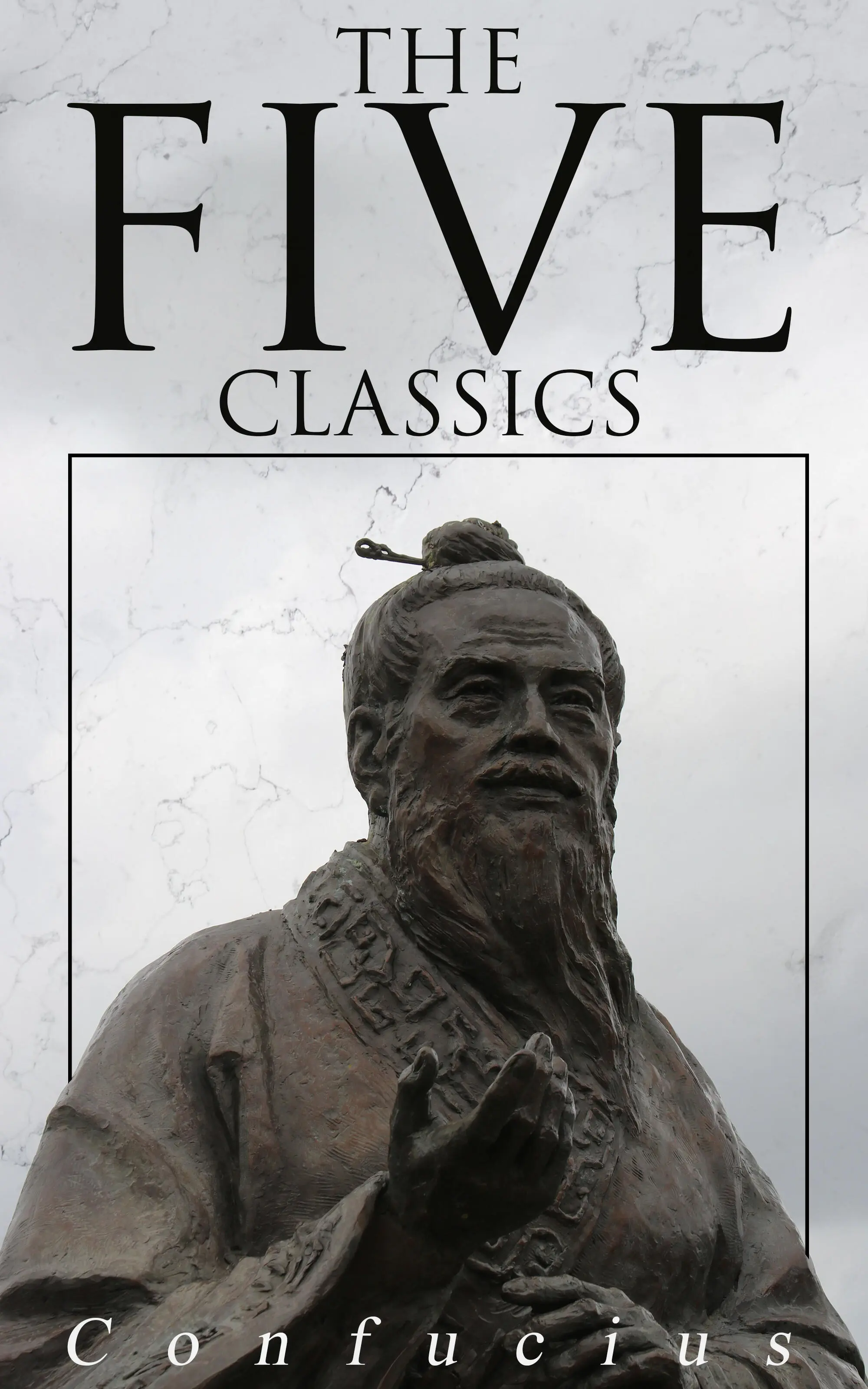
- Название:The Five Classics
- Автор:
- Жанр:
- Год:неизвестен
- ISBN:нет данных
- Рейтинг книги:5 / 5. Голосов: 1
-
Избранное:Добавить в избранное
- Отзывы:
-
Ваша оценка:
The Five Classics: краткое содержание, описание и аннотация
Предлагаем к чтению аннотацию, описание, краткое содержание или предисловие (зависит от того, что написал сам автор книги «The Five Classics»). Если вы не нашли необходимую информацию о книге — напишите в комментариях, мы постараемся отыскать её.
I Ching – The book contains a divination system comparable to Western geomancy or the West African Ifá system. In Western cultures and modern East Asia, it is still widely used for this purpose.
Shu King – A collection of documents and speeches alleged to have been written by rulers and officials of the early Zhou period and before. It is possibly the oldest Chinese narrative, and may date from the 6th century BC. It includes examples of early Chinese prose.
The Shih King – A collection of 305 poems divided into 160 folk songs, 105 festal songs sung at court ceremonies, and 40 hymns and eulogies sung at sacrifices to heroes and ancestral spirits of the royal house.
The Li Ki – Describes ancient rites, social forms and court ceremonies. The version studied today is a re-worked version compiled by scholars in the third century BC rather than the original text, which is said to have been edited by Confucius himself.
Spring and Autumn Annals – A historical record of the State of Lu, Confucius's native state, 722–481 BC.
The Five Classics — читать онлайн ознакомительный отрывок
Ниже представлен текст книги, разбитый по страницам. Система сохранения места последней прочитанной страницы, позволяет с удобством читать онлайн бесплатно книгу «The Five Classics», без необходимости каждый раз заново искать на чём Вы остановились. Поставьте закладку, и сможете в любой момент перейти на страницу, на которой закончили чтение.
Интервал:
Закладка:
This way of speaking of the trigrams, moreover, as father and mother, sons and daughters, is not so old as Fû-hsî; nor have we any real proof that it originated with king Wăn. It is not of 'the highest antiquity.' It arose some time in 'middle antiquity,' and was known in the era of the Appendixes; but it had not prevailed then, nor has it prevailed since, to discredit and supersede the older nomenclature. We are startled when we come on it in the place which it occupies. And there it stands alone. It is not entitled to more attention than the two paragraphs that precede it, or the eight that follow it, none of which were thought by P. Regis worthy to be translated. I have just said that it stands 'alone.' Its existence, however, seems to me to be supposed in the fourth chapter, paragraphs 28-30, of the third Appendix, Section ii; but there only the trigrams of 'the six children' are mentioned, and nothing is said of 'the parents.' K ăn, khân, and kăn are referred to as being yang, and sun, lî, and tui as being yin. What is said about them is trifling and fanciful.
Leaving the question of the mythology of the Yî, of which I am myself unable to discover a trace, I now call attention to paragraphs 8-10, where the author speaks of the work of God in nature in all the year as a progress through the trigrams, and as being effected by His Spirit. The description assumes the peculiar arrangement of the trigrams, ascribed to king Win, and which I have exhibited above, on page 33 29. Father Regis adopts the general view of Chinese critics that Win purposely altered the earlier and established arrangement, as a symbol of the disorganisation and disorder into which the kingdom had fallen 30. But it is hard to say why a man did something more than 3000 years ago, when he has not himself said anything about it. So far as we can judge from this Appendix, the author thought that king Win altered the existing order and position of the trigrams with regard to the cardinal points, simply for the occasion,--that he might set forth vividly his ideas about the springing, growth, and maturity in the vegetable kingdom from the labours of spring to the cessation from toil in winter. The marvel is that in doing this he brings God upon the scene, and makes Him in the various processes of nature the 'all and in all.'
The 8th paragraph says:--
'God comes forth in K ăn (to his producing work); He brings (His processes) into full and equal action in Sun; they are manifested to one another in Lî; the greatest service is done for Him in Khwăn; He rejoices in Tui; He struggles in Kh ien; He is comforted and enters into rest in Khân; and he completes (the work of) the year in Kăn.'
God is here named Tî, for which P. Regis gives the Latin 'Supremus Imperator,' and Canon McClatchie, after him, 'the Supreme Emperor.' I contend that 'God' is really the correct translation in English of Tî; but to render it here by 'Emperor' would not affect the meaning of the paragraph. K û Hsî says that 'by Tî is intended the Lord and Governor of heaven;' and Khung Ying-tâ, about five centuries earlier than K û, quotes Wang Pî, who died A.D. 249, to the effect that 'Tî is the lord who produces (all) things, the author of prosperity and increase.'
I must refer the reader to the translation in the body of the volume for the 9th paragraph, which is too long to be introduced here. As the 8th speaks directly of God, the 9th, we are told, 'speaks of all things following Him, from spring to winter, from the east to the north, in His progress throughout the year.' In words strikingly like those of the apostle Paul, when writing his Epistle to the Romans, Wan Kh ung-ȝung (of the Khang-hsî period) and his son, in their admirable work called, 'A New Digest of Collected Explanations of the Yî King,' say:--'God (Himself) cannot be seen; we see Him in the things (which He produces).' The first time I read these paragraphs with some understanding, I thought of Thomson's Hymn on the Seasons, and I have thought of it in connexion with them a hundred times since. Our English poet wrote:--
'These, as they change, Almighty Father, these
Are but the varied God. The rolling year
Is full of Thee. Forth in the pleasing spring
Thy beauty walks, Thy tenderness and love.
Then comes Thy glory in the summer months,
With light and heat refulgent. Then Thy sun
Shoots full perfection through the swelling year.
Thy bounty shines in autumn unconfined,
And spreads a common feast for all that lives.
In winter awful Thou!'
Prudish readers have found fault with some of Thomson's expressions, as if they savoured of pantheism. The language of the Chinese writer is not open to the same captious objection. Without poetic ornament, or swelling phrase of any kind, he gives emphatic testimony to God as renewing the face of the earth in spring, and not resting till He has crowned the year with His goodness.
And there is in the passage another thing equally wonderful. The 10th paragraph commences:--'When we speak of Spirit, we mean the subtle presence (and operation of God) with all things;' and the writer goes on to illustrate this sentiment from the action and influences symbolised by the six 'children,' or minor trigrams,--water and fire, thunder and wind, mountains and collections of water. K û Hsî says, that there is that in the paragraph which he does not understand. Some Chinese scholars, however, have not been far from descrying the light that is in it. Let Liang Yin, of our fourteenth century, be adduced as an example of them. He says:--'The spirit here simply means God. God is the personality (literally, the body or substantiality) of the Spirit; the Spirit is God in operation. He who is lord over and rules all things is God; the subtle presence and operation of God with all things is by His Spirit.' The language is in fine accord with the definition of shăn or spirit, given in the 3rd Appendix, Section i, 32.
I wish that the Treatise on the Trigrams had ended with the 10th paragraph. The writer had gradually risen to a noble elevation of thought from which he plunges into a slough of nonsensical remarks which it would be difficult elsewhere to parallel. I have referred on p. 31 to the judgment of P. Regis about them. He could not receive them as from Confucius, and did not take the trouble to translate them, and transfer them to his own pages, My plan required me to translate everything published in China as a part of the Yî King; but I have given my reasons for doubting whether any portion of these Appendixes be really from Confucius. There is nothing that could better justify the supercilious disregard with which the classical literature of China is frequently treated than to insist on the concluding portion of this treatise as being from the pencil of its greatest sage. I have dwelt at some length on the 14th paragraph, because of its mythological semblance; but among the eight paragraphs that follow it, it would be difficult to award the palm for silliness. They are descriptive of the eight trigrams, and each one enumerates a dozen or more objects of which its subject is symbolical. The writer must have been fond of and familiar with horses. Kh ien, the symbol properly of heaven, suggests to him the idea of a good horse; an old horse; a lean horse; and a piebald. K ăn, the symbol of thunder, suggests the idea of a good neigher; of the horse with white hind-legs; of the prancing horse; and of one with a white star in his forehead. Khân, the symbol of water, suggests the idea of the horse with an elegant spine; of one with a high spirit; of one with a drooping head; and of one with a shambling step. The reader will think he has had enough of these symbolisings of the trigrams. I cannot believe that the earlier portions and this concluding portion of the treatise were by the same author. If there were any evidence that paragraphs 8 to 10 were by Confucius, I should say that they were worthy, even more than worthy, of him; what follows is mere drivel. Horace's picture faintly pourtrays the inconsistency between the parts:--
Читать дальшеИнтервал:
Закладка:
Похожие книги на «The Five Classics»
Представляем Вашему вниманию похожие книги на «The Five Classics» списком для выбора. Мы отобрали схожую по названию и смыслу литературу в надежде предоставить читателям больше вариантов отыскать новые, интересные, ещё непрочитанные произведения.





Обсуждение, отзывы о книге «The Five Classics» и просто собственные мнения читателей. Оставьте ваши комментарии, напишите, что Вы думаете о произведении, его смысле или главных героях. Укажите что конкретно понравилось, а что нет, и почему Вы так считаете.