Confucius - The Five Classics
Здесь есть возможность читать онлайн «Confucius - The Five Classics» — ознакомительный отрывок электронной книги совершенно бесплатно, а после прочтения отрывка купить полную версию. В некоторых случаях можно слушать аудио, скачать через торрент в формате fb2 и присутствует краткое содержание. Жанр: unrecognised, на английском языке. Описание произведения, (предисловие) а так же отзывы посетителей доступны на портале библиотеки ЛибКат.
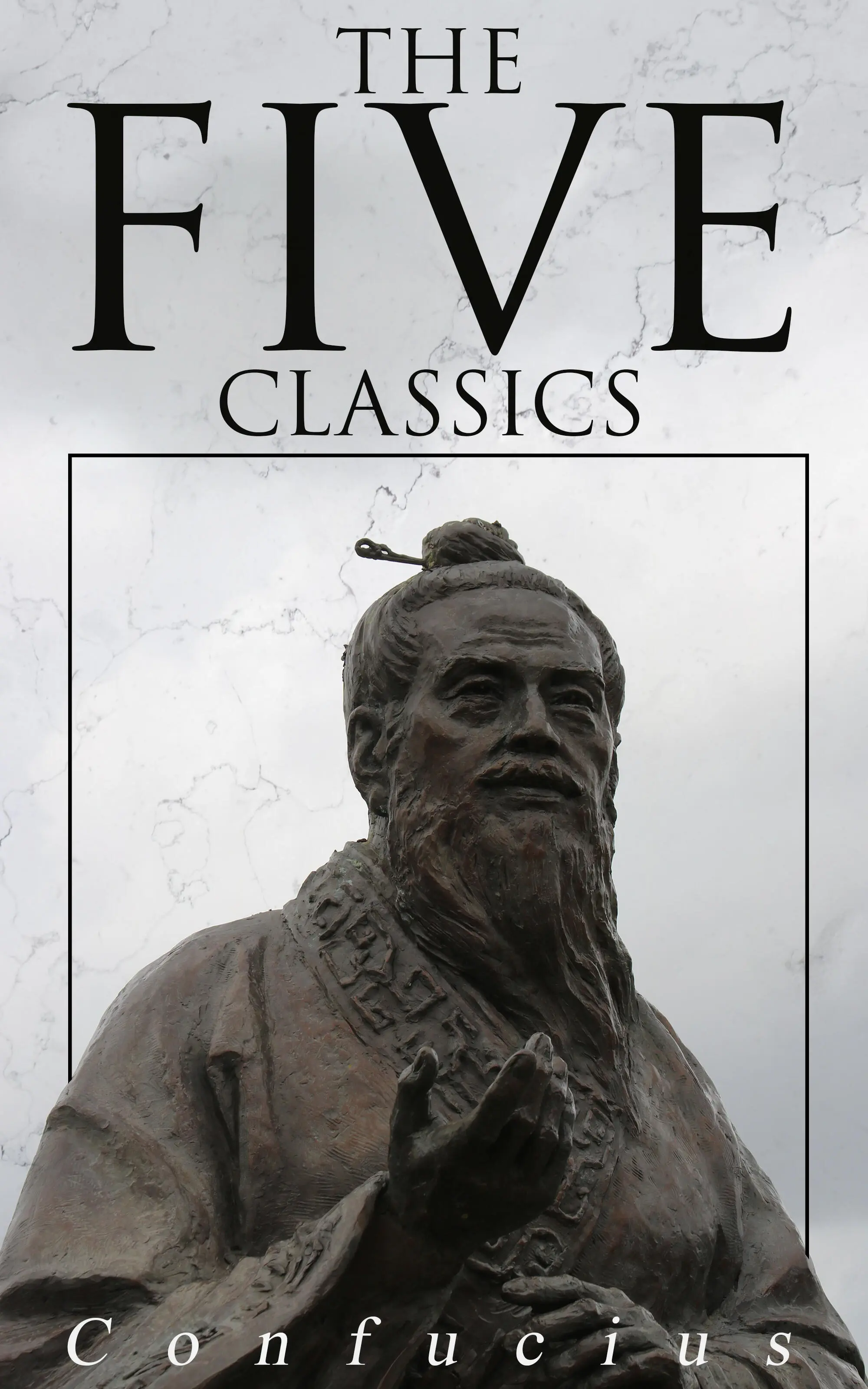
- Название:The Five Classics
- Автор:
- Жанр:
- Год:неизвестен
- ISBN:нет данных
- Рейтинг книги:5 / 5. Голосов: 1
-
Избранное:Добавить в избранное
- Отзывы:
-
Ваша оценка:
The Five Classics: краткое содержание, описание и аннотация
Предлагаем к чтению аннотацию, описание, краткое содержание или предисловие (зависит от того, что написал сам автор книги «The Five Classics»). Если вы не нашли необходимую информацию о книге — напишите в комментариях, мы постараемся отыскать её.
I Ching – The book contains a divination system comparable to Western geomancy or the West African Ifá system. In Western cultures and modern East Asia, it is still widely used for this purpose.
Shu King – A collection of documents and speeches alleged to have been written by rulers and officials of the early Zhou period and before. It is possibly the oldest Chinese narrative, and may date from the 6th century BC. It includes examples of early Chinese prose.
The Shih King – A collection of 305 poems divided into 160 folk songs, 105 festal songs sung at court ceremonies, and 40 hymns and eulogies sung at sacrifices to heroes and ancestral spirits of the royal house.
The Li Ki – Describes ancient rites, social forms and court ceremonies. The version studied today is a re-worked version compiled by scholars in the third century BC rather than the original text, which is said to have been edited by Confucius himself.
Spring and Autumn Annals – A historical record of the State of Lu, Confucius's native state, 722–481 BC.
The Five Classics — читать онлайн ознакомительный отрывок
Ниже представлен текст книги, разбитый по страницам. Система сохранения места последней прочитанной страницы, позволяет с удобством читать онлайн бесплатно книгу «The Five Classics», без необходимости каждый раз заново искать на чём Вы остановились. Поставьте закладку, и сможете в любой момент перейти на страницу, на которой закончили чтение.
Интервал:
Закладка:
Much more might be said on the third Appendix, for the writer touches on many other topics, antiquarian and speculative, but a review of them would help us little in the study of the leading subject of the Yî. In passing on to the next treatise, I would only further say that the style of this and the author's manner of presenting his thoughts often remind the reader of 'the Doctrine of the Mean.' I am surprised that 'the Great Treatise' has never been ascribed to the author of that Doctrine, Ȝze-sze, the grandson of Confucius, whose death must have taken place between B. C. 400 and 450.
7. The fourth Appendix, the seventh wing' of the Yî, need not detain us long. As I stated on p. 27, it is confined to an exposition of the Text on the first and second hexagrams, being an attempt to show that what is there affirmed of heaven and earth may also be applied to man, and that there is an essential agreement between the qualities ascribed to them, and the benevolence, righteousness, propriety, and wisdom, which are the four constituents of his moral and intellectual nature.
It is said by some of the critics that Confucius would have treated all the other hexagrams in a similar way, if his life had been prolonged, but we found special grounds for denying that Confucius had anything to do with the composition of this Appendix; and, moreover, I cannot think of any other figure that would have afforded to the author the same opportunity of discoursing about man. The style and method are after the manner of 'the Doctrine of the Mean' quite as much as those of 'the Great Treatise.' Several paragraphs, moreover, suggest to us the magniloquence of Mencius. It is said, for instance, by Ȝze-sze, of the sage, that 'he is the equal or correlate of Heaven 23,' and in this Appendix we have the sentiment expanded into the following:--
'The great man is he who is in harmony in his attributes with heaven and earth; in his brightness with the sun and moon; in his orderly procedure with the four seasons; and in his relation to what is fortunate and what is calamitous with the spiritual agents. He may precede Heaven, and Heaven will not act in opposition to him; he may follow Heaven, but will act only as Heaven at the time would do. If Heaven will not act in opposition to him, how much less will man! how much less will the spiritual agents 24!'
One other passage may receive our consideration:--
'The family that accumulates goodness is sure to have superabundant happiness, and the family that accumulates evil is sure to have superabundant misery 25.'
The language makes us think of the retribution of good and evil as taking place in the family, and not in the individual; the judgment is long deferred, but it is inflicted at last, lighting, however, not on the head or heads that most deserved it. Confucianism never falters in its affirmation of the difference between good and evil, and that each shall have its appropriate recompense; but it has little to say of the where and when and how that recompense will be given. The old classics are silent on the subject of any other retribution besides what takes place in time. About the era of Confucius the view took definite shape that, if the issues of good and evil, virtue and vice, did not take effect in the experience of the individual, they would certainly do so in that of his posterity. This is the prevailing doctrine among the Chinese at the present day; and one of the earliest expressions, perhaps the earliest expression, of it was in the sentence under our notice that has been copied from this Appendix into almost every moral treatise that circulates in China. A wholesome and an important truth it is, that 'the sins of parents are visited on their children;' but do the parents themselves escape the curse? It is to be regretted that this short treatise, the only 'wing' of the Yî professing to set forth its teachings concerning man as man, does not attempt any definite reply to this question. I leave it, merely observing that it has always struck me as the result of an after-thought, and a wish to give to man, as the last of 'the Three Powers,' a suitable place in connexion with the Yî. The doctrine of 'the Three Powers' is as much out of place in Confucianism as that of 'the Great Extreme.' The treatise contains several paragraphs interesting in themselves, but it adds nothing to our understanding of the Text, or even of the object of the appended treatises, when we try to look at them as a whole.
8. It is very different with the fifth of the Appendixes, which is made up of 'Remarks on the Trigrams.' It is shorter than the fourth, consisting of only 22 paragraphs, in some of which the author rises to a height of thought reached nowhere else in these treatises, while several of the others are so silly and trivial, that it is difficult, not to say impossible, to believe that they are the production of the same man. We find in it the earlier and later arrangement of the trigrams,--the former, that of Fû-hsî, and the latter, that of king Wăn; their names and attributes; the work of God in nature, described as a progress through the trigrams; and finally a distinctive, but by no means exhaustive, list of the natural objects, symbolised by them.
It commences with the enigmatic declaration that 'Anciently, when the sages made the Yî,' (that is, the lineal figures, and the system of divination by them),'in order to give mysterious assistance .to the spiritual Intelligences, they produced (the rules for the use of) the divining plant.' Perhaps this means no more than that the lineal figures were made to 'hold the mirror up to nature,' so that men by the study of them would understand more of the unseen and spiritual operations, to which the phenomena around them were owing, than they could otherwise do.
The author goes on to speak of the Fû-hsî trigrams, and passes from them to those of king Wăn in paragraph 8. That and the following two are very remarkable; but before saying anything of them, I will go on to the 14th, which is the only passage that affords any ground for saying that there is a mythology in the Yî. It says:--
' Kh ien is (the symbol of) heaven, and hence is styled father. Khwăn is (the symbol of) earth, and hence is styled mother. K ăn (shows) the first application (of khwăn to kh ien), resulting in getting (the first of) its male (or undivided lines), and hence we call it the oldest son. Sun (shows) a first application (of kh ien to khwăn), resulting in getting (the first of) its female (or divided lines), and hence we call it the oldest daughter. Khân (shows) a second application (of khwăn to kh ien), and Lî a second (of kh ien to khwăn), resulting in the second son and second daughter. In K ăn and Tui we have a third application (of khwăn to kh ien and of kh ien to khwăn), resulting in the youngest son and youngest daughter.'
From this language has come the fable of a marriage between Kh ien and Khwăn, from which resulted the six other trigrams, considered as their three sons and three daughters; and it is not to be wondered at, if some men of active and ill-regulated imaginations should see Noah and his wife in those two primary trigrams, and in the others their three sons and the three sons' wives. Have we not in both cases an ogdoad? But I have looked in the paragraph in vain for the notion of a marriage-union between heaven and earth.
It does not treat of the genesis of the other six trigrams by the union of the two, but is a rude attempt to explain their forms when they were once existing 26. According to the idea of changes, Kh ien and Khwăn are continually varying their forms by their interaction. As here represented, the other trigrams are not 'produced 27' by a marriage-union, but from the application, literally the seeking, of one of them of Khwăn as much as of Kh ien--addressed to the other 28.
Читать дальшеИнтервал:
Закладка:
Похожие книги на «The Five Classics»
Представляем Вашему вниманию похожие книги на «The Five Classics» списком для выбора. Мы отобрали схожую по названию и смыслу литературу в надежде предоставить читателям больше вариантов отыскать новые, интересные, ещё непрочитанные произведения.





Обсуждение, отзывы о книге «The Five Classics» и просто собственные мнения читателей. Оставьте ваши комментарии, напишите, что Вы думаете о произведении, его смысле или главных героях. Укажите что конкретно понравилось, а что нет, и почему Вы так считаете.