Confucius - The Five Classics
Здесь есть возможность читать онлайн «Confucius - The Five Classics» — ознакомительный отрывок электронной книги совершенно бесплатно, а после прочтения отрывка купить полную версию. В некоторых случаях можно слушать аудио, скачать через торрент в формате fb2 и присутствует краткое содержание. Жанр: unrecognised, на английском языке. Описание произведения, (предисловие) а так же отзывы посетителей доступны на портале библиотеки ЛибКат.
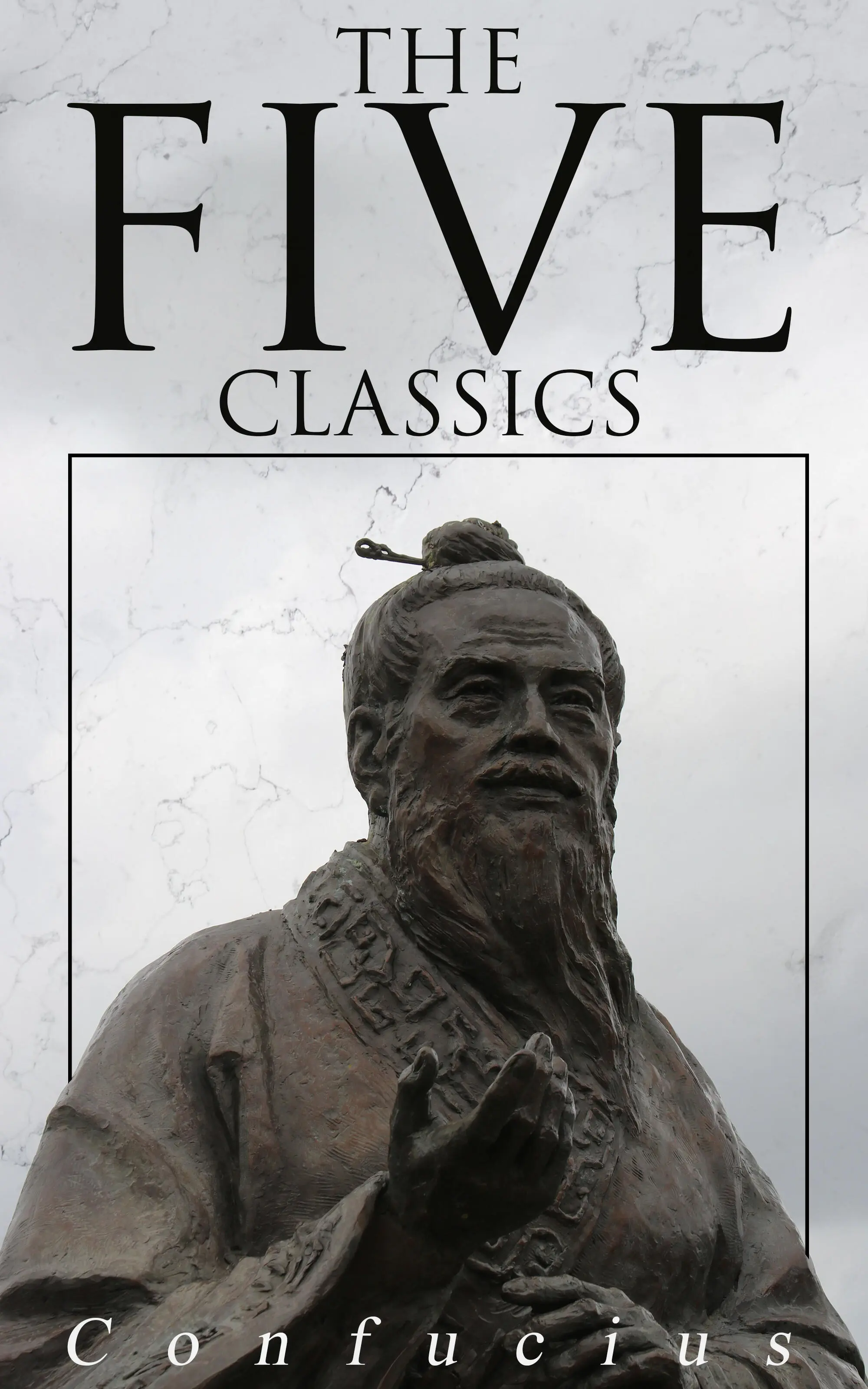
- Название:The Five Classics
- Автор:
- Жанр:
- Год:неизвестен
- ISBN:нет данных
- Рейтинг книги:5 / 5. Голосов: 1
-
Избранное:Добавить в избранное
- Отзывы:
-
Ваша оценка:
The Five Classics: краткое содержание, описание и аннотация
Предлагаем к чтению аннотацию, описание, краткое содержание или предисловие (зависит от того, что написал сам автор книги «The Five Classics»). Если вы не нашли необходимую информацию о книге — напишите в комментариях, мы постараемся отыскать её.
I Ching – The book contains a divination system comparable to Western geomancy or the West African Ifá system. In Western cultures and modern East Asia, it is still widely used for this purpose.
Shu King – A collection of documents and speeches alleged to have been written by rulers and officials of the early Zhou period and before. It is possibly the oldest Chinese narrative, and may date from the 6th century BC. It includes examples of early Chinese prose.
The Shih King – A collection of 305 poems divided into 160 folk songs, 105 festal songs sung at court ceremonies, and 40 hymns and eulogies sung at sacrifices to heroes and ancestral spirits of the royal house.
The Li Ki – Describes ancient rites, social forms and court ceremonies. The version studied today is a re-worked version compiled by scholars in the third century BC rather than the original text, which is said to have been edited by Confucius himself.
Spring and Autumn Annals – A historical record of the State of Lu, Confucius's native state, 722–481 BC.
The Five Classics — читать онлайн ознакомительный отрывок
Ниже представлен текст книги, разбитый по страницам. Система сохранения места последней прочитанной страницы, позволяет с удобством читать онлайн бесплатно книгу «The Five Classics», без необходимости каждый раз заново искать на чём Вы остановились. Поставьте закладку, и сможете в любой момент перейти на страницу, на которой закончили чтение.
Интервал:
Закладка:
The object of the divination, it should be acknowledged, was not to discover future events absolutely, as if they could be known beforehand 13, but to ascertain whether certain schemes, and conditions of events contemplated by the consulter, would turn out luckily or unluckily. But for the actual practice the stalks of the plant were necessary; and I am almost afraid to write that this Appendix teaches that they were produced by Heaven of such a nature as to be fit for the purpose. 'Heaven,' it says, in the 73rd paragraph of Section i, quoted above on p. 14, 'Heaven produced the spirit-like things.' The things were the tortoise and the plant, and in paragraph 68, the same quality of being shăn, or 'spirit-like,' is ascribed to them. Occasionally, in the field of Chinese literature, we meet with doubts as to the efficacy of divination, and the folly of expecting any revelation of the character of the future from an old tortoise-shell and a handful of withered twigs 14; but when this Appendix was made, the writer had not attained to so much common sense. The stalks were to him 'spirit-like,' possessed of a subtle and invisible virtue that fitted them for use in divining.
Given the stalks with such virtue, the process of manipulating them so as to form the lineal figures is described (Section i, chap. 9, parr. 49-58), but it will take the student much time and thought to master the various operations. Forty-nine stalks were employed, which were thrice manipulated for each line, so that it took eighteen manipulations to form a hexagram. The lines were determined by means of the numbers derived from the River Map or scheme. Odd numbers gave strong or undivided lines, and even numbers gave the weak or divided. An important part was played in combining the lines, and forming the hexagrams by the four emblematic symbols, to which the numbers 9, 8, 7, 6 were appropriated 15. The figures having been formed, recourse was had for their interpretation to the thwan of king Wăn, and the emblematic sentences of the duke of K âu. This was all the part which numbers played in the divination by the Yî, helping the operator to make up his lineal figure. An analogy has often been asserted between the numbers of the Yî and the numbers of Pythagoras; and certainly we might make ten, and more than ten, antinomies from these Appendixes in startling agreement with the ten principia of the Pythagoreans. But if Aristotle was correct in holding that Pythagoras regarded numbers as entities, and maintained that Number was the Beginning (Principle, ἀρχή) of things, the cause of their material existence, and of their modifications and different states, then the doctrine of the philosopher of Samos was different from that of the Yî 16, in which numbers come in only as aids in divining to form the hexagrams. Of course all divination is vain, nor is the method of the Yî less absurd than any other. The Chinese themselves have given it up in all circles above those of the professional quacks, and yet their scholars continue to maintain the unfathomable science and wisdom of these appended treatises!
It is in this Appendix that we first meet with the names yin and yang 17, of which I have spoken briefly on pp. 15, 16. Up to this point, instead of them, the names for the two elementary forms of the lines have been kang and z âu, which I have translated by 'strong and weak,' and which also occur here ten times. The following attempt to explain these different names appears in the fifth Appendix, paragraph 4:--
'Anciently when the sages made the Yî, it was with the design that its figures should be in conformity with the principles underlying the natures (of men and things), and the ordinances appointed (for them by Heaven). With this view they exhibited in them the way of heaven, calling (the lines) yin and yang; the way of earth, calling them the strong (or hard) and the weak (or soft); and the way of man, under the names of benevolence and righteousness. Each (trigram) embraced those three Powers, and being repeated, its full form consisted of six lines.'
However difficult it may be to make what is said here intelligible, it confirms what I have affirmed of the significance of the names yin and yang, as meaning bright and dark, derived from the properties of the sun and moon. We may use for these adjectives a variety of others, such as active and inactive, masculine and feminine, hot and cold, more or less analogous to them; but there arise the important questions,--Do we find yang and yin not merely used to indicate the quality of what they are applied to, but at the same time with substantival force, denoting what has the quality which the name denotes? Had the doctrine of a primary matter of an ethereal nature, now expanding and showing itself full of activity and power as yang, now contracting and becoming weak and inactive as yin:--had this doctrine become matter of speculation when this Appendix was written? The Chinese critics and commentators for the most part assume that it had. P. Regis, Dr. Medhurst, and other foreign Chinese scholars repeat their statements without question. I have sought in vain for proof of what is asserted. It took more than a thousand years after the closing of the Yî to fashion in the Confucian school the doctrine of a primary matter. We do not find it fully developed till the era of the Sung dynasty, and in our eleventh and twelfth centuries 18. To find it in the Yî is the logical, or rather illogical, error of putting 'the last first.' Neither creation nor cosmogony was before the mind of the author whose work I am analysing. His theme is the Yî,--the ever-changing phenomena of nature and experience. There is nothing but this in the 'Great Treatise' to task our powers;--nothing deeper or more abstruse.
As in the first Appendix, so in this, the name kwei-shăn occurs twice; in paragraphs 21 and 50 of Section i. In the former instance, each part of the name has its significance. Kwei denotes the animal soul or nature, and Shăn, the intellectual soul, the union of which constitutes the living rational man. I have translated them, it will be seen, by 'the anima and the animus.' Canon McClatchie gives for them 'demons and gods;' and Dr. Medhurst said on the passage, 'The kwei-shăns are evidently the expanding and contracting principles of human life The kwei-shăns are brought about by the dissolution of the human frame, and consist of the expanding and ascending shăn, which rambles about in space, and of the contracted and shrivelled kwei, which reverts to earth and nonentity 19.'
This is pretty much the same view as my own, though I would not here use the phraseology of 'expanding and contracting.' Canon McClatchie is consistent with himself, and renders the characters by 'demons and gods.'
In the latter passage it is more difficult to determine the exact meaning. The writer says, that 'by the odd numbers assigned to heaven and the even numbers assigned to earth, the changes and transformations are effected, and the spirit-like agencies kept in movement;' meaning that by means of the numbers the spirit-like lines might be formed on a scale sufficient to give a picture of all the changing phenomena, taking place, as if by a spiritual agency, in nature. Medhurst contents himself on it with giving the explanation of K û Hsî, that 'the kwei-shăns refer to the contractions and expandings, the recedings and approachings of the productive and completing powers of the even and odd numbers 20.' Canon McClatchie does not follow his translation of the former passage and give here 'demons and gods,' but we have 'the Demon-god (i.e. Shang Tî) 21.' I shall refer to this version when considering the fifth Appendix.
The single character shăn occurs more than twenty times;--used now as a substantive, now as an adjective, and again as a verb. I must refer the reader to the translation and notes for its various significance, subjoining in a note a list of the places where it occurs 22.
Читать дальшеИнтервал:
Закладка:
Похожие книги на «The Five Classics»
Представляем Вашему вниманию похожие книги на «The Five Classics» списком для выбора. Мы отобрали схожую по названию и смыслу литературу в надежде предоставить читателям больше вариантов отыскать новые, интересные, ещё непрочитанные произведения.






Обсуждение, отзывы о книге «The Five Classics» и просто собственные мнения читателей. Оставьте ваши комментарии, напишите, что Вы думаете о произведении, его смысле или главных героях. Укажите что конкретно понравилось, а что нет, и почему Вы так считаете.