Confucius - The Five Classics
Здесь есть возможность читать онлайн «Confucius - The Five Classics» — ознакомительный отрывок электронной книги совершенно бесплатно, а после прочтения отрывка купить полную версию. В некоторых случаях можно слушать аудио, скачать через торрент в формате fb2 и присутствует краткое содержание. Жанр: unrecognised, на английском языке. Описание произведения, (предисловие) а так же отзывы посетителей доступны на портале библиотеки ЛибКат.
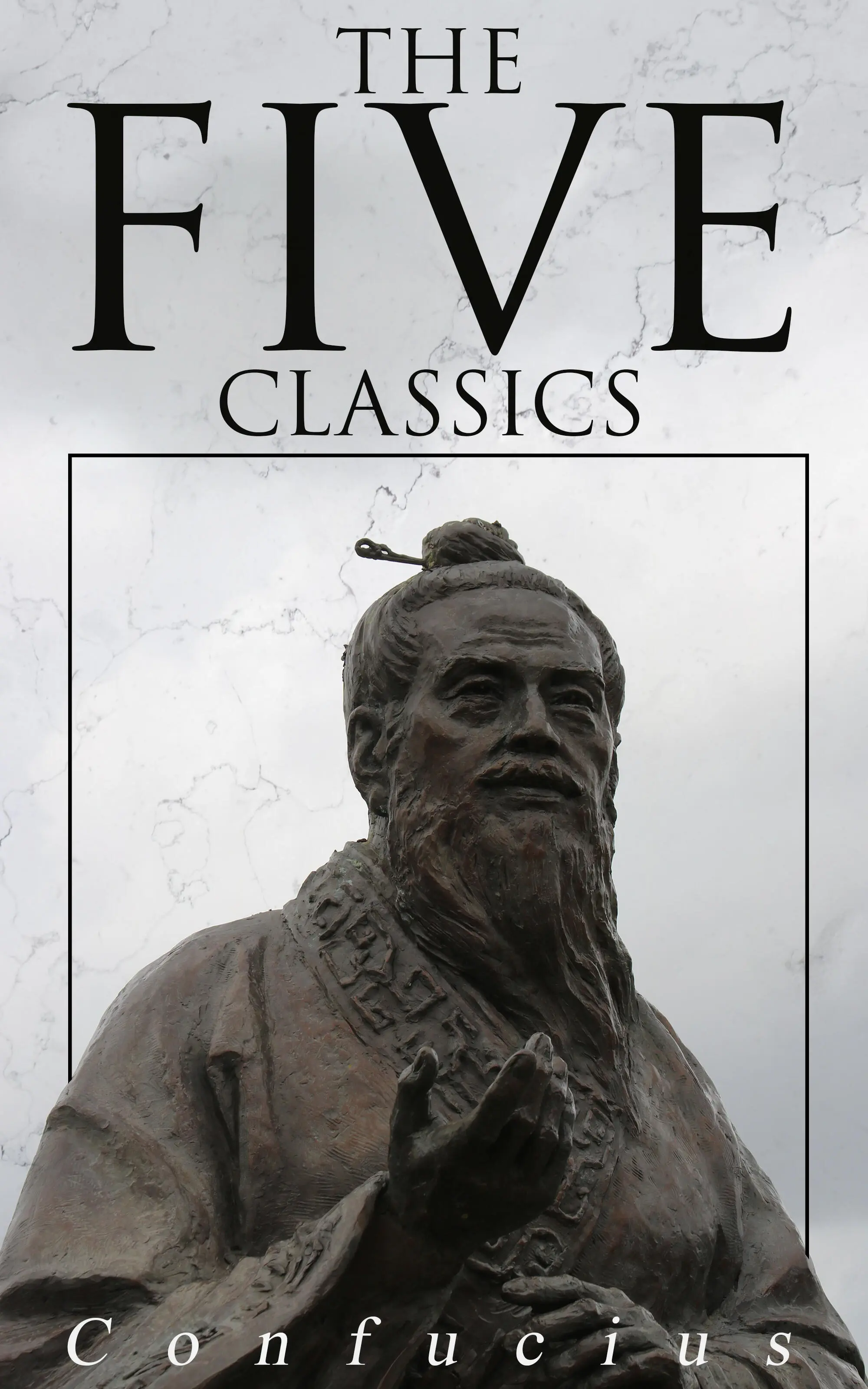
- Название:The Five Classics
- Автор:
- Жанр:
- Год:неизвестен
- ISBN:нет данных
- Рейтинг книги:5 / 5. Голосов: 1
-
Избранное:Добавить в избранное
- Отзывы:
-
Ваша оценка:
The Five Classics: краткое содержание, описание и аннотация
Предлагаем к чтению аннотацию, описание, краткое содержание или предисловие (зависит от того, что написал сам автор книги «The Five Classics»). Если вы не нашли необходимую информацию о книге — напишите в комментариях, мы постараемся отыскать её.
I Ching – The book contains a divination system comparable to Western geomancy or the West African Ifá system. In Western cultures and modern East Asia, it is still widely used for this purpose.
Shu King – A collection of documents and speeches alleged to have been written by rulers and officials of the early Zhou period and before. It is possibly the oldest Chinese narrative, and may date from the 6th century BC. It includes examples of early Chinese prose.
The Shih King – A collection of 305 poems divided into 160 folk songs, 105 festal songs sung at court ceremonies, and 40 hymns and eulogies sung at sacrifices to heroes and ancestral spirits of the royal house.
The Li Ki – Describes ancient rites, social forms and court ceremonies. The version studied today is a re-worked version compiled by scholars in the third century BC rather than the original text, which is said to have been edited by Confucius himself.
Spring and Autumn Annals – A historical record of the State of Lu, Confucius's native state, 722–481 BC.
The Five Classics — читать онлайн ознакомительный отрывок
Ниже представлен текст книги, разбитый по страницам. Система сохранения места последней прочитанной страницы, позволяет с удобством читать онлайн бесплатно книгу «The Five Classics», без необходимости каждый раз заново искать на чём Вы остановились. Поставьте закладку, и сможете в любой момент перейти на страницу, на которой закончили чтение.
Интервал:
Закладка:
The fifty-ninth hexagram, called Hwân  is formed by the trigrams Kh ân
  , representing water, and Sun
  , representing wind, and it is said on it:--(The symbol of) water and (that of wind) above it form Hwân. The ancient kings, in accordance with this, presented offerings to God, and established the ancestral temple.' The union of the two trigrams suggested to king Wăn the idea of dissipation in the alienation of men from the Supreme Power, and of the minds of parents from their children; a condition which the wisdom of the ancient kings saw could best be met by the influences of religion.
One more example. The twenty-sixth hexagram, called Tâ Kh û  , is formed of the trigrams Khien, representing heaven or the sky, and Kân
  , representing a mountain, and it is said on it:--'(The symbol of) heaven in the midst of a mountain forms Tâ Kh û. The superior man, in accordance with this, stores largely in his memory the words of former men and their conduct, to subserve the accumulation of his virtue.' We are ready to exclaim and ask, 'Heaven, the sky, in the midst of a mountain! Can there be such a thing?' and K û Hsî will tell us in reply, 'No, there cannot be such a thing in reality; but you can conceive it for the purpose of the symbolism.'
From this and the other examples adduced from the Great Symbolism, it is clear that, so far as its testimony bears on the subject, the trigrams of Fû-hsî did not receive their form and meaning with a deep intention that they should serve as the basis of a philosophical scheme concerning the constitution of heaven and earth and all that is in them. In this Appendix they are used popularly, just as one
'Finds tongues in trees, books in the running brooks,
Sermons in stones, and good in everything.'
The writer moralises from them in an edifying manner. There is ingenuity, and sometimes instruction also, in what he says, but there is no mystery. Chinese scholars and gentlemen, however, who have got some little acquaintance with western science, are fond of saying that all the truths of electricity, heat, light, and other branches of European physics, are in the eight trigrams. When asked how then they and their countrymen have been and are ignorant of those truths, they say that they have to learn them first from western books, and then, looking into the Yî, they see that they were all known to Confucius more than 2000, years ago. The vain assumption thus manifested is childish; and until the Chinese drop their hallucination about the Yî as containing all things that have ever been dreamt of in all philosophies, it will prove a stumbling-block to them, and keep them from entering on the true path of science.
6. We go on to the third Appendix in two sections, being the fifth and sixth 'wings,' and forming what is called 'The Great Treatise.' It will appear singular to the reader, as it has always done to myself, that neither in the Text, nor in the first two Appendixes, does the character called Yî, which gives its name to the classic, once appear. It is the symbol of 'change,' and is formed from the character for 'the sun' placed over that for 'the moon 4.' As the sun gives place to the moon, and the moon to the sun, so is change always proceeding in the phenomena of nature and the experiences of society. We meet with the character nearly fifty times in this Appendix;--applied most commonly to the Text of our classic, so that Yî King or Yî Shû is 'the Classic or Book of Changes.' It is also applied often to the changes in the lines of the figures, made by the manipulations of divination, apart from any sentence or oracle concerning them delivered by king Wăn or his son. There is therefore the system of the Yî as well as the book of the Yî. The definition of the name which is given in one paragraph will suit them both:--'Production and reproduction is what is called (the process of) change 5.' In nature there is no vacuum. When anything is displaced, what displaces it takes the empty room. And in the lineal figures, the strong and the weak lines push each other out.
Now the remarkable thing asserted is, that the changes in the lines of the figures and the changes of external phenomena show a wonderful harmony and concurrence. We read:--
'The Yî was made on a principle of accordance with heaven and earth, and shows us therefore, without rent or confusion, the course (of things) in heaven and earth 6.'
'There is a similarity between the sage and heaven and earth; and hence there is no contrariety in him to them. His knowledge embraces all things, and his course is intended to be helpful to all under the sky; and therefore he falls into no error. He acts according to the exigency of circumstances, without being carried away by their current; he rejoices in Heaven, and knows its ordinations; and hence he has no anxieties. He rests in his own (present) position, and cherishes the spirit of generous benevolence; and hence he can love (without reserve) 7.'
'(Through the Yî) he embraces, as in a mould or enclosure, the transformations of heaven and earth without any error; by an ever-varying adaptation he completes (the nature of) all things without exception; he penetrates to a knowledge of the course of day and night (and all other correlated phenomena). It is thus that his operation is spirit-like, unconditioned by place, while the changes (which he produces) are not restricted to any form.'
One more quotation:--
'The sage was able to survey all the complex phenomena under the sky. He then considered in his mind how they could be figured, and (by means of the diagrams) represented their material forms and their character 8.'
All that is thus predicated of the sage, or ancient sages, though the writer probably had Fû-hsî in his mind, is more than sufficiently extravagant, and reminds us of the language in 'the Doctrine of the Mean,' that 'the sage, able to assist the transforming and nourishing powers of heaven and earth, may with heaven and earth form a ternion 9.'
I quoted largely, in the second chapter, from this Appendix the accounts which it gives of the formation of the lineal figures. There is no occasion to return to that subject. Let us suppose the figures formed. They seem to have the significance, when looked at from certain points of view, which have been determined for us by king Wăn and the duke of K âu. But this does not amount to divination. How can the lines be made to serve this purpose? The Appendix professes to tell us.
Before touching on the method which it describes, let me observe that divination was practised in China from a very early time. I will not say 5,200 years ago, in the days of Fû-hsî, for I cannot repress doubts of his historical personality; but as soon as we tread the borders of something like credible history, we find it existing. In the Shû King, in a document that purports to be of the twenty-third century B. C. 10, divination by means of the tortoise-shell is mentioned; and somewhat later we find that method continuing, and also divination by the lineal figures, manipulated by means of the stalks of a plant 11, the Ptarmica Sibirica 12, which is still cultivated on and about the grave of Confucius, where I have myself seen it growing.
Читать дальшеИнтервал:
Закладка:
Похожие книги на «The Five Classics»
Представляем Вашему вниманию похожие книги на «The Five Classics» списком для выбора. Мы отобрали схожую по названию и смыслу литературу в надежде предоставить читателям больше вариантов отыскать новые, интересные, ещё непрочитанные произведения.






Обсуждение, отзывы о книге «The Five Classics» и просто собственные мнения читателей. Оставьте ваши комментарии, напишите, что Вы думаете о произведении, его смысле или главных героях. Укажите что конкретно понравилось, а что нет, и почему Вы так считаете.